Institute has fought stereotype about Coasterians and education
by The Star
Audio By Vocalize
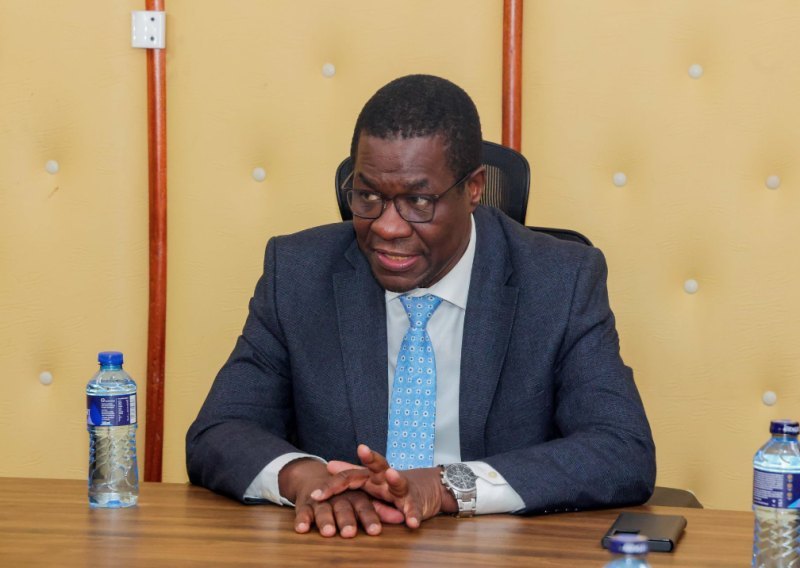
North Coast Training College academics director Reuben Waswa
In the suburb of South Kilifi, about 16km from Mombasa town, lies a private medical institution that is working towards changing the education system in a modern way of learning.
The North Coast Medical Training College, which started in September 2012, has not only changed the face of Bomani village but also encouraged students to go back to school.
Emmanuel Hamisi, a third-year student doing health system support management as a course, said growing up seeing his mother struggle to provide for the family and at the same time pay school fees gave him zero hope of joining any college or university.
After high school education, he was called to go and pursue education but due to financial struggles, he could not continue with his studies.
Hamisi said he started working as a motorcyclist after losing hope with education, but due to his determination, he took himself to the school, which gave him a second chance of achieving his dream.
“The existence of this school in our area has been our joy because it has a big contribution to our family and the community as a whole,” he said.
“I had lost hope of education but when I came here and told the directors my story, I was given an opportunity to continue with my studies.”
Hamisi, who is expecting to graduate next year, said the school has contributed a lot in motivating children in the area to go to school.
“In this area, we have a notion that children do not like to go to school. I can say the school has contributed to 80 per cent, motivating and influencing children in education,” he said.
Rueben Waswa, school director in charge of academics, said the institution was placed where it is because they wanted to be closer to a community that is in rural areas and that they are doing a lot of ideas to support Universal Health Care.
“It is not by default that this school is located here, it is by design that we are where we are,” he said.
“We really fought a lot of war to be here because many regulatory bodies felt like we should be in Mombasa or Kilifi town, at least 5km from the main hospital, but we said no.”
He said that they found a sigh of relief after the government introduced Universal Health Care (UHC), a model which enables affordable education to students.
Waswa said the school is designed it in a way that it accommodates the competency-based education system.
I had lost hope of education but when I came here and told the directors my story, I was given an opportunity to continue with my studies
EMBRACING TECHNOLOGY
Alumnus and Community Health lecturer Shadrack Mumba said unlike public institutions, where teaching is still done the traditional way, the school embraces technology.
“We have a student-centred learning programme, where they are given an opportunity to do things practically,” he said.
“They discuss issues in groups before a tutor comes in and as a result, they become competent and develop scholarly habits, where they search for information using modern technology.”
He said the school is also embracing the concept of universal health coverage and to implement this, it has come up with a tent to act as an information centre.
Here, students learn then the community benefits in getting information, counselling and basic screening. A process which has improved the primary health care services in the community.
The school has an innovative way of training, where they introduced the skills lab methodology.
Waswa said this is a hectic but humane way of training because previously, people would come out from class and start injecting patients, making mistakes on them during their attachment in hospitals.
The skills lab helps students to simulate as many procedures as possible before one is allowed to do the actual treatment on human beings.
“There are procedures that are potentially dangerous, that if you are not very proficient, you can easily cause harm and sometimes permanent harm to the human body,” he said.
He said the skills lab has models that mimic the human body, so it enables students to practice in a more or less realistic way.
Apart from practical, the skills lab also helps the institution in practising competency-based education.
Waswa said this is one of the biggest innovations the school is trying to scale up in Kenya.
“We were the first pioneers to think about CBC education back in 2012 before the government thought of it. In 2000, we tried to introduce it in a number of colleges in Kenya but it did not work,” he said.
“This is because the people we dealt with said it is a nice mode of learning but requires a lot of effort, the same thing parents are complaining about now; it is engaging and takes a lot of time.”
Waswa said without changing the education system to CBC, as a country, we cannot move.
“There is no way we are going to improve ourselves without adopting CBC, no matter how difficult it is,” he said.
He said the lab, which is yet to be fully equipped, is going to be the biggest skills lab in Kenya, with all the required equipment.
“We helped the regulatory body to make it mandatory. Right now, you cannot start a medical college without a skills lab. People have them but we are the pioneers in Kenya, so we have to keep ahead,” he said.
Procuring the models is not easy. Waswa said through them, there would be a supply chain where the school will bring in people who provide the models in other colleges because when it comes to health, you cannot be selfish; everybody should be able to get good health.
Among the medical institutions in Kenya, North Coast medical training college is one of the few practising the community-based education and services. This entails learning as you do the real thing.
Moi University is also working to implement the idea.
“So far we have been providing community health and clinical based health care to people because we want to immerse ourselves in the community,” Waswa said.
“We want people to get used to stepping in the mud as they go to look for the communities, to get the challenges and understand the cultural aspect of health.”
Waswa said the public has lost confidence in healthcare, so people on the ground should be equipped to make the system work well for them.
The institution is trying to build primary healthcare through the community-based education services to restore faith in the system.
"We partnered with the government to improve health services in our nearest health centre,” he said.
"For the last one year we have been there, the number of patients has improved 10 times higher because we have made the facility at primary level very effective."
The school brought partners, including German doctors, who usually come after every three weeks to work with them.
“We did not start the training to make money. Our focus was to improve the quality of health. Initially, the dispensary did not have a maternity wing something which was a challenge to patients,” he said.
“We also felt the pinch because we could not access the services past 5pm. So this motivated us to improve the services at the facility by renovating it and equipping the maternity wing.”
They have exchange programmes not only locally but also internationally, where they are working with German doctors and an organisation called Comundo from Switzerland.
"We are also working with two universities in Netherlands: Maastricht, which is the one of the pioneers in competency-based education, and Harsdey Technical University,” he said.
He said having worked with partners from abroad, the level of quality they expect, Kenya cannot meet it unless something is done, and that is what the school is trying to work on.
“Despite the opportunity we have been given to export manpower, we have a lot of work to do,” he said.
Given it is located in a rural area, where many local people cannot pay school fees, the school came up with a community health promotion fund, which works with Helb to support students who cannot afford school fees.
The school, which has produced notable students working locally and internationally, has 70 per cent of workers who are locals.
Out of demand, Waswa said they are purely doing medical training, but they want to start unique technical courses and through that, the community members will be engaged in a positive way.
“We are stimulators. We are no longer facilitators or tutors but enablers of learning," he said.
An Intravenous training arm that is used for practicals in the skills lab
ECONOMIC BOOST
Rose Matsake, a resident of Bomani Kireme village and employee of the institution, credited the school with infrastructural development.
“In the past, this area was like a bush, with so many insecurities, but now the place has changed,” she said.
"The school has not only provided jobs to the residents, including the boda boda people, but also motivated children to go to school."
Matsake, who did not have money to go to school, said she was given an opportunity five years ago to work as a cook. Through her work, she managed to go back to school. And now she is working as a professional chef in the same place.
The director of academics said one of the biggest things they are proud of as an institution is being located where they are because they have really opened up the place.
“There is a lot of interest in this place. Land rates have gone up because of us, and the locals are now venturing into business. Any new building along the road was built because of us; we are proud of that,” Matsake said.
“We have really demystified the stereotype that coastal people are not going to school.”
In five years to come, Waswa said the school has an ambitious strategic plan in terms of infrastructure, where they want to see the college fully built.
“We have had good gestures from regulatory bodies, who are asking us to be a technical institution,” he said.
“We want to change to a private national polytechnic, so we hope that in five years to come, we would have been accredited to be a national polytechnic.”
The academic director also said they are working towards improving the education system in future.
Despite having financial constraints because of efficiency, the institution is spending a lot in human resource development, where they also sponsor students to go out for further training.
“The school is growing and we believe that by the time we are done with this new building, which has the skills lab, we will be able to accommodate more than 1,500 students. Currently we have 910 students,” Waswa said.
He called upon parents to allow their children to do what they are passionate about because health is the basic of everything.
“Students should be guided to do what is related to their character of nature, let us not just be pushed into anything,” he said.
“For us, we value quality, and we do not fear to take students who feel they have been defeated anywhere.”
Waswa said the government has done a lot in the health system, but a lot still needs to be done by creating public and private institutions partnership, which will help them achieve more in the sector.
The new skills lab, which is the biggest lab in Kenya, in the school compound
This is premium content
Subscribe to Continue Reading
Help us continue bringing you unbiased news, in-depth investigations, and diverse perspectives. Your subscription keeps our mission alive and empowers us to provide high-quality, trustworthy journalism. Join us today to make a difference!