
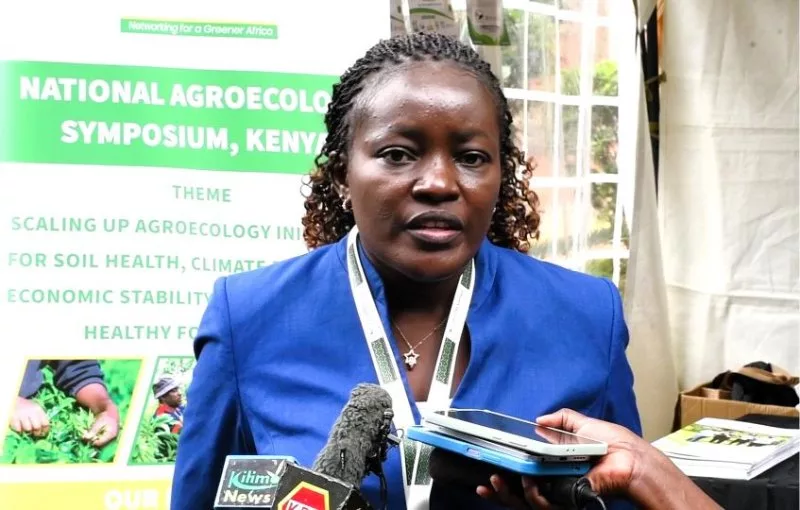
 Pelum Kenya country coordinator Rosinah Mbeya during the 3rd Agroecology Symposium /AGATHA NGOTHO
At least five counties have adopted agroecology policies as Kenya accelerates efforts to promote climate-resilient and sustainable farming.
Murang'a, Makueni, Nakuru, West Pokot and Kiambu have already developed county agroecology policies, while Trans Nzoia, Turkana, Laikipia, Kirinyaga and Machakos are drafting similar frameworks.
Stakeholders are urging more devolved governments to fast-track implementation to strengthen food security.
Participatory Ecological Land Use Management (Pelum) Kenya country coordinator Rosinah Mbeya said counties must move beyond policy development by allocating adequate budgets and implementing programmes that directly support farmers. She spoke during the Third Agroecology Symposium.
Mbeya said although agroecology is gaining momentum in Kenya, greater political commitment, increased financing and faster implementation are needed to help farmers cope with climate change, rising production costs and declining soil health.
Kenya continues to grapple with multiple agricultural challenges, including climate change, emerging crop pests and diseases and increasing input costs driven by global economic disruptions.
"These challenges are making farming increasingly difficult, particularly for smallholder farmers. However, they also present an opportunity to transform our food systems and build farming systems that are more resilient and less dependent on external inputs," Mbeya said.
She described agroecology as an environmentally sustainable approach that restores ecosystems while improving agricultural productivity, conserving biodiversity and protecting human health and the environment.
Mbeya said the focus should now shift from developing strategies to implementing them through adequate funding and practical support for farmers.
"The discussion is no longer about developing strategies. It is now about implementation, budgeting and ensuring these policies benefit farmers on the ground," she said.
Mbeya said agroecology continues to attract support from development partners, researchers and policymakers.
However, only a small proportion of Kenya's estimated 7.5 million smallholder farmers practise agroecology through organised networks.
She said Pelum works with about 1.5 million farmers but said wider adoption is needed to transform the country's food systems.
Agriculture secretary in the State Department for Agriculture Peter Aoko said crop diversification remains one of the government's key strategies for strengthening climate resilience and improving household nutrition.
"Different crops perform differently under different ecological conditions. Diversification ensures that if one crop fails because of weather or pests, another succeeds while also providing better nutrition," he said.
Aoko said the government is strengthening farmers' capacity through agricultural extension services and knowledge sharing while working with county governments to domesticate the National Agroecology Strategy.
He acknowledged that implementation has progressed slowly because agriculture is a devolved function but expressed confidence that momentum would increase as more counties adopt the strategy.
"Agroecology is about producing food sustainably while protecting the environment, particularly soil health. Without healthy soils, agricultural production cannot be sustained over the long term," he said.
Dr Lisa Fuchs, a scientist with the Alliance of Bioversity International and CIAT, said agroecology extends beyond environmentally friendly farming by integrating ecological sustainability, economic viability and social equity.
She said the approach promotes crop diversity, healthy soils, circular farming systems and locally adapted food production to improve food security and nutrition.
Fuchs encouraged farmers to recognise the value of indigenous knowledge and work collectively to develop solutions suited to local conditions.
"Agroecology is a science, a practice and a movement. Farmers should organise, share knowledge, work with their neighbours and partner with government, researchers and other stakeholders to strengthen local food systems," she said.
She said agricultural research institutions are increasingly embracing participatory approaches that involve farmers and communities in developing, testing and scaling innovations to ensure solutions respond to local needs.