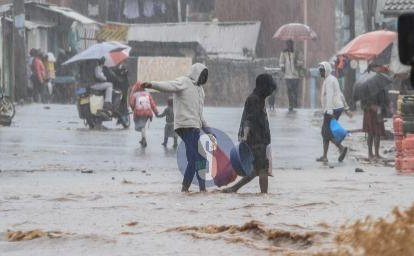
 Nairobi residents wade through water after heavy rains /FILE
As Kenya prepares for a possible El Niño cycle, attention is increasingly turning to the familiar threats of crop
failure, livestock deaths and food shortages.
Yet behind these visible impacts lies a less discussed but equally damaging consequence: rising household debt that can trap farmers long after the rains return.
A new analysis by the Food and Agriculture Organization (FAO) warns that El Niño events do more than disrupt rainfall patterns.
They often trigger a chain reaction of failed harvests, livestock losses, income shocks, migration and mounting debt as rural households struggle to survive.
For many Kenyan farmers and pastoralists, the effects of drought do not end with the return of rains.
After losing crops or animals, households frequently resort to borrowing money to meet basic needs such as food, livestock feed, water, school fees, seeds and medical expenses.
Without harvests or livestock sales to repay these loans, many are pushed into prolonged debt cycles that take years to recover from.
In Narok North, livestock keeper John Marakesh embodies this struggle.
For years, he depended on cattle and goats to support his family and pay school fees. But the severe drought of 2010 wiped out much of his herd.
“That year, the drought was severe. Many of my cattle and goats died because pasture and water were scarce,” he recalls.
“I moved the animals over long distances in search of grazing land, but some were too weak to complete the journey.”
With only a few surviving animals, Marakesh was forced to sell part of his herd through a government livestock off-take programme meant to support pastoralists during drought. However, the prices were far below normal market value.
“I sold some cattle for about Sh3,000 each, which was much lower than their normal market value, but it helped me recover part of my losses,” he says.
By 2011, the losses had significantly weakened his household income, forcing him to take out a loan to restock livestock—something he had never done before.
While he has since adopted coping strategies such as storing fodder and hay, the fear of future drought remains constant.
FAO’s findings, based on 41 years of satellite data, come as the World Meteorological Organization forecasts a stronger-than-usual El Niño phase.
The data show past El Niño cycles have repeatedly hit the same vulnerable regions, leading to widespread agricultural losses.
The hardest-hit areas include the Sahel, Southern Africa, South and Southeast Asia, and Central America’s Dry Corridor and the Caribbean, where some regions face more than a 50 per cent probability of drought in the coming months.
The analysis also highlights the global scale of the crisis. During the 2015–16 El Niño event, more than 60 million people were affected worldwide, prompting humanitarian appeals worth Sh647 billion (US$5 billion) across 23 countries, including Kenya.
Similar impacts were recorded during the 2023–24 cycle, when farmers and pastoralists again bore the brunt.
In response, FAO and the World Food Programme have launched a Sh26.2 billion (US$202 million) anticipatory action appeal aimed at protecting 8.8 million people across 22 high-risk countries.
The initiative focuses on early interventions such as drought-tolerant seeds, fodder storage, cash assistance, water conservation and improved early warning systems.
FAO natural resources officer Jorge Alvar-Beltrán said the urgency is heightened by worsening global conditions.
“Risks are now skewed to the upside as climate extremes increasingly collide with conflict and economic stress,” he said.
“This isn't like previous El Niños. The planet is much warmer today, and with conflict and food insecurity widespread, this new phase will hit hardest in places already vulnerable and with limited coping capacity.”
He warned that even moderate droughts can be devastating in regions where livelihoods depend entirely on rain-fed agriculture and livestock, with little capacity to recover from repeated shocks.
He said more than 80 per cent of drought impacts on agriculture are expected to affect low- and middle-income countries.
A farmer may first lose crops, then livestock, and ultimately their entire livelihood, he said, stressing the need for early action before crises escalate.
FAO expert Riccardo Soldan said timely risk information can significantly improve preparedness at the local level, allowing farmers to adjust planting dates, choose drought-resistant crops, and secure fodder and water in advance.
He said the challenge lies in translating precise forecasts into action.
While FAO’s systems can identify risk areas down to a single square kilometre, the effectiveness of early warning depends on coordination between meteorological agencies, agriculture ministries and extension officers to ensure farmers receive timely guidance.
“Instead of spreading resources thinly, support can be directed to hotspots through cash transfers, water interventions and livestock feed,” he said.
“El Niño is forming, and the maps are clear. What happens next depends on how quickly decisions follow.”