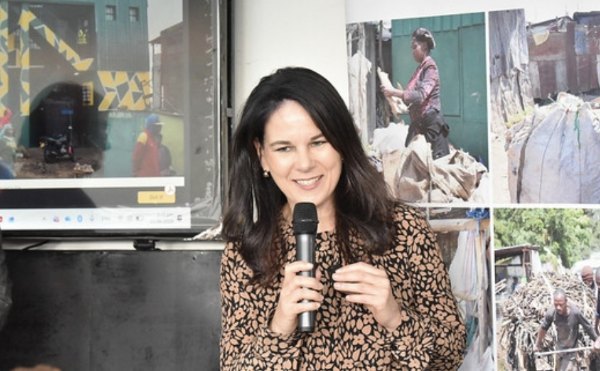
 The President of the United Nations General Assembly, Annalena Baerbock, during her visit to Korokocho.
The President of the United Nations General Assembly, Annalena Baerbock, has warned that the lack of funds risks stalling peacekeeping missions, humanitarian assistance and development programmes.
Baerbock gave the warning shot during a press conference at the United Nations Office at Nairobi.
“We should not sugarcoat things. The UN is in a deep liquidity crisis,” Baerbock said, appealing to member states to meet their financial obligations.
The UN relies on multiple funding methods, including voluntary donations, service-based revenue, and private-sector partnerships.
Baerbock said she has made a proposal, which is going to be discussed in one of the committees, that they should change one of the very counterproductive roles.
She said one of the counterproductive roles touches on redistribution of money which has been unspent by the UN to member states.
There is a rule where the UN is forced to return hundreds of millions of dollars to member states in budget credits for unspent money, even if those same member states never actually paid their assessed contributions.
“At the moment, the UN has to pay back money it never received because, especially, one of the bigger member states did not pay a contribution at all.”
Baerbock said the move is counterproductive to peace and security.
“I think the discussion of the last week has underlined for all member states, if you call for a stronger role for peace and security of the UN, you cannot sacrifice the so important part, especially of peacekeeping, by not paying your contribution.”
Baerbock said some countries have not paid in full and on time.
She said the fact that the US, which is the biggest donor, has pulled out of some of the UN’s bodies will worsen the situation.
Baerbock said the dwindling resources will hurt the UN's programmes.
“My proposal is for all member states to continue with their contributions also, and especially for the agencies and their important work on the ground.
Baerbock said the UN Secretary General António Guterres early this year raised alarm over the funding gap facing the UN development system.
Guterres, who made the remarks during the opening of the Economic and Social Council’s Operational Activities for Development Segment for 2026 in New York, said contributions to the UN development system suffered the highest cuts among all development partners and are projected to decline further this year.
He said core funding remains well below agreed targets.
“Most funding continues to be short-term and tightly earmarked — limiting flexibility and undermining collective priorities,” Guterres said.
“The resident coordinator system remains underfunded and dependent mostly on voluntary contributions – and faced a $46 million (Sh5.96 billion) shortfall in 2025. This places coordinated delivery at risk.”
Guterres said that while the provision of $53 million (Sh6.86 billion) from the regular budget for the resident coordinator system was a step in the right direction, it is not sufficient.
“We need more stable, predictable and flexible funding. I urge member states to reach the 30 per cent core funding target called for by the Funding Compact and help equip the system to deliver and succeed.”
Every member state is legally obligated to pay their respective share towards peacekeeping.
This is in accordance with the provisions of Article 17 of the Charter of the United Nations.
The General Assembly apportions peacekeeping expenses based on a special scale of assessments under a complex formula that Member States themselves have established.
This formula takes into account, among other things, the relative economic wealth of member states, with the five permanent members of the Security Council required to pay a larger share because of their special responsibility for the maintenance of international peace and security.
The approved budget for UN peacekeeping operations for the fiscal year 1 July 2024 - 30 June 2025 is $5.6 billion.
This amount finances nine of the 11 UN’s peacekeeping missions and provides support, technology and logistics to all peace operations through global service centres in Brindisi (Italy) and a regional service centre in Entebbe (Uganda).
The remaining two peacekeeping missions, the UN Truce Supervision Organisation (UNTSO) and the UN Military Observer Group in India and Pakistan (UNMOGIP), are financed through the UN regular budget.
By way of comparison, this is less than a half of one per cent of world military expenditures (estimated at $2443 billion in 2023).
The 2024-2025 budget (about $5.6 billion) represents an average decrease of 8.2 per cent compared to the approved budget for 2023-2024 (about $6.1 billion).
The top 10 providers of assessed contributions to United Nations peacekeeping operations for 2024-2025 are the United States (26.95%), China (18.69%), Japan (8.03%), Germany (6.11%), the United Kingdom (5.36%), France (5.29%), Italy (3.19%), Canada (2.63%), the Republic of Korea (2.57%) and the Russian Federation (2.29%).
The event which highlighted the important role of the UN in Africa was part of a wider visit to Nairobi, where she engaged with senior UN leadership and visit programme initiatives.
During the press briefing, Baerbock touched on the important role of the UN in Africa, including as a centre for key UN agencies such as UNEP and UN-Habitat and as a hub for crucial fieldwork.
She also highlighted the role of Africa as a leader in multilateralism and the wider UN80 reform process, including the need for greater African representation and the current regional and global issues.
During her visit, President Baerbock met with under-secretary-general and director-general of the UN Office in Nairobi Zainab Bangura.
She also held bilateral meetings with Under-Secretary-General and Executive Director of the United Nations Environment Programme (UNEP) Inger Andersen and other senior diplomats and senior officials of UN-Habitat in Nairobi.
During her visit, Baerbock also met the United Nations Country Team, led by the UN Resident Coordinator in Nairobi, where she exchanged views on the work of the UN system on the ground and its collaboration with the Government of Kenya.
She also termed the under-representation of the African continent in the security council as ‘one of the injustices of the past within also the international system.’