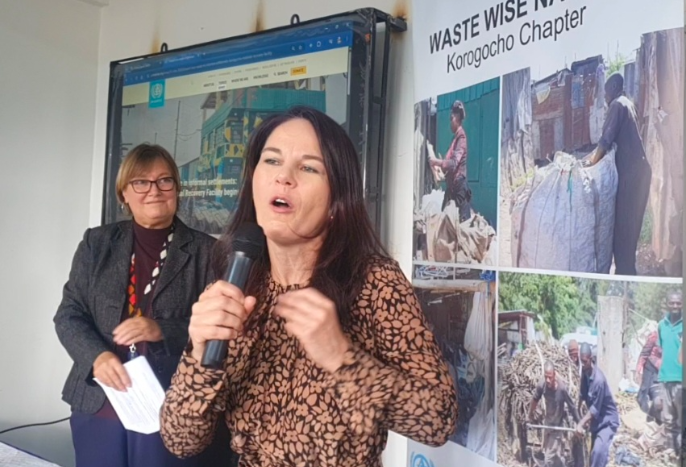
 United Nations General Assembly president Annalena Baerbock during a
tour of the Korokocho material recovery facility /UN
United Nations General Assembly president Annalena Baerbock during a
tour of the Korokocho material recovery facility /UNThe United Nations has promised to scale up ongoing efforts to manage waste in Nairobi a sustainable manner.
President of the 80th session of the United Nations General Assembly Annalena Baerbock made the commitment to press for the scaling up of material recovery sites in the country after visiting the Korokocho material recovery facility.
“I promise you that I will deliver your wishes from the ground to the UN Assembly, and I'm also hoping that you will encourage many of your friends, neighbours and volunteers on the ground. This is a very valuable job you are doing, because the resources you hold in your hand, like plastic being recycled again, can inspire others,” Baerbock said.
Baerbock said having a circular economy is part of the sustainable development goals and what the waste pickers were doing is in line with the UN General Assembly’s work.
The UN Assembly president said the project is also in line with her presidency and the UN slogan of ‘better together'.
“So I'm taking your example here back to New York, if you allow me to share it, and your experience there as well, and I heard very loud and clear.”
Baerbock said there is a need to scale up the project in order to address challenges facing waste management.
During the visit, the president was taken through the steps associated with deriving value from waste.
Waste pickers Stephen Kimani and Mercy Atieno said the project had helped them not only earn a living but also make the environment clean.
Ambassador Susan Nakhumicha from the Kenyan mission to UN Habitat, Director of the Global Solutions Division at UN Habitat Rafael Tuts, Area Programme Manager AVSI Gabriele Tardivo, Guilia Orlandi from the Embassy of Italy, and
Nakhumicha said there is a need to scale up similar projects to address the existing gaps in waste management.
The Government of Italy, through the Italian Agency for Development Cooperation CAJCS, has funded the project "Waste Wise Nairobi-Korogocho Chapter. It is a partnership with UN-Habitat, Nairobi City County, AVSI, and Miss Koch Kenya to enhance municipal solid waste management (SWM) and resource efficiency, with a focus on the informal settlement of Korogocho.
Informal settlements are disproportionately affected due to the absence of formal collection services, resulting in poor hygiene conditions and environmental degradation.
Nairobi generates approximately 4,000 tonnes of municipal solid waste daily, of which 65 per cent is collected and only 5 per cent recycled.
The project addresses these challenges by establishing a coordinated collection scheme that links Community-Based Organisations (CBOs), recycling companies, and the Nairobi City county government.
During 2024-2025, the project built the capacity of CBOs working on solid waste management in Korogocho and constructed the first Material Recovery Facility (MRF) in informal settlements in Nairobi for recovery of recyclables, sorting and aggregation.
The project has also engaged the community and established waste segregation at the source.
The MRF sorts dry recyclables into waste streams, including plastic PET, HDPE, LDPE, and paper for sale to recycling companies, thereby enhancing material recovery efforts in the community and creating opportunities for employment within the Korogocho settlement.
The project builds on existing informal collection systems by professionalising 29 CBOs through training, equipment, and improved facilities.
Community sensitisation activities promoted awareness of sound sustainable waste management practices and the role of waste actors in maintaining a cleaner environment.
The door-to-door collection service within the community is a key component of separate waste collection and household waste management under the project.
In collaboration with the community organisations responsible for waste collection, a total of 1,500 households, representing approximately 6 per cent of the neighbourhood population, have been identified, mapped and included in the service.
The initiative has transformed waste management from informal practice into structured community service, a move that has improved environmental conditions while fostering local ownership and long-term sustainability.
The visit by the UN Assembly President highlighted the importance of partnership for improved sustainable waste management services, better livelihoods for waste actors and communities, expanded recycling opportunities, a cleaner environment, and a replicable model for sustainable waste management in informal settlements.