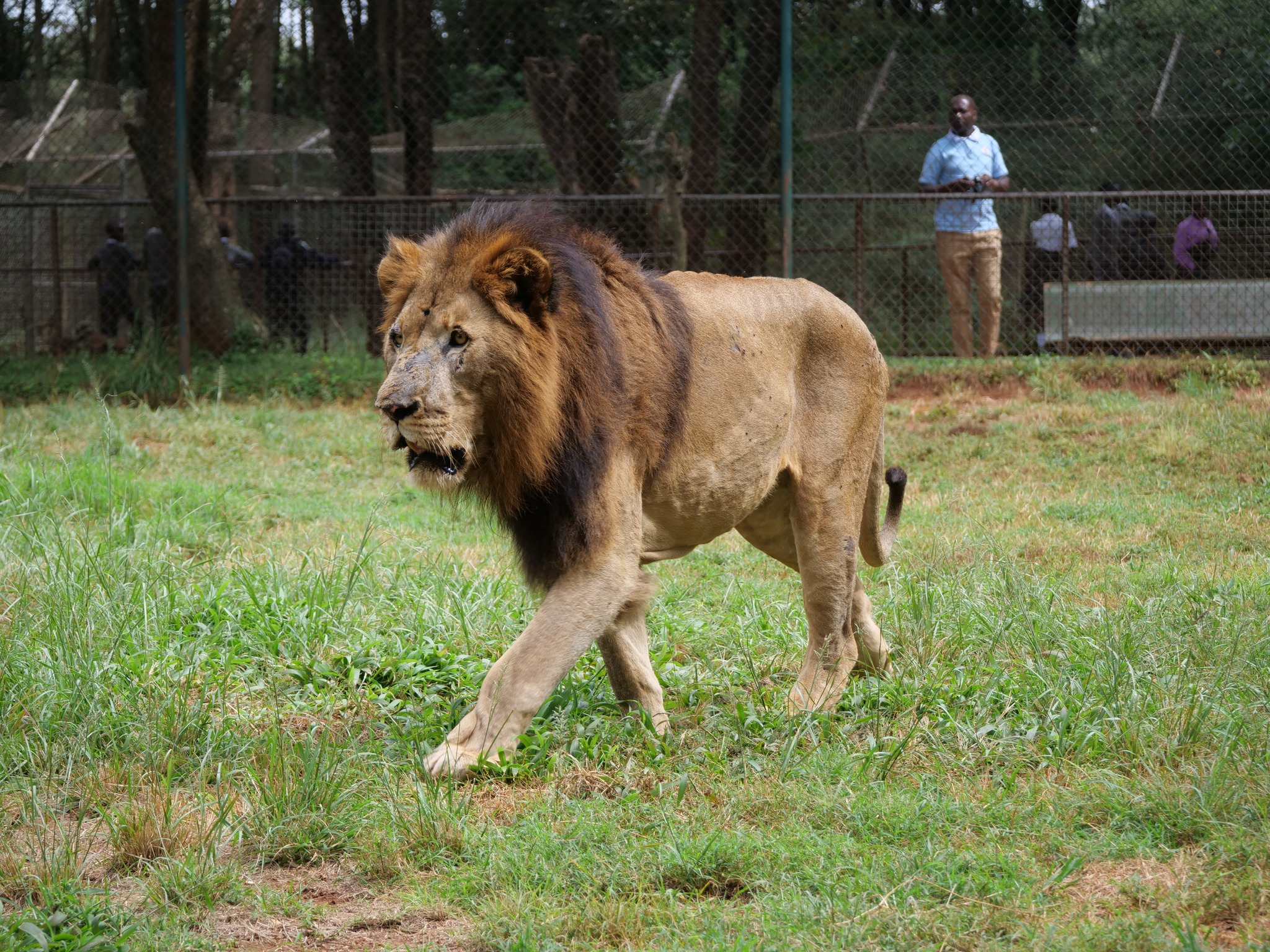
 A lion roaming the Nairobi Animal Orphanage/KWS
Civil society organisations have vowed to explore all available avenues in their latest bid to protect Nairobi National Park from what they term as plans to grab it.
Friends of Nairobi National Park on Tuesday said they will not allow the planned animal orphanage project to proceed.
They argued that it will compromise the integrity of the 117-square-kilometre park a stone’s throw from Nairobi CBD.
The organisation said the park is a unique ecological heritage, the world’s only national park bordering a capital city and a critical refuge for wildlife, biodiversity and future generations.
“Any plans that threaten its integrity must be subjected to meaningful public participation, environmental scrutiny and full transparency. Decisions concerning protected public resources cannot be made without the informed consent and involvement of the people of Kenya.”
On Monday, six organisations held a peaceful demonstration to oppose the project.
They included Friends of Nairobi National Park (FoNNaP), Just Act, United Green Movement Party, The Green Belt Movement, Amnesty International Kenya and Greenpeace Africa.
During the demonstration, which was largely peaceful, nine people, including former Chief Justice David Maraga, were arrested.
The organisations condemned the use of force against citizens exercising their constitutional rights to peaceful assembly, expression and public participation.
They said the arrests and reported acts of intimidation against those raising legitimate concerns about the future of Nairobi National Park represent a dangerous assault on civic space and democratic participation.
They called for the immediate and unconditional release of all those arrested and urged authorities to respect, protect and facilitate the right to peaceful assembly as guaranteed under the Constitution of Kenya and international human rights law.
The organisations said Nairobi National Park is not for sale.
“Our public spaces, our environment and our rights cannot be traded away behind closed doors. This is about more than land. It is about power, accountability, transparency and the right of people to be heard. When citizens raise concerns about decisions that may permanently alter a national treasure, the response of the state must be engagement and accountability, not arrests, violence and repression.”
They said development must never come at the cost of rights, heritage or the collective future.
On April 29, FoNNaP’s partners, Just Act and Kituo Cha Sheria, filed a case at the Environment and Land Court to challenge the planned loss of part of the park.
They said the new orphanage can be built in any other part of the city or country and still meet the project’s objectives.
“Kenya Wildlife Service states that only 0.3 per cent of the park will be lost. It is the same line of reasoning used to justify the Southern Bypass, SGR Phases 1 and 2, and the ICD road. Those alone, when added up, have resulted in about a four per cent loss of land from the park in the last decade alone. This is not counting losses from other illegal encroachments and developments.”
The organisations raised concerns that the project Environmental Impact Assessment document has already been approved, the EIA licence issued and land clearing commenced.
“Any gaps, inconsistencies and errors in those can easily translate into catastrophic developments on the ground.”
The organisations said they oppose the relocation, noting that the EIA document contradicts the scope of the project.
“In one section, it states the developments will require 26 acres of land (pages 20 and 36). In another, it talks of 64 acres (page 32). It then finally declares the acreage as 76.6 acres (31 hectares), the figure contained in the licence.”
The organisations said a presentation during a board meeting in March showed that the acreage for the new facility was 89 acres.
“There is also the issue of a 10km perimeter fence (pages 22, 32 and 49), which would enclose an area of approximately 1,500 acres.”
They said the area being cleared for the project is heavily used by lions, leopards and black rhinos, contrary to KWS claims.
“The EIA does a very poor job of assessing the biodiversity in the area and the ecosystem services it provides, especially the critical role forest glades play in regulating water systems and supporting forest biodiversity.”
They said the project also intends to develop an ecological corridor between the new orphanage and the Safari Walk.
However, they said there are no substantial details in the EIA explaining what the corridor will entail.
They said the 2020–2030 park management plan declares the area a “low-use zone” and prohibits developments, including new visitor roads, due to the sensitive and fragile nature of the ecosystem.
They said this had been ignored in the EIA.
The organisations accused KWS of failing to engage them and said the project had been shrouded in secrecy.
They also raised concerns about a planned car park that will host up to 1,500 vehicles, saying it will damage the park.
The stiff opposition from the organisations has put the spotlight on KWS.
KWS has, however, insisted that it followed all required procedures.
The service said the 62-year-old facility, established in 1964 as a wildlife rescue, rehabilitation and conservation education centre, has failed the test of time.
KWS director general Prof Erustus Kanga said four options had been considered.
The first option was to expand the current facility.
The site was dropped due to overcrowding and pressure on the existing facility. Kanga said indigenous trees within the facility would also be affected.
The second option was to move the facility to the Southern Bypass site, but this was dropped due to its proximity to Wilson Airport.
The third option was to move the facility to Athi River.
Kanga said the Athi River site is significantly further from Nairobi and would reduce accessibility for schools and visitors, leading to lower visitor numbers and reduced revenue.
He said operational costs for wildlife transport and management would also increase.
The fourth option, the Galleria–Bomas area site, was
selected for several reasons.
“The selected site emerged as the most suitable because it consists largely of open glade habitat with minimal indigenous tree cover, and it provides adequate space for modern wildlife rescue and rehabilitation facilities,” Kanga said.
Kanga said the site is located near major visitor and tourism circuits.
“Accessibility for schools, tourists and researchers is improved. Traffic management opportunities are better.”
The DG said the total site area is approximately 410,500 square metres, more than 20 times larger than the existing orphanage, and is positioned along Langata Road, a major urban corridor.
He said the site has direct connectivity to Nairobi National Park and surrounding ecosystems.
Kanga said the expanded site capacity would enable larger habitats, improved animal welfare and a better visitor experience.
He said the site also offers strong integration with surrounding tourism infrastructure, including Galleria, BICC and schools, as well as efficient and dedicated access for visitors, staff and emergency animal transfers.
Kanga dismissed claims by conservation organisations that public participation was inadequate.
He said there is a growing number of orphaned wildlife resulting from habitat loss, human-wildlife conflict and environmental pressures.
The old facility has provided refuge to injured, orphaned, confiscated and rescued wildlife while serving as a unique platform through which millions of Kenyans and international visitors have interacted with wildlife.
It now receives up to 17,000 visitors on peak days, making it one of the most visited conservation education facilities in Kenya.
The new facility will sit on an 89-acre parcel of land, with 81 acres dedicated to wildlife enclosures, rescue and rehabilitation spaces.
It will also feature a modern veterinary care centre, expanded wildlife rescue and rehabilitation facilities, quarantine and nursery facilities, and dedicated release and rewilding zones.
Other features will include a conservation education centre, interpretation centre and outdoor classrooms, a conservation boardwalk, an aquarium showcasing Kenya’s aquatic biodiversity and a conservation heroes monument.
Kanga said more than 1,000 jobs will be created during the construction and operation of the facility, which will have the capacity to host more than 20,000 students and visitors.