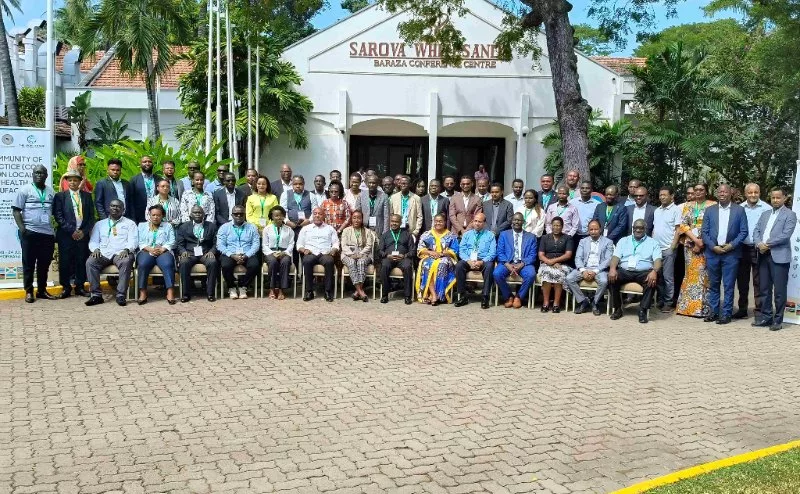
 Delegates at IGAD’s Community of Practice (COP) on Local Health Manufacturing meeting in Mombasa on Wednesday / BRIAN OTIENO
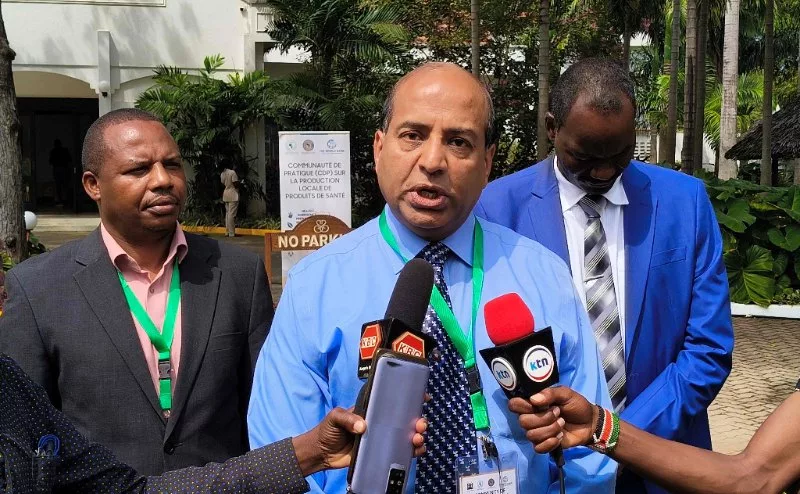 World Bank representative Ramesh Govindaraj at IGAD’s Community of Practice (COP) on Local Health Manufacturing meeting in Mombasa on Wednesday / BRIAN OTIENO
 The Community of Practice (COP) on Local Health Manufacturing chair Stephen Njuguna at the IGAD meeting in Mombasa on Wednesday / BRIAN OTIENO
African countries must break down trade barriers and pool resources together to build a strong regional pharmaceutical industry for the continent to reduce its heavy dependence on imported medicines and vaccines.
Industry leaders and experts said Africa still imports about 80 per cent of its pharmaceutical products and nearly 99 per cent of its vaccines, leaving the continent vulnerable during health emergencies.
They spoke during an Intergovernmental Authority on Development (IGAD) meeting in Mombasa on Wednesday.
"Basically, we are importing almost all health products," said Stephen Njuguna, the chairman of the Community of Practice (COP) on Local Health Manufacturing.
Director of the East African Community Regional Centre of Excellence for Vaccines, Immunisation and Health Supply Chain Management John Mwesigye said the continent spends about $28 billion (Sh3.6 trillion) annually importing medicines and vaccines.
The African Union has set a target of producing 60 per cent of the continent's pharmaceutical products and vaccines locally by 2040.
IGAD Head of Health Mohammed Elduma said 11 countries from Eastern, Central and Southern Africa, including Kenya, Ethiopia, Rwanda, Burundi, the Democratic Republic of Congo, Malawi, Zambia, Mozambique and Sao Tome, are participating in the regional manufacturing programme.
He said Africa must develop the capacity to respond rapidly to disease outbreaks instead of relying on imports.
"We don't have a vaccine for the new
strain of Ebola. We need to be able to produce suitable vaccines for any
outbreak or health emergency," Elduma said.
He urged African countries to adopt a regional rather than national approach to pharmaceutical manufacturing.
Njuguna said although Kenya has made
significant progress, no single country has a sufficiently large market to
sustain competitive pharmaceutical manufacturing.
"Africa has a population of about 1.58 billion people. We need to think beyond borders and view Africa as one market if we are to compete with countries such as India and China," he said.
He said pharmaceutical manufacturing is capital-intensive and requires economies of scale that can only be achieved through regional integration.
World Bank representative Ramesh Govindaraj
said the Covid-19 pandemic and Ebola outbreaks exposed Africa's overreliance on
imported medicines and highlighted the need to strengthen regional
manufacturing.
"For far too long Africa has depended on imports, making the continent reliant on the goodwill of others during health emergencies," he said.
Govindaraj said regional integration will create a larger market, attract investment and strengthen health security, but acknowledged that countries would first need to harmonise policies, regulations and quality standards.
He added that stronger national regulatory authorities would be critical to ensuring locally manufactured medicines meet international standards.
Mwesigye said EAC is reviewing its second Regional Pharmaceutical Manufacturing Plan of Action and developing a new 10-year strategy.
The region is also establishing pooled procurement systems to provide manufacturers with reliable market data and encourage investment in local production.
"We are working as a region to develop incentive packages that will support pharmaceutical manufacturing," he said.
African pharmaceutical value chain expert Wilson Chandomba said the continent already possesses the technical expertise needed to manufacture medicines, noting that pharmaceutical production in Africa dates back to the 1950s.
"Our challenge is not capacity but
implementation," he said.
Chandomba urged African governments to embrace Pan-African cooperation and build on existing successes instead of focusing on national borders.
"When we look at Africa as one market, it is large enough for us to competitively manufacture and supply essential medicines," he said.