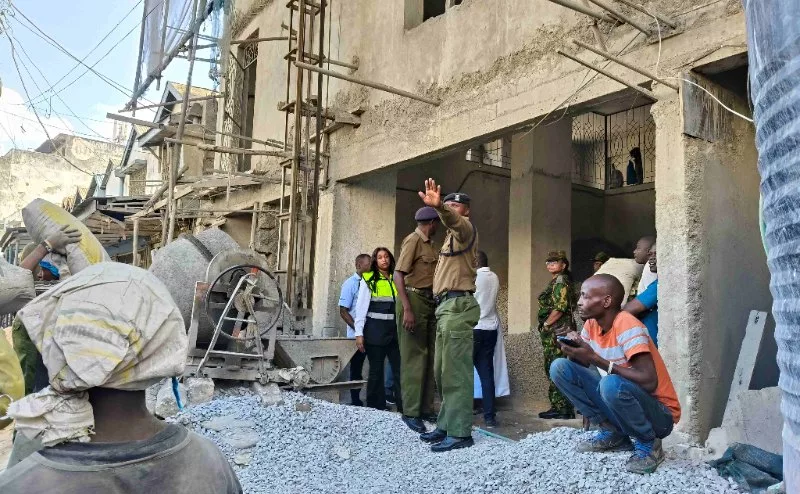
 A house under construction in Majengo being flagged by authorities for flouting construction rules on June 26 /BRIAN OTIENO
Majengo residents have decried the broken sewer system in their area.
Led by elders from the Majengo Community Organisation (MCO), the residents said they have to walk through overflowing sewage to get to the mosque.
"People are not happy. Elders are forced to pray at home because when they arrive at the mosque, they are already dirty with sewage water. They must go and seek another tohara," MCO chairperson Abdalla Dadala said.
Tohara is the spiritual purification performed before one goes to pray in the mosque.
He spoke at a public participation meeting where residents discussed the proposed Majengo market, affordable housing units and the Mombasa County Revolving Fund.
Dadala urged the county government to fix the sewer system to help prevent waterborne diseases from spreading and harming the community.
However, Majengo MCA Khamis Nyundo called for patience, saying the county cannot fix everything at the same time.
He said Governor Abdulswamad Nassir has made efforts to address many of the issues Mombasa residents have raised but needs more time.
"Even if we get another governor from among you here, they will not fix everything that we want fixed," Nyundo said.
The MCA said residents also bear a significant share of the blame for the broken sewer system.
"It is not the county government alone to blame. When you want to build your houses, there are provisions in the plans, including parking, drainage, lifts and all.
"But when it comes to the actual construction, these are not included and you remain silent. You don't come to us to complain so that we know the contractor has not included these provisions," Nyundo said.
He also lamented some residents dispose of their garbage indiscriminately, blocking the sewer system in the process.
"I don't refute that some county inspectorate officers are given money to look the other way when rogue contractors illegally connect to the county's sewer system," the MCA said.
Governor Nassir, who was the chief guest at the meeting, said the sewer problem is historical and predates the advent of devolution.
He said a large part of Majengo does not have a sewer line.
Nassir said those whose house plans were approved by the administration were expressly instructed to construct soak pits.
"But people became greedy, starting with our forefathers. The system we have is the stormwater drainage system that was supposed to direct all the storm water into the ocean.
"But those who constructed houses, instead of digging soak pits, illegally connected their sewer lines to the storm-water drainage system," Nassir said.
He said this overwhelmed the stormwater drainage system, leading to blockages that have caused the problems Majengo residents are experiencing today.
The county chief said if he were to fix the problem immediately, he would have to demolish many houses, which is not the preferred solution.
"Even our mosques have the same problem," he noted.
He said sewage from houses sometimes contains acidic substances that corrode drainage pipes, eventually causing leaks.
"When it rains, the stormwater drainage system is overwhelmed, mixes with sewage and overflows into houses and public spaces," the governor said.
He said the money required to fix the entire system runs into hundreds of millions of shillings.
Nassir said the county will leverage the affordable housing project to install dedicated sewer pipes that residents will be able to connect to.
"This is a problem that started way back in the 1980s and cannot be fixed within days. New approvals will go the technology way," he said.
Construction inspectors, he said, will be equipped with special gadgets that require them to be physically present at construction sites before they can operate, enabling them to ensure developments comply with approved plans.
He said this will help the county ensure no houses are built without a proper sewer system.
Dadala also asked Nassir to ensure 75 per cent of the housing units under the Majengo Affordable Housing project and the stalls at the proposed Majengo Market are allocated to residents.
"This is the promise that the CEO of the country made to us and we need you to ensure it happens," he said.
However, Nassir said the county, which is responsible for allocating market stalls, will issue sectional titles to stall holders.
He said this will enable the county to monitor ownership and identify those who sell their stalls so appropriate action can be taken.
The county chief said the county is exploring legal mechanisms to facilitate the issuance of the sectional titles.
"We don't want to be blamed when someone sells their stall for one reason or another. We will know who sold the stall," Nassir said.