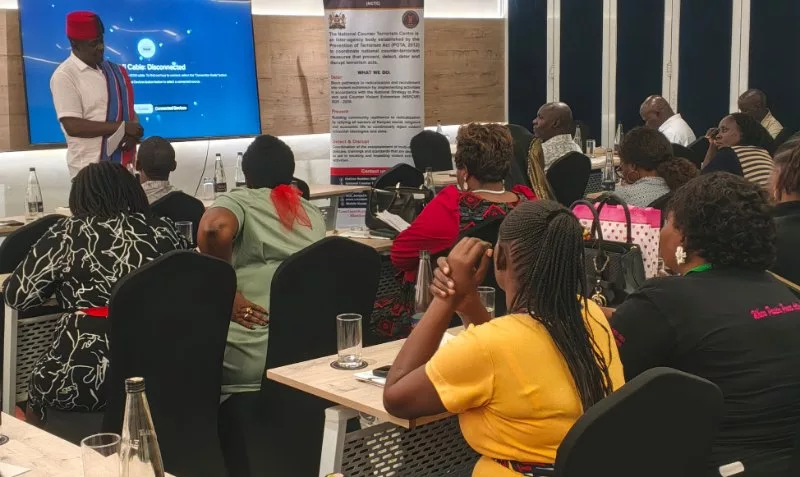
 Teachers and education officials from Mombasa county at the NCTC training workshop on early detection of violent extremism in Kenyan schools in Mombasa on Wednesday / BRIAN OTIENO
A 13-year-old boy who was once quiet and rarely spoke
changed his behaviour during the first term, raising concerns among teachers at
a school in Mombasa county.
EKS, the school’s deputy headteacher, noticed that SAH had
changed his name in all his exercise books.
“I was handing over the exercise books to the children when
I came across a book with a new name. I thought it was a new student. But then
SAH came and said it was his book. I told him, ‘But you are called so and so?’
But he said that was his new name going forward,” EKS said.
Because they considered it a normal case of indiscipline,
teachers punished SAH.
However, a few days later, his parents reported he had
disappeared from home several times, especially at night.
It was later discovered he had started sleeping in a mosque, surprising both his parents and teachers.
“I have been a beacon teacher for quite some time now, but I was not aware of what I have learned. So tell me, how about those who have not had such training?” EKS said.
She spoke on Wednesday during a three-day training workshop
for teachers and education staff in Mombasa county organised by the National
Counter Terrorism Center (NCTC) on identifying early warning signs of violent
extremism and radicalisation among learners.
EKS said she had previously noticed similar warning signs
but did not know they were indicators of a child becoming radicalised.
“Beacon teachers handle extreme cases, but a radicalised
child is one you cannot handle. You just refer because that person endangers
your life. You cannot reason with them,” she said.
She said some teachers, staff members and students were
aware of SAH’s behaviour but chose to remain silent.
“Anybody who is radicalised is dangerous. There are powers
above them who control them,” she said.
Teachers Service Commission (TSC) Mombasa deputy county director
Patrick Mutua said cases of violent extremism had recently been reported in
Mvita and Likoni sub-counties.
“Some of the reported people have been students involved in
these activities,” Mutua said.
He said the training had equipped teachers and education
officials with knowledge on how to respond to such cases and disrupt the
process of learners being introduced to violent extremism.
“It is not just about students. Remember a school is a
community. We have teachers, non-teaching staff, students and parents as well.
Therefore, it is a collaborative, multi-pronged approach where all the
stakeholders will be involved in ensuring learner safety and security,” Mutua
said.
The training aims to help teachers understand what signs to
look out for among learners who may be vulnerable to radicalisation.
Mutua said that once teachers understand factors that
contribute to violent extremism, they will be better placed to identify and
respond to cases.
“They will use the knowledge acquired to help them identify
learners who may be involved in any form of training related to violent
extremism and terrorism, with the aim of disrupting that kind of training,” he
said.
NCTC’s Charles Opiyo said violent extremist groups were
increasingly targeting learners because they seek to exploit their
vulnerability and lack of experience.
Opiyo said teachers often lack the knowledge required to
identify signs of violent extremism among learners.
“Violent extremists exploit the immaturity of our young ones
in the belief systems. Given the fact that the young ones are not grounded
properly in our mainstream belief systems, they usually take advantage to pass
certain narratives, taking advantage of the vulnerability that these young ones
sometimes go through in life or in our society,” Opiyo said.
He said extremists believe that radicalising young people at
an early age allows them to grow up believing that violence is acceptable.
“That is why we are targeting the teachers, them being
custodians of these young ones, to sensitise them about the dynamics of the
treatment by the violent extremists to the young ones,” he said.
Similar trainings have been conducted in Garissa, Elgeyo
Marakwet, Baringo and Taita Taveta counties.
The programme aims to train teachers and education staff in
at least 10 counties by the end of the year.
However, Opiyo said there was no empirical evidence directly
linking violent extremism to recent school unrest in the country.
“If you talk about violent extremism, you are speaking
strictly towards the aspect of terrorism. So we don’t have a direct link,” he
said.
Opiyo noted that social media and digital platforms have
made it difficult for teachers and parents to monitor communication between
young people and those seeking to radicalise them.
“There is that communication gap between the young and the
old. So sometimes infiltrating 100 per cent into the communication environment
of the young ones becomes difficult once you are old,” he said.
He called for increased digital literacy among teachers so
they can better understand how young people communicate online.
The training programme is currently at the pilot stage.
“The Child Safety and Security Against Violent Extremism
Guide was targeting the Education ministry. We have started with teachers but
we hope to incorporate everyone eventually. The main target is the learners,”
Opiyo said.
Center for Sustainable Conflict Resolution director Sheikh
Ramadhan Aula said preventing and countering violent extremism should be
strengthened across the country.
He said teachers, as mentors and guardians of children, need
knowledge on how to identify signs of radicalisation.
Sheikh Aula said religious messages, particularly within
Islam, have sometimes been misused by recruiters seeking to influence young
people.
“Islam has been misused and misconstrued a lot in this
country and beyond. Many young people in this country have been recruited using
religious narratives that have been misused to further goals of recruiters and
whoever is marshaling these young ones,” he said.
He called on religious leaders to increase engagement with
young people and provide accurate information about religion.
“There should be more programmes for the young people,” Sheikh Aula said.
INSTANT ANALYSIS
Violent extremism in Kenyan schools, particularly in the North Eastern, Coast and Nairobi regions, is driven by socioeconomic marginalisation, poverty and extremist networks like al Shabaab. Radicalisation efforts exploit frustrated ambitions and target youth through peer-to-peer recruitment and divisive ideological narratives.



![[PHOTOS] Ol Kalou residents turn out in large numbers to vote](https://cdn.radioafrica.digital/image/2026/07/fe42d51c-7f79-466e-94e8-59561f77bbe7.webp)