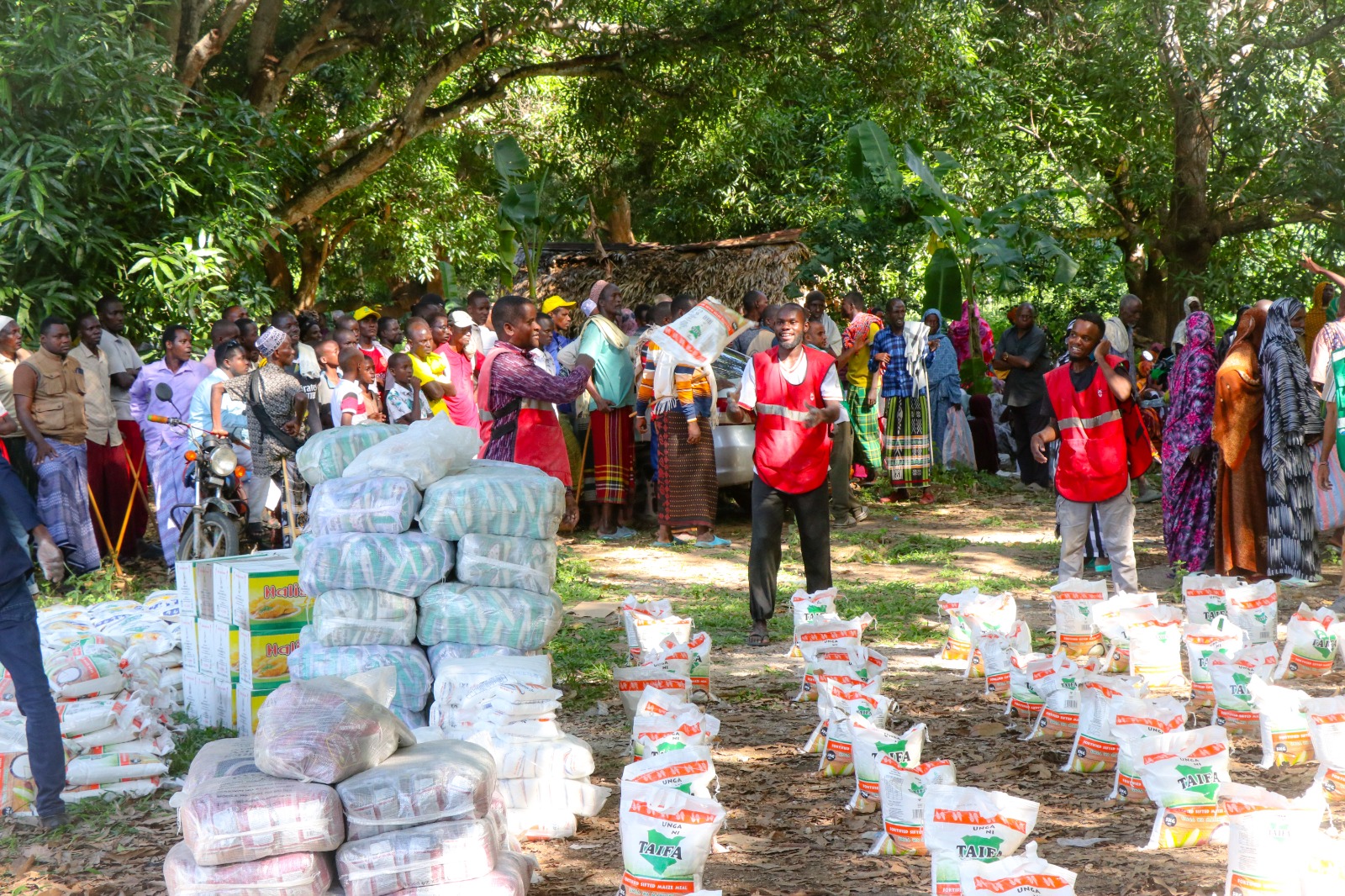
 Tana River flood victims line up to receive relief food from Kenya Red Cross and Taufiq Muslim Youth Foundation
in Tarassa sub-county/CHARLES MGHENYI
Tana River flood victims line up to receive relief food from Kenya Red Cross and Taufiq Muslim Youth Foundation
in Tarassa sub-county/CHARLES MGHENYIMore than 1,000 families affected by devastating floods Tana River have received relief food following the humanitarian crisis that has displaced over 3,000 households across the county.
Another 414 women and girls affected by the floods were provided with dignity kits as part of a coordinated humanitarian intervention aimed at supporting vulnerable populations impacted by the disaster.
The beneficiaries were drawn from several affected areas, including Adad, Ngumu Garjale, Lazima, Marembo, Bula Rahma, Kijo, Galili, and Gomesa villages.
The intervention was jointly implemented by the Tana River County Ward Administration, the Department of Special Programmes, local chiefs, the Kenya Red Cross Society, and Tawfiq Muslim Youth.
The collaboration ensured effective identification of beneficiaries, community participation, and transparent distribution of relief supplies. The beneficiaries are from Tarassa and Tan Delta subcounties, which are the most affected regions.
The support addressed urgent food security and protection needs among displaced and flood-affected families while strengthening partnerships between humanitarian agencies, local authorities, and community leaders.
Kenya Red Cross emergency preparedness and response manager Anthony Muchiri said the organisation continues to provide critical assistance to affected communities.
"We have supported 2,722 households with emergency shelter materials and hygiene promotion services. Together with the county government, we have also constructed 71 latrines to improve sanitation in the affected areas," Muchiri said.
Red Cross will continue offering psychosocial support and conducting routine health outreach programmes to help communities recover, he said.
"The heavy rains were experienced in the highland areas, but it is residents living downstream in the lowlands of Garissa and Tana River who have borne the greatest impact," Muchiri said.
Tawfiq Muslim Youth chairman Ahmed Aboud said the organisation was working with Red Cross to provide relief and mobilise additional support for affected families.
"We are here in Tana River to assist those affected by the floods. We are appealing to more donors to support Kenyans facing this crisis," Aboud said.
There are plans to conduct medical camps in the affected areas and facilitate specialised treatment for patients requiring advanced care at Tawfiq Hospital in Malindi.
"We are also exploring the construction of boreholes to help address the persistent challenge of access to clean water in these communities," he added.
Residents narrated the hardships they have endured following the floods, which destroyed homes, crops, and essential infrastructure.
Deye Omuru, a resident of Lazima village, said many families had been forced to relocate to higher ground after floodwaters submerged their homes.
"Our biggest challenge has been access to clean water and food. Our crops were destroyed by the floods, but we are grateful that Tawfiq and the Kenya Red Cross have provided food and shelter materials," he said.
Hassan Tunda, the headman of Gomesa village, said the floods had wiped out farms that residents depended on for their livelihoods.
"We relied entirely on farming, but our crops were swept away by the floods. We have also experienced disease outbreaks such as diarrhoea and cholera because of the flooding, while the nearest health facility remains inaccessible," he said.
Another resident, Hawata Bukula of Lazima village, said families were thankful for the assistance received.
"Our farms were destroyed, and we had nothing left. We appreciate the government's efforts to move us to safer areas and the support from the Kenya Red Cross and Tawfiq Foundation, which has helped us with food supplies," she said.
The relief intervention comes amid a major humanitarian crisis in Tana River county, where floods have displaced 3,127 families, disrupted learning, cut off access to healthcare, and submerged villages, schools, and health facilities.
The worst-hit areas include Tarasaa subcounty, where villages such as Samicha, Odhole, Mwanja, and Handaraku remain marooned, severely disrupting economic activities and access to essential services.
In Tana Delta, hundreds of families have also been forced to abandon their homes after floodwaters swept through settlements and farms.
Many displaced residents are now living in temporary camps on safer ground.
Kenya Red Cross officials say several affected areas remain inaccessible by road, forcing humanitarian teams to use boats to reach stranded communities.
According to Red Cross, 17 health facilities have been rendered non-operational due to flooding, while several schools remain inaccessible.
Local leaders have continued to appeal for more support, particularly food assistance, healthcare services, and clean water, as affected communities struggle to rebuild their lives.