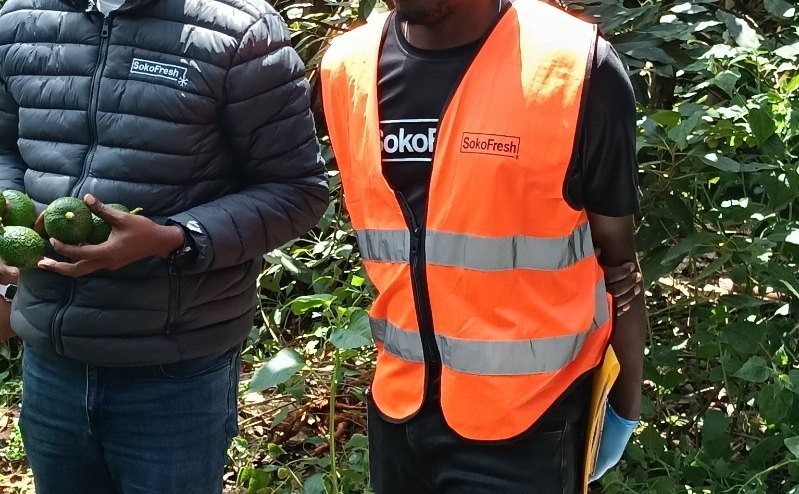
 Ejidio Mburu, the senior export operator from SokoFresh says weighing and grading is done by a specialist /HANDOUT.
In the rolling hills of Murang’a county, a quiet agricultural shift is taking place.
Farmers are increasingly abandoning traditional farming ventures in favour of avocado cultivation, either as a standalone crop or intercropped with bananas, maize, beans and sweet potatoes.
The transition has been driven by rising global demand for avocados and a growing preference for Kenyan varieties in key European markets.
For John Ndotono, the decision to move away from dairy farming and invest in avocados has been one of the most rewarding choices he has made over the past decade.
Through support from supply chain managers, he says he has consistently produced high-quality fruit, with more than 90 per cent meeting export standards.
His 1.5-acre farm in Kiganjo, Gatundu South, has become a thriving avocado orchard.
“I have been in avocado farming for 10 years now. I started out in 2016 with 130 seedlings. Some dried up while others were stolen from the farm, but today I have about 92 trees that are consistently producing fruits suitable for export and the local market,” Ndotono says.
Avocado is considered a non-traditional export crop whose strong market demand presents significant opportunities for strengthening Kenya’s agricultural sector.
Smallholder farmers dominate production, accounting for about 85 per cent of all avocado growers in the country.
Kenya has established itself as a key supplier of avocados to the European Union, benefiting from a favourable production season and relatively competitive shipping costs compared with regional competitors such as South Africa.
Ndotono says he first learnt about avocado farming through the media and later purchased seedlings from Jomo Kenyatta University of Agriculture and Technology (JKUAT).
That decision marked the beginning of a journey he has never regretted.
“In my experience, avocado trees do not require much attention. This makes them a better option than many other crops. Additionally, demand for avocados remains consistently high in both local and international markets, making it easier to find buyers for mature fruits and significantly reducing the risk of losses,” he says.
 John Ndotono says transitioning from dairy
farming to avocado farming has been one of his best decisions in the past 10
years /HANDOUT.
John Ndotono says transitioning from dairy
farming to avocado farming has been one of his best decisions in the past 10
years /HANDOUT.
He is now focused on improving his farm further to ensure every harvested fruit meets export market requirements.
Ndotono notes the entry of sector players such as SokoFresh has played a major role in reducing post-harvest losses.
Since 2019, SokoFresh has supported smallholder avocado farmers through sustainable solar-powered cold storage facilities and direct market linkages.
The company’s services have enabled farmers to access premium export markets, receive instant payments and significantly reduce post-harvest losses.
SokoFresh senior export operator Ejidio Mburu says scouting, onboarding farmers and grading produce are critical steps in ensuring farmers receive adequate support and their fruits are harvested at the right time.
Once the groundwork has been completed, he says, the company works closely with farmers to ensure fruits are harvested, graded, weighed and packaged safely for sale and export.
Farmers are then paid promptly through a digital platform after delivery.
“To ensure we reach as many farmers as possible, we recruit agents from different areas. These agents are also avocado farmers and help us recruit farmers around them. After recruitment, we train farmers on quality control, good agricultural practices and harvest coordination. This helps them maintain high-quality standards,” Mburu says.
“After training, we also conduct scouting visits to identify the quality and varieties of avocados available on each farm. We then develop a harvest plan to ensure proper coordination and make sure we reach all farmers. Before harvesting and before any fruit is taken, we always agree with the farmer on the price.”
For Lucy Mumbi, avocado farming has exceeded expectations.
She says her 1.5-acre farm, which hosts 21 avocado trees, has benefited greatly from improved access to reliable markets.
“SokoFresh has been helpful in enabling us to sell avocados without any problems. Previously, I struggled with brokers who would sometimes harvest the fruits and disappear," Mumbi says.
"This caused significant and unnecessary losses. They have taught us better farming techniques and made it possible to sell our harvest and receive payment on time.”
According to the United States Department of Agriculture (USDA), Kenya produced 633,000 tonnes of avocados in 2023, making it the world’s sixth-largest producer and Africa’s leading exporter by volume. The country ranked second on the continent in export value after South Africa.
Export volumes increased from 103,254 tonnes in 2022 to 122,581 metric tonnes in 2023, a figure expected to rise further as more farmers embrace avocado farming.
Key export destinations in 2024 included the Netherlands (32 per cent), the United Arab Emirates (16 per cent), Spain (13 per cent), France (11 per cent) and Germany (seven per cent).
Despite the sector’s growth, Mburu says several challenges continue to limit the ability of smallholder farmers to fully benefit from Kenya’s strong market position.
“The high percentage of avocado farmers operating on less than one acre makes aggregation, certification, compliance and quality control difficult to organise at scale,” he says.
Research by the International Food Policy Research Institute (IFPRI) shows smallholder farmers continue to grapple with high harvesting and transport costs, financial constraints, delayed payments, limited access to training and credit and poor rural road networks.
While Kenya possesses the market demand, favourable agro-ecological conditions and a large farmer base needed to expand the sector, supply chain inefficiencies continue to prevent many producers from translating their harvests into reliable, higher-value export earnings.