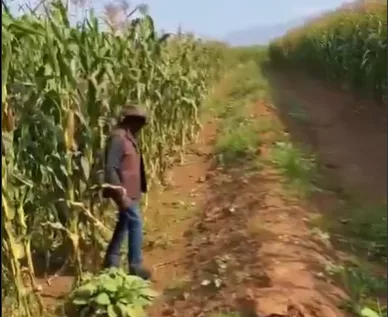
How Taveta residents turned dryland into cash cow by farming groundnuts
Small scale farmers have embraced the drought tolerant crops, thus beating the harsh weather.
by The Star
Audio By Vocalize
Penninah Muinde attends to her 5 acre groundnuts farm at Mokine, Taveta Sub County. She is among tens of small scale farmers in the region who have ventured into nut farming
In a random stop over at the Voi bus park in Taita Taveta County, along the busy Nairobi/Mombasa highway, you will be welcomed by dozens of groundnuts-hawking men and women.
What you do not know is that, the appetizing ‘njugu karanga’ (roasted groundnuts) as they call them are produced by local farmers in the region.
The region is slowly taking up farming of the nuts from the western part of the country that has over the years been known for producing groundnuts for both domestic and commercial use.
Mercy Kagwiria ventured into groundnut farming three years ago and has been raking a good fortune out of it.
The nuts, one of the high-value crops in Kenya, are suitable for tropical climates and do well in arid and semi-arid areas.
Tucked in the semi-arid slopes of Mt. Kilimanjaro, the Mokine village in Taveta SubCounty is characterized by long dry spells and scorching sun.
Despite being close to Kilimanjaro, the area lies on the leeward side thus experiencing low rainfall.
However, small-scale farmers can still smile all the way to the bank, thanks to their new farming techniques that have enabled them to boost production amid the advancing effects of climate change.
The majority of farmers have embraced drought-tolerant crops, thus being able to beat the harsh weather conditions.
“No maize can withstand the long dry spells. The last time we had a good rain season was in 2019. We are now planting groundnuts, sorghum, millet and green grams,” says Kagwiria.
The high-yielding crops, she said, can survive low rainfall and only require little water for irrigation during the low season.
Harvest
When maize farming failed in the area close to a decade ago, Kagwiria, just like other hundreds of farmers in the area turned to drought-resistant crops to curb the recurring losses.
They are majorly planting the Ndovu variety (Egerton II) groundnuts that mature early.
The variety was developed and improved by Egerton University, hence the name Egerton II.
It is the most preferred variety in the area due to its high yields. It matures in 85 – 100 days.
Kagwiria says in a good season, she can harvest more than 26 tons of nuts from her 15-acre farm. In optimum performance, an acre can produce up to 1.5 tons of nuts.
“The ndovu variety is more productive compared to other groundnut varieties. It is slowly becoming our new cash crop since it is easier to produce,” she said.
She is among more than 5,000 farmers in the region who underwent training in good agriculture practices.
The training by USAID through the International Crops Research Institute for the Semi-Arid Tropics (ICRISAT) has been lauded for the bumper harvest.
Like Kagwiria, Peninnah Muinde got interested in farming the nuts after the 2019 training that lured hundreds of small-scale farmers to join the venture.
“At first, I grew groundnuts in just 1.5 acres of my land and harvested close to two tons. Since then I have been planting nuts on my entire 5-acre farm,” the mother of two said.
She said many farmers were amazed by how the new nut variety could survive under the harsh weather conditions in an area that would grow nearly nothing meaningful.
Over-reliance on rain-fed crops, Muinde said, contributed to acute hunger in the area, noting that residents are turning to drought-tolerant crops through the help of agricultural extension officers.
Taita Taveta Nafaka Farmers’ Cooperative (Tanafaco) chairman Peter Munyi during an interview with the Star at a groundnuts farm in Mokine on June 25
Peter Munyi, the chairperson of Taita Taveta Nafaka Farmers’ Cooperative (Tanafaco), the apex farmer producer organization, said the society has recorded increased production since 2019.
The number of farmers producing the nuts and sorghum has ballooned from 26 farmers to 2,983 signalling a significant boost in food security.
Further, they are projecting to reach another 7,500 farmers in the next three years.
“So many farmers are now expressing interest in joining the cooperative society because of the support the small-scale farmers are getting to produce the drought-tolerant crops,” Munyi said.
He said the strategy is to encourage as many farmers as possible to move away from indigenous crop farming and instead embrace best agricultural practices by growing drought-resistant crops.
Market
Owing to the increased production, the farmers are equally smiling to the market thanks to a number of links both locally and internationally.
According to Munyi, just like Kangwiria and Muinde, tens of farmers were attracted to start growing groundnuts because of the guaranteed market and better prices
He said Tanafaco has played a key role in seed procurement, local seed production, and marketing of farmers' produce.
“We are the bridge linking the farmers and researchers, seed producers and buyers. So far we have broken the ceiling in terms of reaching the market,” Munyi said while inspecting his 10 acre seed production farm at Kasaani Village.
The farmers are on Sh18 million deal with Upfield Company that produces the blue band peanut butter.
In the supply deal, Munyi said they are required to supply 100 tonnes of groundnut which is equivalent to 100,000 kilograms. The multi-million deal is in a pilot stage and shall be extended upon meeting the required demand.
“Currently Upfield is our main groundnut buyer. One Kilogram of groundnuts is sold at Sh 87 and one acre produces one ton. This is a good deal because a farmer gets around Sh 80,000 per acre,” he said.
Following the production of high-quality groundnuts, Munyi said the company has set Taita Taveta farmers as their main supplier and has since halted the importation of nuts.
“Initially the company was importing groundnuts from Argentina and India for their peanut butter. Taita is now proudly producing nuts for the company. It is a success story for small-scale farmers from such a dry area,” he said.
Their biggest sale however came in 2018 and 2019 when the society was contracted by USAID to grow sorghum for export to hunger-stricken West African countries.
It is through this multimillion-dollar deal to supply tons of sorghum that awakened the farmers from self-pity and decided to unlock their agriculture potential.
“It was a short-term deal but it made a great impact on farmers. Many of them got capital to start commercial farming of sorghum and groundnuts,” he said.
After the expiration of the export deal, Tanafaco entered into another contract to supply sorghum to East African Breweries. The deal has given a lifeline to tens of sorghum farmers within the cooperative.
Food safety
While many farmers might salivate for the lucrative farm produce supply deals, high-quality standards of production must be observed, says Dr Ganga Rao, a scientist at ICRESAT and a value chain manager at the Accelerated Institutional and Food Systems Development (AIFSD) project.
Rao lauded the farmers’ society for keeping good records of producers, from planting to harvesting thus being able to trace the source.
“They have a bigger role to play in enhancing the best practices in production. We are trying to promote a value chain approach by starting from planting to post-harvesting handling and finally marketing,” he said.
Through the ICRESAT project, Rao said farmers are facilitated to access good quality seeds through the country-led seed system.
He said a past study has revealed that the region is suitable for groundnuts, although many farmers are not much informed on groundnuts cultivation practices.
“There is a great potential of changing this region into Kenya’s leading producer of nuts. This will not only attract investors but also improve the nutrition through household consumption,” Rao said.
ICRESAT scientist Dr. Ganga Rao inspects some of the groundnuts at a farm in Mokine village, Taita Taveta County. He said high quality standards of production must be observed
To maintain food safety, farmers have further integrated the use of a digital extension system that enables agricultural extension officers to reach out to a large number of farmers through the support of the Kenya Plant Health Inspectorate Service (KEPHIS) and other stakeholders.
For the Tanafaco contracted farmers, Munyi says traceability starts by identifying good seed breeders. Farmers then carry out a soil testing exercise to determine the suitability of their farms.
“Our biggest challenge is aflatoxin and proper soil testing is key in fighting it. Any contaminated produce will automatically be rejected by the buyer,” Munyi said.
Agronomist Michael Wasike advises farmers to apply aflasafe- a very effective natural product for minimizing aflatoxin contamination in groundnuts and sorghum.
“When the chemical is applied in the field at the right time, it is able to displace toxin-producing fungus and therefore making the crop safe from aflatoxin,” Wasike said.
Aflatoxin, Wasike said, is among the main challenges facing many farmers across the country, further derailing the fight against hunger.
Wasike who doubles as farm manager at one of Tanafako’s seed production farms at Mokine said farmers are assisted by the Kenya Agricultural and Livestock Research Organization (KALRO) to access and apply aflasafe.
He however said repeated tests have shown that soil in the region has low aflatoxin making it suitable for groundnut production.
“Spraying with the right insecticides, timely harvesting, field sanitation and proper storage are recommended for the best quality of nuts,'' he said.
Besides commercial use, Rao says growing nuts is an important stride in fighting malnutrition due to its high protein content.
“We are trying to promote the nut to as many farmers as possible because the proteins and essential fat acids are of great nutritional value,” Rao said.
At least 165 acres in the county have so far been put under the cover of groundnut, according to Davis Mwangoma, the County Executive for Agriculture, Livestock and Fisheries.
Growing nuts, he said, is one of the key pillars of the county’s economy, having lifted hundreds of farmers out of poverty.
He said the department is projecting to double the acreage under nuts to 350 acres, further urging the youth to embrace farming as a source of income.
He said the agricultural-rich region has the ability to feed the Coastal region if the potential is fully exploited.
WATCH: The latest videos from the Star
This is premium content
Subscribe to Continue Reading
Help us continue bringing you unbiased news, in-depth investigations, and diverse perspectives. Your subscription keeps our mission alive and empowers us to provide high-quality, trustworthy journalism. Join us today to make a difference!