Refugees and IDPs across Africa generate an estimated 27 billion dollars (about Sh3.5 trillion) in annual income, pointing to a huge potential for host communities and governments.
A new report by the Amahoro Coalition shows refugees
and internally displaced persons are rebuilding their lives, starting
businesses and farming lands to create value for themselves and their
communities.
The report “Hiding in Plain Sight: Africa’s $27B Displacement Market Opportunity” documents the economic scale of displacement across Africa and the commercial case for private sector investment in the affected communities.
The central finding shows that Africa’s displaced population generates income that is equal to the size of GDPs of many countries.
Amahoro Coalition, a private-sector platform that drives job creation and funding for forcibly displaced people, says in its report that this population manages to generate that income with no banking sector, formal retail chains and no structured access to credit.
“Africa’s displaced communities are not waiting for rescue. They are running businesses, farming land, and moving goods across borders with almost none of the financial infrastructure available to everyone else. That gap is where the opportunity is,” says Tito Mbathi, head of partnerships at Amahoro Coalition.
The report released in Kampala, Uganda last week, documented refugees and internally displaced persons in Kenya, Uganda, Tanzania, Rwanda, Chad, Ghana, Mali, Nigeria among others.
The report mapped the investment potential across five sectors of entrepreneurship, agriculture, finance, supply chain, and manufacturing, with primary data, market sizing, and case studies drawn from working models already generating commercial returns.
The coalition said discussions about displaced populations across Africa often centre on what has been lost in homes, livelihoods and stability.
The crisis is measured in numbers that capture absence rather than presence. What is far less visible is what displaced communities are building in the wake of that loss, Mbathi said.
In Kenya, the research focused on refugees in Kakuma,
Turkana county and at the Dadaab camp in Garissa county.
It examined opportunities available and found that most constraints are structural rather than inherent. For instance, most refugees are denied financial services because they lack documentation.
When financial institutions deny services due to documentation requirements, space emerges for adapted financial models. When supply chains bypass concentrated settlement markets, opportunities arise for new distribution networks,” Amahoro Coalition's overseer Isaac Kaku Fokuo Jr said.
Already, the coalition had partnered with DFCU Bank in Uganda to translate the report’s findings into concrete financial products and pathways for displaced entrepreneurs across the country.
With more than 43 million refugees and displaced people across the continent, Amahoro urges private sector players to tap into the opportunities presented by these populations for economic development.
“This research challenges prevailing perceptions of displacement. Behind humanitarian statistics are viable customers, capable workers and innovative entrepreneurs. The question is whether the private sector is ready to recognise what has long existed,” Fokuo added.
Established in 2019, Amahoro Coalition has become the leading convener of African private sector leaders for social impact, providing tailored solutions to the private sector to enable them tap into the African demographic dividend, including in vulnerable settings like displaced communities.
The report found out that Africa’s displaced populations constitute a major economic ecosystem with its 8.8 million internally displaced persons earning an estimated $22.1 billion (about Sh2.9 trillion) a year.
Refugees generate $5.6 billion (about Sh725 billion) a year in a displaced economy that is comparable in size to the Gross Domestic Product of many countries.
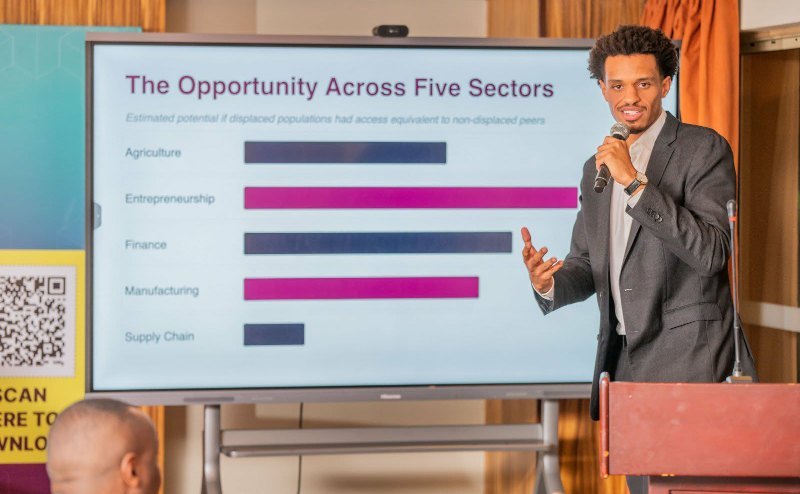 Tito Mbathi, the head of partnerships at Amahoro Coalition, explains the research findings during the release of the report in Kampala, Uganda on June 18, 2026 /HANDOUT
In Kenya, refugees are split between urban integration and camp-based settlements, creating different market opportunities. Urban refugees integrate into existing city economies, accessing traditional labour markets and participating in commerce.
“These inflows create vibrant new centres, such as Eastleigh in Nairobi, which has been transformed by Somali refugees into one of East Africa’s top commercial hubs,” the report notes.
It noted that most refugees in the area have integrated more seamlessly into host communities as they do not have much constraints. “This reduces visibility while creating fewer distinct market opportunities.”
For camp-based settlements like Kakuma and Dadaab, the study found that refugee camps function as concentrated economic nodes, where populations averaging 15,000+ people create market densities comparable to small cities.
“The larger camps have populations greater than 300,000, where estimates suggest more than $100 million (about Sh13 billion) is generated in economic activity,” the report states.
It says camp settlements collectively hold an estimated $400 million (about 51.8 billion) in accumulated wealth while generating $2.2 billion (Sh285 billion) with an entrepreneurship rate of 12 per cent.
Communities around displaced populations benefit from surging food demand, with Ethiopian host communities adding 15.9 per cent to livestock sales on every one per cent increase in refugee numbers, while hosts within 10km of Kakuma camp are earning 25 per cent more due to extra food sales.
A single refugee camp creates sufficient customer
volume to support all manner of business services.
As such, customer acquisition costs drop compared to dispersed rural markets due to geographic concentration and community network effects.
Predictable demand patterns enable inventory optimisation and working capital efficiency which proves particularly valuable for businesses serving lower-income markets where demand volatility can constrain commercial viability.
Another key finding of the research is that displaced populations build sophisticated cross-border logistics without institutional support meaning formalisation partnerships could multiply existing capabilities.
For instance, entrepreneurial networks in Dadaab operate massive informal cross-border logistics operations, taking advantage of the market gap created by insecurity to transport goods across Kenya and Somalia.
“The organisation logistics around kinship relationships rather than contracts, enabling cross-border operations with many transactions on informal credit.”
It was established that the refugees and their kin often use real-time mobile intelligence to navigate security threats, dynamically redirecting through alternative routes when formal systems fail.
This has enabled trade, especially in livestock, with markets on both Kenya and Somali sides. They employ hybrid transportation systems that combine traditional methods like livestock trekking with modern trucking.
“Informal logistics transaction volumes are larger than many formal logistics companies, with operations spanning Kenya, Somalia, Ethiopia, Uganda, even extending to the Middle East.”
Some banks in Nairobi’s Eastleigh neighbourhood which is the Kenya’s Somali hub have over $20 million (about Sh2.6 billion) in daily cash flows.
The report says the total annual additional income generated in the cross-border livestock marketing chain in Somalia’s Berbera and Bosasso marketing corridors alone are estimated at $150 million (Sh19.5 billion).