This is expected to provide a major boost to the country's investment in clean energy, digital transformation, agriculture, skills development and private sector growth.
The funding was announced following the conclusion of the Kenya–Germany Biennial Government-to-Government Negotiations on Development Cooperation held in Berlin, where the two countries reaffirmed their long-standing economic and development partnership.
National Treasury Principal Secretary Chris Kiptoo said the new technical and financial cooperation package will finance priority programmes aimed at accelerating Kenya's economic transformation while strengthening resilience against climate change.
The funds, he said, will support initiatives in private sector development, trade and investment, digital transformation, technical and vocational education and training (TVET).
It will also support activities in labour mobility, renewable energy, e-mobility, climate action, irrigation, climate-smart agriculture, food systems and good governance.
Germany further indicated that it is considering an additional Sh4 billion financing package for Kenya's energy sector, with a decision expected in the coming weeks.
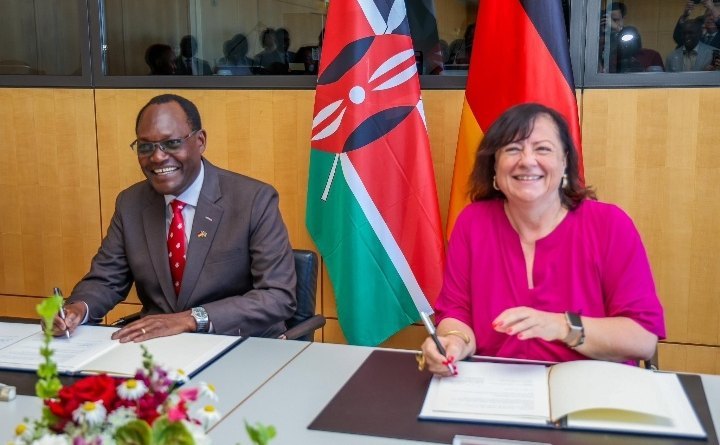
The financing agreement was formalised after Kiptoo and Germany's Parliamentary State Secretary at the Federal Ministry for Economic Cooperation and Development (BMZ), Bärbel Kofler, signed the summary record marking the close of the bilateral negotiations.
Kiptoo described the outcome as a significant milestone in the two countries' development partnership, saying the latest financing would help Kenya implement programmes that promote sustainable economic growth while creating jobs and improving livelihoods.
"We appreciate the Government of Germany for its commitment of Sh7.8 billion in new Technical and Financial Cooperation for the period 2026–2028 to support priority programmes in private sector development," Kiptoo said.
Beyond the financing package, the two governments agreed to deepen collaboration in several strategic sectors expected to unlock greater investment and trade opportunities.
Among the key areas identified were agribusiness and improved market access for Kenyan products, expansion of labour mobility programmes through technical skills development and language training.
Others are digitalisation, innovation, renewable energy, e-mobility, financial technology, investment promotion, public procurement opportunities and the fast-growing Business Process Outsourcing (BPO) industry.
Kiptoo said Kenya will continue addressing regulatory, logistical and market access challenges that have limited trade and investment in order to fully exploit the opportunities identified during the talks.
The negotiations also reflected the growing commercial ties between the two countries.
Kenya's exports to Germany have risen by more than 73 per cent over the last four years, increasing from about Sh26.2 billion ($203 million) in 2021 to Sh45.4 billion ($352 million) in 2025.
Germany remains one of Kenya's leading European trading partners, importing cut flowers, coffee and other horticultural products while supplying machinery, industrial equipment and technology to the Kenyan market.
The growing relationship was further underscored during the Kenya–Germany Business Day held in Berlin ahead of the negotiations, where government officials and private sector players explored new investment opportunities.
Several Memoranda of Understanding were signed during the forum.
They cover digital skills development, manufacturing, renewable energy, climate-smart agriculture, digital innovation, energy storage and job creation, laying the groundwork for increased private sector collaboration.
The Kenyan delegation was led by Investments, Trade and Industry Cabinet Secretary Lee Kinyanjui and included senior principal secretaries from the Trade, ICT and Irrigation ministries.
They held discussions with German officials led by Parliamentary State Secretaries Stefan Rouenhoff and Dr Bärbel Kofler.
According to the National Treasury, more than 120 German companies currently operate in Kenya, many using Nairobi as their regional base for Sub-Saharan Africa, highlighting Kenya's strategic position as a gateway for investment into the region.
The latest agreement builds on decades of development cooperation between the two countries.
Since bilateral development cooperation began in the 1960s, Germany has supported Kenya through successive financial and technical cooperation packages targeting social and economic growth.
The Berlin negotiations also build on the previous round of government consultations held in Nairobi in November 2024 and subsequent high-level engagements between the two governments.