County governments
devoted almost half of their wage bill to paying salaries and allowances for health
sector alone as the devolved units struggle to bear the weight of devolved health services.
A new report by
the Controller of Budget (CoB) shows that for the 2024-25 financial year
counties spent Sh220.64 billion on employee compensation, which is about 64 per
cent of total recurrent expenditure.
Of the wage bill,
the health sector absorbed the largest portion of 44 per cent, equivalent to
nearly Sh97 billion.
This even as community
health workers across the devolved units continue to gobble up hundreds of millions
using manual payrolls.
The total wage
bill is nearly double the constitutionally accepted threshold by the Public
Finance Management (PFM) regulations, which require counties to spend no more
than 35 per cent of their revenues on wages.
With only eight
out of 47 governments having complied, Controller of Budget is now raising
issue with the trend warning that such high personnel spending is squeezing
funds meant for development and the settlement of pending bills.
“The expenditure
landscape reveals excessive spending on employee compensation, with only eight
Counties staying within the 35 per cent regulatory ceiling. Furthermore, the
health sector's wage bill accounts for 44 per cent of total expenditures,
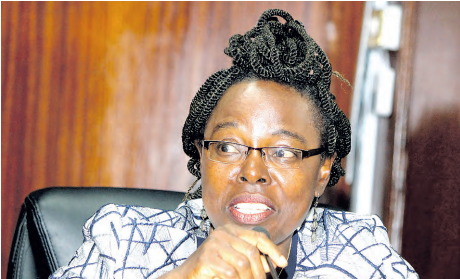
raising concerns about financial management,” Controller of Budget Margaret
Nyakang’o noted in the report.
Nairobi which runs the largest workforce, topped as one of the biggest
spenders on compensation, alongside Kiambu, Machakos and Nakuru.
Nairobi’s huge
health workforce, inherited from the now-defunct Nairobi Metropolitan Service
and previous administrations, continues to exert pressure on its budget.
The controller of
budget data shows that Sh353 million was paid using manual payroll, with Community
Health Workers talking home Sh195.5 million of this.
West Pokot County
ranked second with Sh72.69 million, followed by Uasin Gishu at Sh59.35 million,
Siaya at Sh51.05 million and Kirinyaga at Sh31.97 million.
The allocations
however, reflect growing recognition of CHWs as an essential link between
households and the formal health system.
Their roles
include disease surveillance, preventive care, maternal and child health
support, and easing the burden on overstretched hospitals.
In Machakos,
employee costs crowded out development spending, with the county recording one
of the lowest development absorption rates at 41 per cent.
Similarly, Kiambu
County reported high salary obligations while still carrying a heavy load of
pending bills worth Sh7.89 billion.
The
disproportionate health wage bill was attributed to the devolved nature of the
sector, which brought tens of thousands of nurses, doctors, and support staff
under county payrolls.
Counties like
Meru, Kericho, and Narok spent heavily on healthcare staff, with health wages
consuming well over 40 per cent of their total personnel budgets.
On the other end,
counties such as Nandi, Trans Nzoia, and West Pokot managed to keep their
personnel expenditure in check relative to their revenues.
Nandi, which
recorded the highest budget absorption rate at 98 per cent, balanced its books
more prudently by prioritising development and containing recurrent expenses.
According to the
CoB Elgeyo Marakwet also kept a relatively lean wage bill, despite challenges
in revenue mobilisation.
Overall, county
governments spent Sh346.98 billion on recurrent expenditure, nearly three times
the Sh123.76 billion allocated to development.
As a result, 23
counties failed to meet the legal requirement of allocating at least 30 per
cent of their budgets to development.
The CoB cautioned
that unless wage bill growth is tamed, counties risk becoming payroll-centred
institutions rather than engines of development.
Pending bills
remain another casualty, with Nyakang’o pointing out that as of June 2025,
counties collectively owed suppliers and contractors Sh176.8 billion.
To ease the
pressure, the CoB recommends measures such as staff rationalisation, strict
adherence to the 35 per cent wage ceiling, and the adoption of innovative
financing for health services.
“Counties must
align their wage bills with legal requirements and prioritise sustainable
spending. Without reforms, service delivery and development will continue to
stagnate,” the report stated.
















![[PHOTOS] Ruto hosts Bungoma delegation at State House](https://cdn.radioafrica.digital/image/2026/07/38c18064-4bd7-4a52-9171-4dcce631a74b.webp)