

If you follow international news closely, then you will sooner or later come to the conclusion that just as some people really enjoy watching “a good horror movie”, so too do many in the West enjoy reading reports coming out of Africa, of the latest atrocities and disasters.
This is a logical conclusion insofar as you could argue that if there wasn’t a continuing demand for such TV entertainment – and likewise for such troubling news from poor nations – there would not be so much of it being produced on a regular basis.
As an example, consider the reporting by one of the world’s most celebrated journalists, the New York Times columnist, Nicholas Kristof.
There is no doubt that this man is something of a hero. About 20 years ago, and at a time when few people outside Sudan knew there was a place called Darfur, he took great risks to investigate and write about the genocide which was then ongoing in Darfur, shining a bright light on one of the darkest chapters of African history.
I also recall reading his reports on the trafficking of young women into prostitution in East Asia, some years back.
So, as I say, his great reputation is well deserved.
But then even the best of us have our flaws. And I have noticed that many of these famous foreign correspondents tend to be rather simplistic when covering these atrocity stories. At least when it comes to East Africa.
It is not so much that they exaggerate or present fake news as fact. That they rarely do. The problem lies more with their frame of reference – their predetermined ideas of the stories they set out to cover.
And so it was with Kristof’s coverage of the recent events flowing from the closing down of the United States Agency for International Development which for about six decades now, has been a key source of humanitarian interventions all over the world.
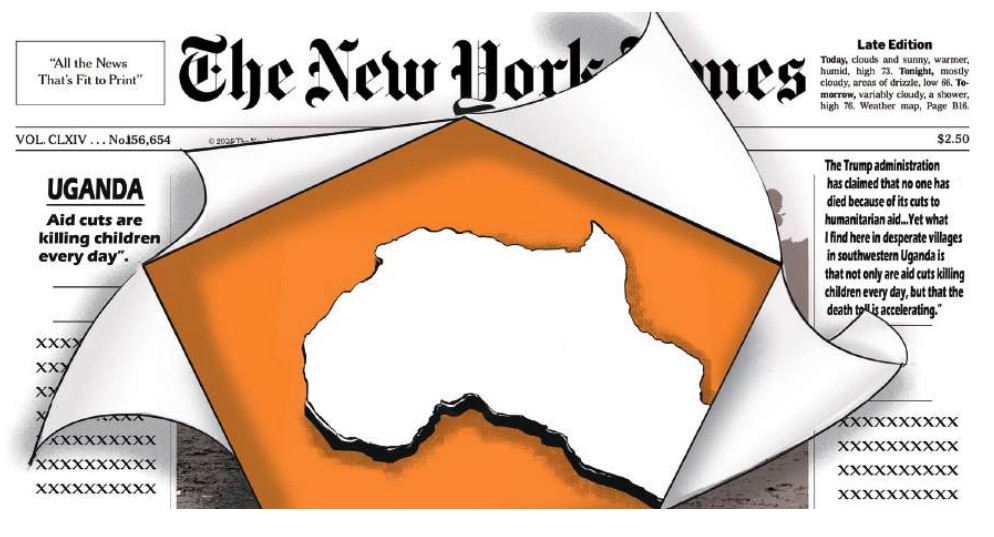
In an opinion column published on September 20, which is specified as having been reported “from Ramwanja Uganda”, under the headline “Trumps Most Lethal Policy”, Kristoff launched the following accusation:
“The Trump administration has claimed that no one has died because of its cuts to humanitarian aid…Yet what I find here in desperate villages in southwestern Uganda is that not only are aid cuts killing children every day, but that the death toll is accelerating.”
He then goes on to elaborate:
“Stockpiles of food and medicine are running out here. Village health workers who used to provide inexpensive preventive care have been laid off. Public health initiatives like deworming and vitamin A distribution have collapsed. Immunizations are being missed…because children are particularly vulnerable, they are often the first to starve and the first to die.”
All this must have provoked gasps of horror from his American readers – maybe even from ill-informed Kenyan readers.
But
what I think we need to weigh here is not the undeniable facts on the ground
about the devastation being caused by the collapse of the public health
infrastructure previously supported by USAID. Rather it is whether it is in any
way accurate for him to claim “aid cuts [are] killing children every day”.
Uganda is not a rich country. But it is also not a dysfunctional wasteland in which only emergency aid from the likes of USAID can provide what Kristof himself defines as “inexpensive preventive care”.
The Ugandan government is not as lacking in agency as Kristof’s reporting seems to suggest. It is eminently capable of stepping in and restoring the programmes, which USAID had previously supported.
Indeed, any responsible government, the moment that it became clear that USAID’s days were numbered, would immediately have engaged its own experts and consultants to do a critical assessment of those likely to be most affected by the withdrawal of USAID support. And following this, come up with emergency measures designed to ensure some degree of damage control.
The proper context of this story is that it reveals a failure of the Ugandan government’s public health policy, in its response to the US aid cuts.
And it is really quite absurd to declare “aid cuts [are] killing children every day”.