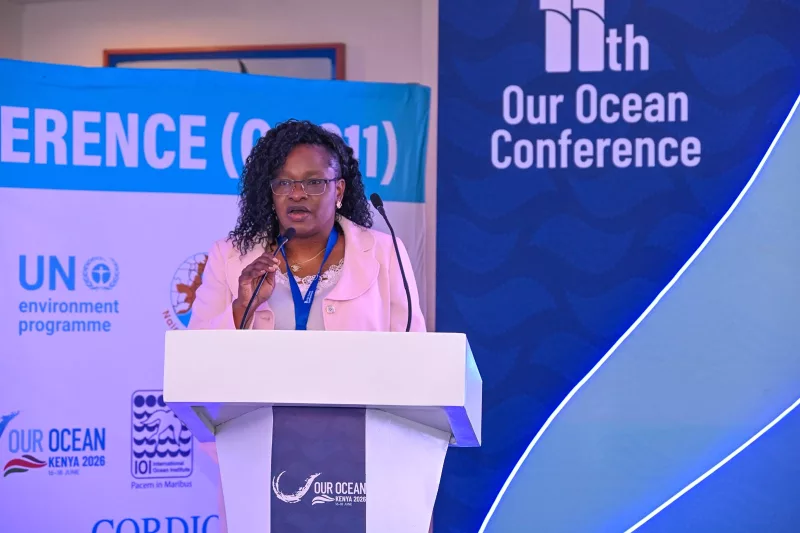
 East African Wildlife Society Executive Director Nancy Ogonje addresses delegates during the 11th Our Ocean Conference in Mombasa /HANDOUT
Global leaders meeting in Mombasa have pledged more than $6.4 billion (Sh828.9 billion) to strengthen marine conservation
They also unveiled over 320 new commitments, marking one of the most significant outcomes of the 11th annual Our Ocean Conference.
The commitments, announced at the high-level summit, are expected to accelerate efforts to combat illegal fishing, protect marine biodiversity and reduce ocean pollution
They are also expected to build climate resilience as countries grapple with mounting pressure on marine ecosystems.
The conference brought together heads of state, policymakers, development partners, conservation groups and private sector leaders, reaffirming a shared commitment to safeguarding the world's oceans, which support food security, trade and livelihoods for billions of people.
Among the key outcomes was the adoption of the Mombasa Declaration, which seeks to strengthen global cooperation against illegal, unreported and unregulated (IUU) fishing, a practice that continues to threaten fish stocks and undermine the livelihoods of coastal communities.
While the billions pledged and policy commitments represent a major boost for marine conservation, environmental experts say the true measure of success will depend on how effectively the commitments are translated into action on the ground.
According to Nancy Ogonje, executive director of the East African Wildlife Society (EAWLS), international environmental conferences have demonstrated their ability to develop ambitious global frameworks, but implementation often remains the weakest link.
"International environmental summits excel at drafting macro-level solutions, such as the newly adopted Mombasa Declaration aimed at curbing illegal, unreported, and unregulated fishing," she said.
"Yet,
a severe disconnect often exists between international negotiating tables and
the real-world realities of vulnerable coastal populations."
She argued that governments must move beyond policy pronouncements by placing civil society organizations and coastal communities at the centre of marine governance.
According to Ogonje, legislation alone cannot safeguard marine ecosystems or restore depleted fisheries without the active participation of communities whose livelihoods depend directly on ocean resources.
"For the Mombasa summit to be remembered as a genuine milestone rather than an exercise in performative diplomacy, the implementation phase must prioritize localized institutional support," she said.
She noted that empowering communities transforms conservation from an externally driven agenda into a locally owned responsibility.
In many coastal areas, civil society organizations serve as a critical bridge between governments and residents by monitoring the implementation of environmental policies.
They also track conservation funding and ensure accountability in the use of public resources.
At the same time, local communities possess generations of traditional ecological knowledge that can strengthen marine conservation programmes and improve the effectiveness of investments made through international partnerships.
Ogonje called for greater inclusion of women, youth and vulnerable groups in ocean governance, saying their lived experiences remain essential to protecting marine resources.
"We must be intentional about building platforms that elevate marginalized voices, especially those of women, youth and the vulnerable, to harness their invaluable knowledge and lived experiences," she said.
She also urged governments to strengthen legal awareness among coastal communities so they can better navigate environmental regulations and defend their marine resources.
"Only when local communities are active, well-funded and legally recognized partners will the tide truly turn in favor of marine preservation," she said.