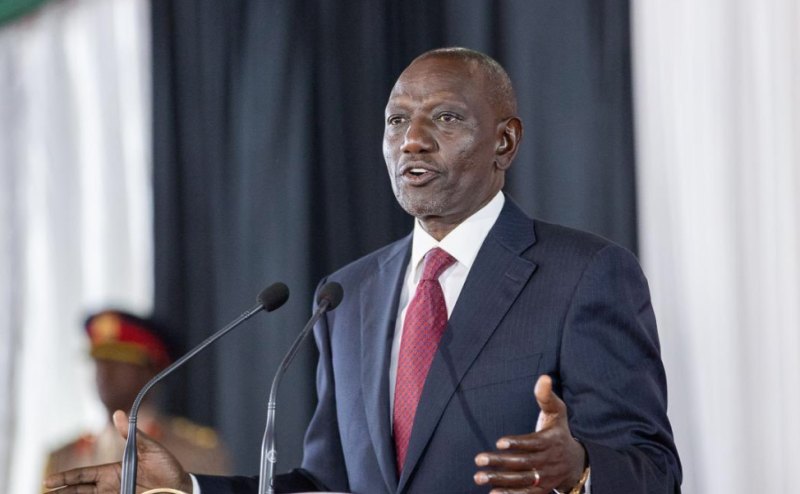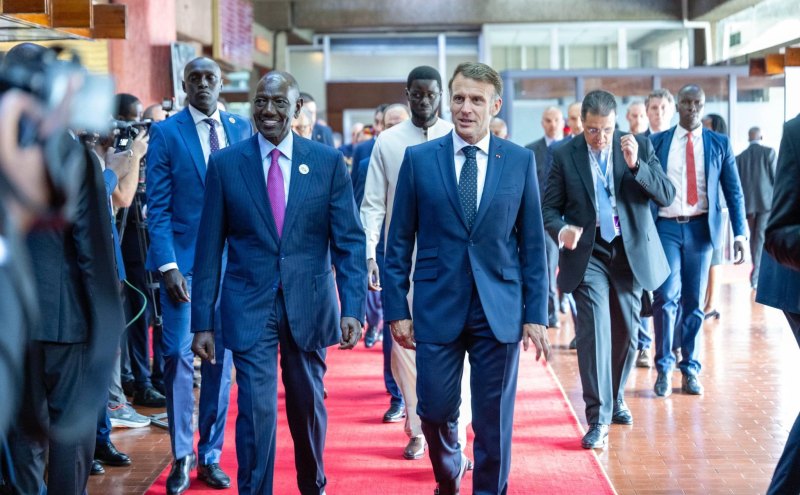
President William Ruto will is set for another significant moment on the global diplomatic stage as he joins leaders of the world’s most powerful economies at the G7 Summit starting today in Évian-les-Bains, France.
Kenya's head of state is expected to champion Africa’s concerns on debt, climate financing, trade, investment and reforms of the global financial system.
Ruto’s participation comes barely a month after he hosted French President Emmanuel Macron and several African leaders in Nairobi during the Africa Forward Summit.
The forum sought to strengthen ties between Africa and Europe while advancing discussions on sustainable development, investment and economic transformation.
The invitation to the G7 is widely viewed as recognition of Kenya’s growing diplomatic influence and its role as a bridge between Africa and the developed world.
The three day aummit, hosted by France from June 15 to 17, brings together leaders from the G7 countries — France, the United States, Germany, Italy, Japan, Canada and the United Kingdom — alongside invited partners including Kenya, India, Brazil and South Korea.
This year’s summit is taking place against the backdrop of mounting concerns over widening global economic imbalances.
French President Macron has made the issue the central theme of France’s G7 presidency, warning that persistent disparities in trade and current account balances among major economies could trigger financial instability and undermine global growth.
Current account balances measure the difference between what countries earn from exports of goods and services and what they spend on imports and other international transactions.
The growing gap between large surplus economies and heavily indebted deficit economies has become a major source of concern among policymakers.
For Africa, however, the debate extends beyond trade balances.
The continent is expected to use the summit to press for a fairer international financial architecture that addresses long-standing concerns over access to affordable financing, debt distress, climate adaptation funding and unequal representation in global economic institutions.
Ruto is expected to argue that while advanced economies focus on macroeconomic imbalances among themselves, developing nations continue to grapple with challenges that threaten their growth prospects and ability to achieve sustainable development goals.
Among Africa’s biggest concerns is the growing debt burden facing many developing countries.
Several African governments are spending a substantial portion of their revenues servicing debt, leaving limited resources for healthcare, education, infrastructure and job creation.
African leaders have repeatedly called for debt restructuring mechanisms that are faster, fairer and more responsive to the realities facing developing economies.
Climate financing is also expected to feature prominently in discussions.
Although the continent contribute only a small fraction of global greenhouse gas emissions, the region is among the most vulnerable to climate shocks such as droughts, floods and extreme weather events.
The continent has consistently pushed wealthy nations to honour commitments on climate funding and to support investments in renewable energy, resilience and adaptation programmes.
To this date, rich countries have not meet their 2009-2020 pledge to mobilize $100 billion annually for developing countries.
Under the Paris Agreement, wealthy economies committed to balancing funding between emissions reduction and climate adaptation.
However, the vast majority of developed nations allocate less than 50 per cent of their climate finance to adaptation, leaving vulnerable regions like the Horn of Africa struggling to manage droughts and extreme weather.
Rather than providing non-repayable grants, over 60 per cent of current climate finance is disbursed as loans.
This forces poor nations to finance their own climate resilience out of development budgets, severely worsening the regional debt crisis.
Trade and investment is another key pillar of Africa’s message in France.
African leaders who converged in Nairobi in April argued that development cannot be achieved through aid alone.
Instead, they are seeking greater investment in infrastructure, manufacturing, digital technologies and value-added industries that can create jobs for Africa’s rapidly growing population.
Kenya has been particularly vocal in advocating for reforms that would unlock private capital flows into developing economies while lowering the cost of borrowing.
These issues were also central to discussions at the recent Africa Forward Summit in Nairobi.
Addressing the forum today, Ruto is expected to press for reforms of global institutions such as the International Monetary Fund and the World Bank to provide developing countries with greater influence in decision-making processes.
Africa is concerned that institutions created after the Second World War no longer reflect the realities of the modern global economy, where emerging and developing countries account for an increasingly significant share of growth.
The continent wants a greater say in decisions that shape the global economy and affect billions of people beyond the G7 nations.
Speaking at the Africa Forward Summit, Ruto insisted that solutions to global challenges cannot succeed without meaningful participation from developing countries.
James Wamae, an international relations analyst says that as Ruto takes his seat among the world’s most influential leaders in France, he will carry not only Kenya’s aspirations but also the expectations of a continent.
"Africa is seeking a stronger voice in global governance and a fairer share of the opportunities offered by an increasingly interconnected world."Wamae told the Star
For Ruto, the invitation represents another opportunity to position Kenya as a leading African voice on global issues.
This is not the first time Kenya has been invited to participate in a G7 summit.
In 2024, Ruto attended the G7 Summit in Apulia, Italy, where he joined other invited leaders from Africa, Asia, the Middle East and Latin America in discussions on global security, migration, artificial intelligence, energy transition and economic development.
Kenya was among a select group of non-G7 countries invited by Italian Prime Minister Giorgia Meloni to contribute perspectives from the Global South.
During that summit, Ruto used the platform to advocate for stronger partnerships with Africa and highlighted the need for reforms in global financing structures to support sustainable development across the continent.
His return to the forum this year underscores Kenya’s increasing prominence in international diplomacy and its growing strategic relationship with France.
Analysts note that Paris sees Nairobi as a stable regional partner and an influential voice capable of articulating broader African priorities on the world stage.
Beyond economic discussions, this year’s summit is expected to address geopolitical tensions, including conflicts in Ukraine and the Middle East, alongside concerns about global supply chains, critical minerals and technological competition.