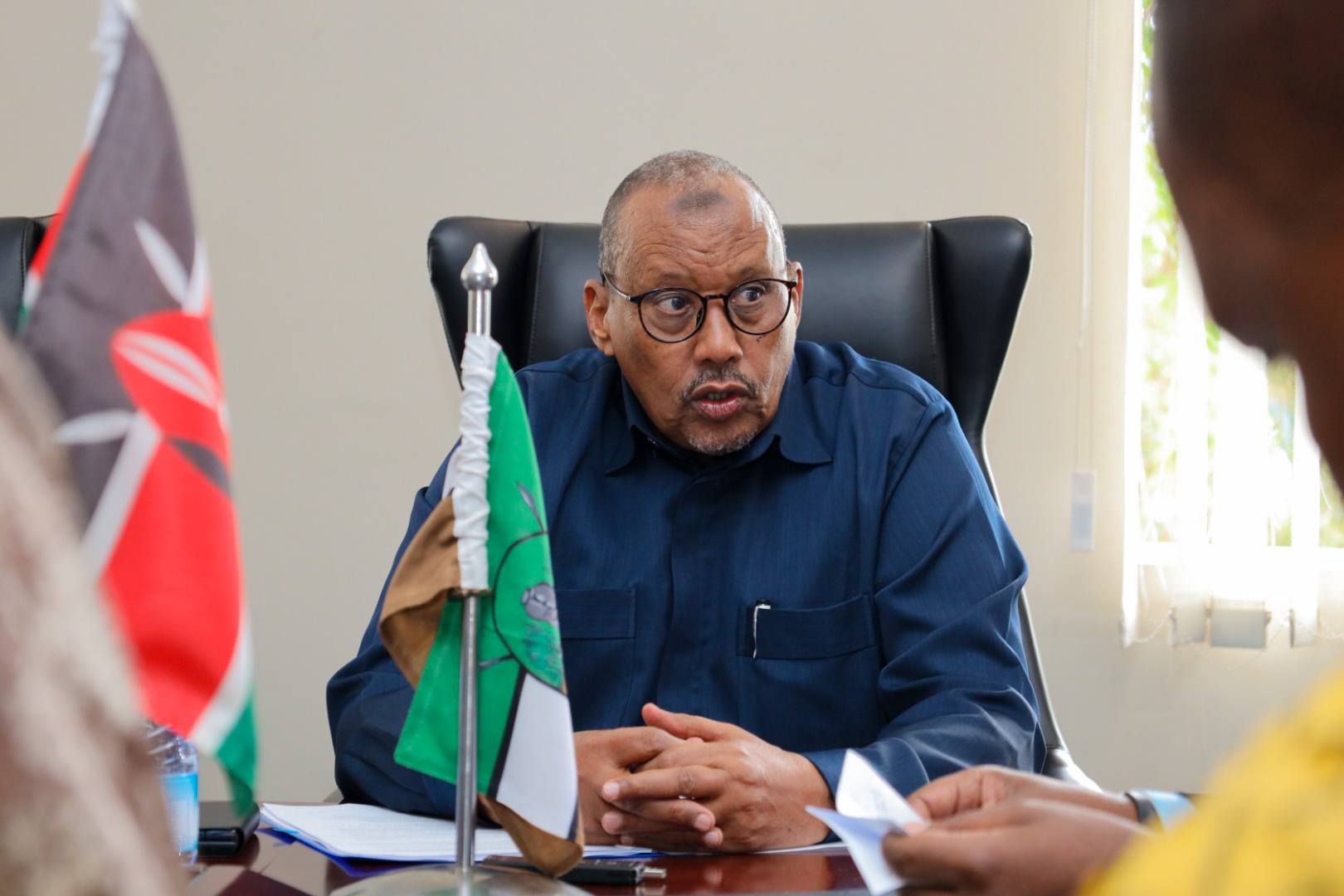
 Wajir Senator Mohamed Abass, who is also the chair of the Standing Committee on Devolution and Intergovernmental Relations/HANDOUT
Some of the state entities undertaking devolved functions should be re-designated as executive agencies and cleared to proceed with the roles under proposed government reforms, a Senate committee has proposed
The move follows an increase in the number of entities that have been undertaking the devolved roles, which require national coordination.
A brief prepared by the Standing Committee on Devolution and Intergovernmental Relations, chaired by Wajir Senator Mohamed Abass, is signalling a shift in how the State intends to manage institutions caught between national and county mandates in the post-devolution era.
Following a meeting with the Kenya Medical Supplies Authority (KEMSA), senators now want, several state corporations performing devolved functions to be restructured.
Under this classification, the parastatals will be tasked with delivering targeted public services on behalf of the national government, while operating in cooperation with counties.
“There may be a need to review KEMSA’s legal framework to reposition it as a joint national-county corporation, with balanced governance and financing aligned to devolved responsibilities,” the committee stated in the paper.
Under the proposed reforms, government-owned entities that continue to operate in devolved sectors such as water, roads and energy could be formally reclassified as executive agencies, rather than dissolved or handed over to counties entirely.
This would allow them to continue performing their current roles, but under an updated governance structure that reflects devolution.
The move responds to long-running tensions over overlapping mandates, duplication of roles, and financial disputes between national bodies and counties.
“Agencies like KEMSA supply products and services to counties, but operate under national direction, despite counties being responsible for local delivery,” said Abbas in the paper.
The committee notes that this situation has resulted in inefficiencies, jurisdictional conflict, and resource misalignment.
The reform push comes after the National and County Governments Coordinating Summit resolved in December 2024 that all remaining devolved functions would be transferred by mid-2025, with financing to follow.
However, the committee paper suggests that a complete handover may be impractical for certain entities due to economies of scale, technical expertise, or national strategic interest.
By recasting such organisations as executive agencies, the government would formalise a hybrid model that enables national oversight while preserving county autonomy.
The committee further suggests that some agencies be structured as joint ventures between the two levels of government, with shared representation on boards to enhance accountability and reflect the fact that counties are now the primary service delivery units.
KEMSA, which appeared before the Senate committee to defend its role, maintained that it performs a national function focused on procurement, quality assurance, and national stock reserves, not devolved service delivery.
It also disclosed that it is owed more than Sh4.5 billion by counties and county health facilities, affecting its order fulfilment rate, and appealed for Senate intervention to facilitate debt settlement.
The committee paper identifies this financial interdependence as further evidence of a governance mismatch, arguing that national funds are subsidising devolved roles indirectly, rather than resources flowing directly to counties as envisaged under Article 202 of the Constitution.
Following the recommendation, the Senate is expected to question KEMSA on how it intends to balance national and county interests, and whether it supports legal reforms that would see it transformed into an executive agency jointly governed by both levels of government.
The proposed restructuring is part of broader efforts to rationalise State corporations and complete the long-delayed devolution transition, which continues to affect service delivery and public expenditure across key sectors.
If adopted, the reforms would mark one of the most significant shifts in Kenya’s governance system since devolution was rolled out in 2013, potentially reshaping how public health, water, roads, and energy services are managed across the country.
![[PHOTOS] The new Ngong –Naivasha Road viaduct](https://cdn.radioafrica.digital/image/2026/06/64d4f771-4432-4aee-ba3c-2f304c4436ec.jpg)







![[PHOTOS] 'Mr Speaker Sir' Gen Z protester in court](https://cdn.radioafrica.digital/image/2026/06/b3e62d8e-25c3-4780-90f9-4eb48b1ce8a7.jpg)