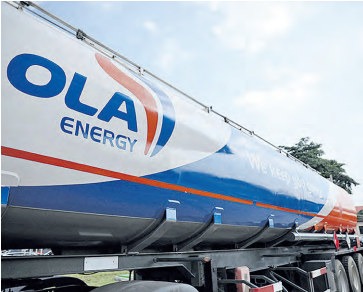
Ola Energy, the fourth largest oil
marketing company, said it has commenced restructuring of its local unit
in a move that would see some of its
employees declared redundant.
In a statement, the firm said that
it has found it difficult to sustain
its current fixed costs, pushing it
to embark on a “strategic business
restructuring process aimed at significantly enhancing its profitability
and market share in Kenya.”
Ola Energy, previously known as
Oil Libya, is Kenya’s fourth largest
oil marketing company (OMC), a
position it has retained for years.
It did not disclose how many staff
members would be affected, but said that the process would be “managed
with utmost sensitivity.”
In the Kenyan oil market, Vivo Energy leads with a 22.07 per cent share,
followed by TotalEnergies with 14.88
per cent and Rubis with 14.05 per
cent while Ola has 7.5 per cent.
Other
oil marketers hold a combined market share of 34.44 per cent.
It added that shareholders had
injected significant capital into the
business but this had “however not
yielded the expected returns”.
The firm joins the growing list of
companies that are opting to send
employees home in a bid to stay
afloat locally, with recent industry
data showing firms across different
sectors have shed off more than
5,000 jobs over the last three years.
Kenyans have been declared redundant from their workplaces over
the past three years, with the manufacturing sector bearing the brunt
of the job losses.
The firm, which has 112 petrol
stations across Kenya and 132 employees, said it had embarked on
a strategic business restructuring
aimed at “significantly enhancing
its profitability and market share in
Kenya over the next five years”.
The restructuring is expected to see
some of its employees lose their jobs.
“Ola Energy Kenya is finding it
difficult to sustain its current fixed
costs. It is, therefore, with deep regret,
that we need to implement a redundancy program,” said the firm in a
statement on Wednesday.
It added
that it started to implement a plan
that would push sales and cut costs.
“During the past year, Ola Energy Kenya initiated a rescue action
plan with several initiatives to turn
around the trajectory the company
was taking, including increasing
sales and reducing costs. Through
this restructuring, we are committed
to reversing the current trends and
positioning Ola Energy Kenya for
sustainable growth.”
The tough economic environment in the country has seen families reevaluate their budgets, with
the majority slowing down on their consumption of petroleum products,
with the usage of diesel and super
petrol having grown by a modest
one per cent in 2024.
Last week,
the Energy and Petroleum Regulatory Authority (Epra) announced it
would be increasing fuel prices as it
sought to give oil marketers and fuel
transporters higher margins.
The regulator said it would increase the cost of super petrol by
Sh7.80 per litre, diesel by Sh7.75 per
litre and kerosene by Sh7.67 per litre.
Epra noted that business costs
had increased but margins for the
industry had remained static for
years, posing a challenge for many
players, especially the small-sized
oil marketers and transporters.
The
regulator is seeking to adjust the
money earned by industry players
who cannot adjust prices to reflect
what Epra noted are realities of the
business environment due to the regulated nature of pump prices.
Epra said it would increase the
cost of super petrol by Sh7.80 per
litre, diesel by Sh7.75 per litre and
kerosene by Sh7.67 per litre.
Epra Director General Daniel
Kiptoo noted that a lot had changed
for the industry but margins had remained the same since 2018, when
the Authority last reviewed margins
for marketers and 2010.