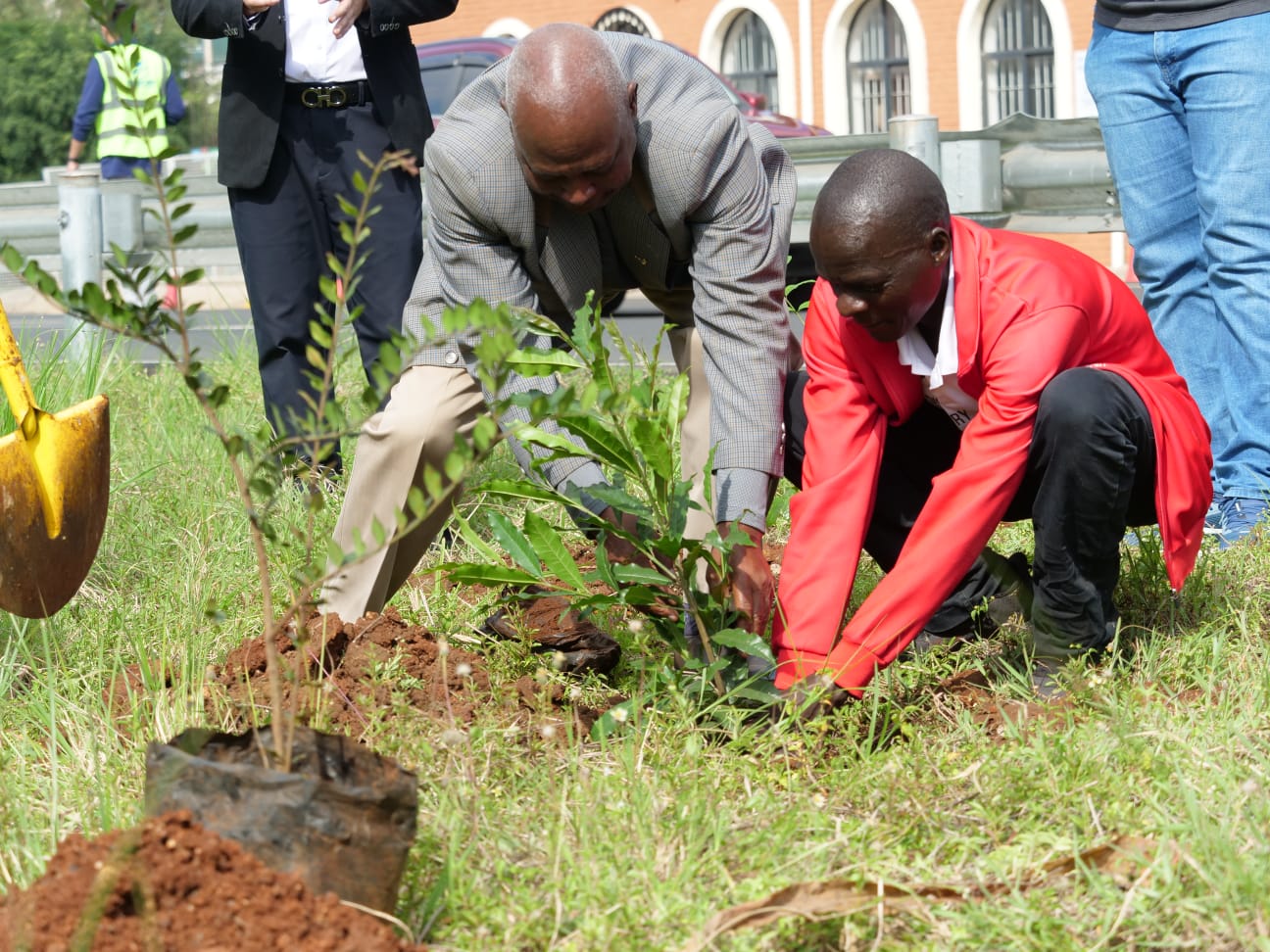
 AK President Jackson Tuwei plants a tree, assisted by support staff John Apidi/ HANDOUT
With just a day to the fifth edition of the Nairobi City Marathon, organisers have shifted part of the spotlight from the road to the environment, launching a dual-pronged climate initiative designed to deliver cleaner air for athletes and a greener future for the city.
The groundbreaking initiative was officially launched at the Haile Selassie Expressway terminal, where a high-level coalition of sports, science and infrastructure leaders converged to champion cleaner air and greener urban spaces ahead of one of Africa's premier road races.
Led by Athletics Kenya (AK) PresidentJackson Tuwei, the delegation took part in a symbolic tree-planting exercise, underscoring a growing partnership focused on combating urban air pollution while advancing Nairobi's green canopy agenda.
The ceremony brought together influential global and local stakeholders, including Dr Philip Osano, Chief Operating Officer of CIFOR (Centre for International Forestry Research)-ICRAF (International Centre for Research in Agroforestry), Yu Fukai, Chief Executive Officer of Moja Expressway Limited and Niall O'Connor, Centre Director of the Stockholm Environment Institute (SEI) Africa.
At the heart of this year's sustainability campaign is the strategic deployment of four specialised air quality monitoring sensors along the Nairobi Expressway, the iconic stretch of road that forms the competitive backbone of the marathon course.
Installed by the Stockholm Environment Institute (SEI) Africa in collaboration with Moja Expressway and AK, the sensors have been positioned at key locations along the route, including Jomo Kenyatta International Airport (JKIA), Uhuru Park, ABC Place in Westlands and Museum Road.
The cutting-edge technology is expected to generate critical data on air quality conditions, offering valuable insights for race organisers, athletes and environmental experts while helping safeguard the wellbeing of both elite competitors and recreational runners.
Lauding the partnership for delivering unprecedented, data-driven insights into the intersection of urban living and endurance sport, Tuwei emphasised that climate action transcends geographical boundaries.
"A good and clean environment has no boundaries, and we must work together as a team to achieve the common good on climate change and clean air," said Tuwei.
Beyond race day, organisers are also focused on creating a lasting environmental footprint through an extensive tree-planting programme. The initiative forms part of the Nairobi City Marathon's long-term sustainability blueprint, which targets the planting of 5,000 trees annually and positions the event as a year-round catalyst for urban forestry. "Greening of sporting venues is key, and we are also glad to help the Nairobi City Marathon in realising their dream of planting 5,000 trees annually," said Dr Osano.
O'Connor reiterated the importance of transparency and evidence-based environmental management, noting that accurate data remains essential in protecting both athletes and city residents. "We are happy to always assist Athletics Kenya in providing and installing the air quality sensors and helping in analysing the data," O'Connor said.




![[PHOTOS] Obado Leaves court in handcuffs](https://cdn.radioafrica.digital/image/2026/07/efc75d55-2eb9-4019-bb24-937dc4fc4f56.webp)