


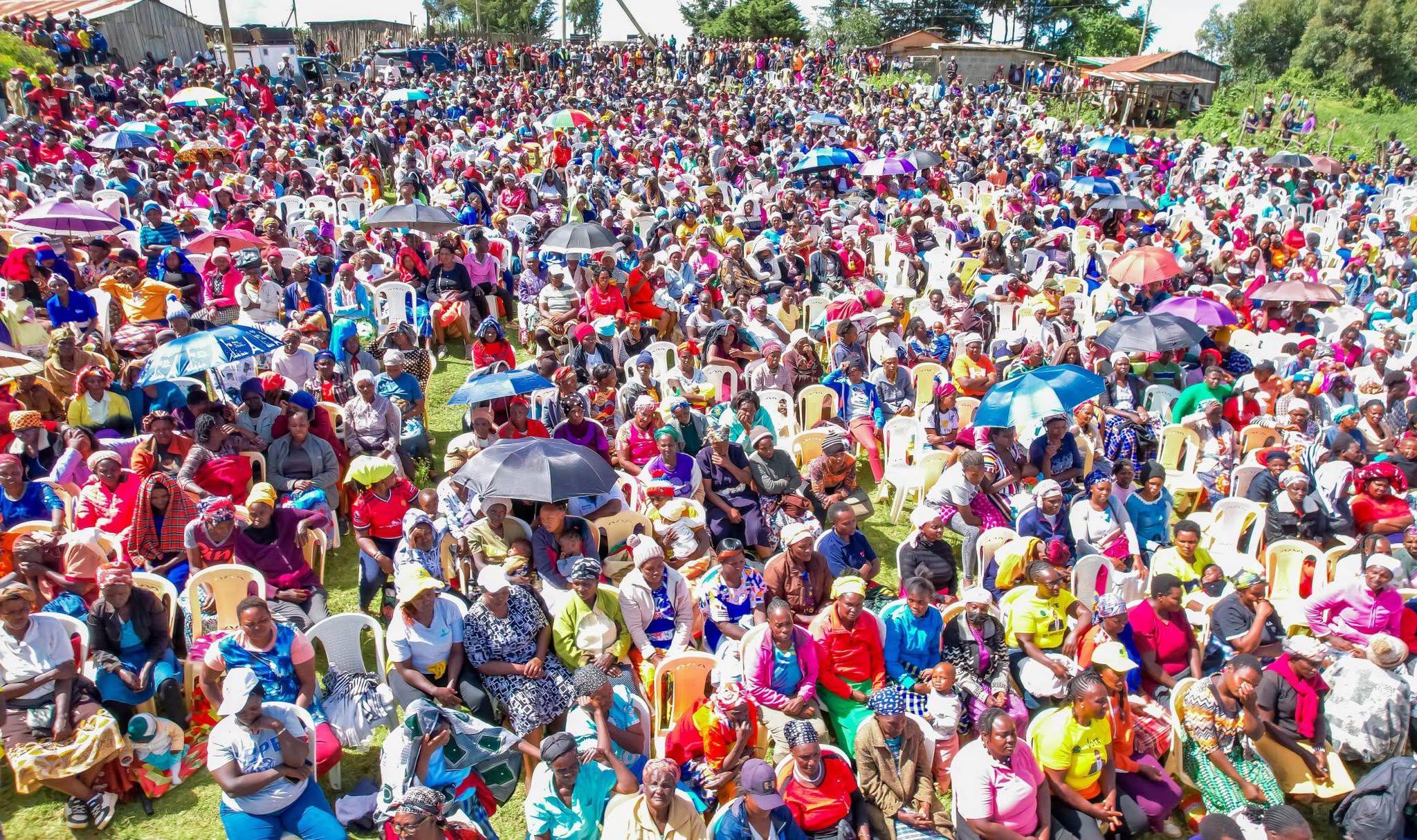
The reported remarks of Anne Nderitu, a member of the IEBC and former Registrar of Political Parties, were deeply depressing, as she spoke about distribution of goodies before Ol Kalou by-election.
What did she say?
Not every gift or government project launched during a campaign period is illegal. There is a difference between bribery and “treatment” of voters. The latter is not a crime. You cannot suspend development during an election campaign period.
“The people of Ol Kalou constituency who will vote on Tuesday deserve
the projects and benefits they have received from the government. It is
immaterial to argue otherwise,” Nderitu
said.
Some history
We owe the word “candidate” to ancient Rome: people standing for election wore togas specially whitened with chalk (symbolising “purity and the candidate's intention to serve the public”, says Brittanica). The toga was candida and the candidate “candidatus”. They also had voter bribery.
The range of possible incentives to voters to vote, or not to vote or vote in a particular way is enormous, of course. Bribery involves a deal. And the recipient, as well as the giver, commits the offence.
But going back to Roman times is also the possibility of gifts, especially food or drink, being given to voters more widely and not necessarily in return for any act or undertaking of theirs. Such a practice was recognised in England by the 17th century, and labelled “treating”. Law was passed against it, but not effectively until the mid-19th century. In an Act of 1854, providing or paying for “any meat, drink, entertainment, or provision to or for any person, in order to be elected, or for being elected, or for the purpose of corruptly influencing such person … shall be deemed guilty of the offence of treating.”
The Kenyan 2011 Elections Act was a descendant of that English law. It included as offences both bribery and treating.
Bribery (in brief) involved giving or promising money or something else of value to get someone to vote or not to vote for a particular candidate, or attending or not attending any political meeting or otherwise supporting or not supporting a political party or candidate.
“Treating” overlapped with that. It applied before or during an election. The behaviour included “pays, undertakes or promises to pay wholly or in part to or for any voter, expenses for giving or providing any food, drinks refreshment or provision of any money, ticket or other means or device to enable the procurement of any food, drink or refreshment or provision to or for any person for the purpose of corruptly influencing that person…” Sorry about the complex language - it is part of a 91-word sub-paragraph clearly taken from that old English law - including the word “provision” that no-one explains clearly.
In 2016 a major change took place in the Kenyan law. The part on offences disappeared from the Elections Act, and the Election Offences Act was passed. But treating did not appear in the new Act. Senator Kiraitu Murungi, one of the sponsors of the Bill, said, according to the Daily Nation, “In this country, you cannot win any election if you don’t meet your supporters and buy them refreshments.”
If no-one did this, would no-one be elected?
Describing this as “treatment of voters” has caused critical comment. The Oxford English Dictionary says calling this “treatment” is “obsolete” - but not apparently in Kenya.
“Treatment” tends to suggest maybe medical treatment, or the general way someone deals with other people or a particular person. The sort of behaviour we are talking about is usually called “treating” voters, using the word in the same sort of sense as when we say, “This is a real treat” or “she treated all the children to ice cream.” In other words, it’s about getting something pleasant.
Treating is usually thought of as involving refreshment - it is not clear that a gift of a mattress or a gas cylinder is “provision” and therefore “treating”, and a road or water project is clearly not.
The problem for IEBC
The Election Offences Act of 2016 also differs from the earlier Elections Act because it no longer allows the commission to arrest and prosecute people. That is the job of the DPP. It is like the position of the EACC ¾ it is felt not to be a good idea for the same body that identifies an offence and, it believes, an offender to be able to prosecute that person in court. Indeed, Kenya has taken that power away from the police. There is sense in this ¾ but it does mean that the IEBC, while not powerless, has only limited power to pursue criminal activity. When another IEBC commissioner says on TV that behaviour will be “dealt with according to the law”, they cannot guarantee that.
Does it matter?
After the Ol Kalou by-election some people have said things like: it doesn’t matter if this behaviour is a crime because clearly Kenyans are not affected by it. A rather unscientific conclusion from a single by-election. Clearly there was something else that voters attached more importance to. And yes - they realised what was being done, and chose not to be influenced. Should we be overjoyed that they chose to vote ethnically rather than in gratitude? And Ol Kalou area has an unusual history, going back to JM Kariuki and Daniel Moi, that may encourage its voters to be particularly cynical about governments bearing gifts.
Incidentally in 2022, based on research in 2016, a Crime Research Centre report said that more than 50 per cent believed that bribery did affect the way people voted.
There is, of course, another angle: even if this sort of treating does
not work, it is still a violation of the principles of Chapter Six of the
Constitution on leadership and integrity. Public money supplied these goods and
projects. It was clearly part of an election campaign. Public money is not
supposed to be used for campaigning under the Election Campaign Financing
Finance Act, which came into effect after the 2017 election and says that “[The]
state, a state institution or a public officer shall not use any public
resource to — (a)support or to campaign in support of a candidate, a political
party.”
Kenyans need to be more sensitive to the way their money is spent (it is not the government’s money). Unfortunately, this Act does not make it an offence for a state official as such to use money in this way – only a candidate or a party (meaning its officials).
Treating - while not a crime - is still, under the Elections Act, the basis for excluding votes if votes are scrutinised after an election, though proof of this may be difficult.
Back to Commissioner Nderitu
What came across from commissioner Nderitu’s remarks was, first of all, a remarkable degree of naivete. While Ol Kalou voters and Kenyans generally recognised what the government behaviour was - an effort at vote influencing - she was denying this.
Development is of course vital. But is randomly giving out mattresses
and gas cylinders really development? And why Ol Kalou at this particular time
for other projects? True, Public Service Cabinet Secretary Geoffrey Ruku has
said that handouts were funded by UDA not government - but how nice, then, of the party to brand the
mattresses as “GOK”!
Worst was the impression of the IEBC defending government in a project that most people considered glaringly obviously improper, if not illegal. And at a time when IEBC needed to establish its independence from government.
Of course, it is government that has most obviously undermined public trust in elections. In quite a number of countries government - by law or convention - is required to refrain from behaviour that might influence the outcome of elections. This would include making certain types of decisions, carrying out new projects, or making certain types of payments. Could that happen here?
Jill is a retired law teacher and member of the Katiba Institute Board The author writes in her personal capacity






![[PHOTOS] Linda Mwananchi takes Trans Nzoia by storm](https://cdn.radioafrica.digital/image/2026/07/0d132395-ad4b-4671-867e-880c9f8144f5.webp)