The practice
of addressing judges as "My Lord" or "My Lady" was a direct
transplant from the English legal system, where High Court Justices
historically held seats in the House of Lords.
This linguistic import became an
integral part of the colonial legal apparatus, serving to create an aura of
deference and unassailable authority around the bench.
In Kenya, a Crown colony
from 1920 until 1963, this tradition was meticulously adopted and became second
nature for generations of lawyers across East Africa.
However,
more than six decades after the winds of independence swept across the region,
the colonial relic of judicial honorifics has been systematically dismantled by
its former adherents, leaving Kenya as the last bastion of "My Lord"
in East Africa.
Uganda, through a recent and sweeping directive from its Law
Society, has become the latest nation to join a growing continental movement to
shed these symbols of its colonial past.
The Ugandan order, which takes
immediate effect, prohibits its lawyers from using "My Lord,"
"Your Lordship," "My Lady," and "Your Worship,"
mandating instead plain forms of address such as "Mr Justice" or
"Madam Judge".
This move follows in the footsteps of Tanzania, which
long ago abandoned these titles in favour of Swahili and other more egalitarian
forms of address.
The Ugandan
move is expected to reignite debate across East Africa on whether inherited
colonial legal customs remain compatible with modern constitutional values and
equal access to justice and Kenya’s legal profession, like Uganda’s, was a
colonial construct—the Law Society of Kenya was initially composed mainly of
English barristers and solicitors who became an appendage of the colonial
government.
Kenya has already taken tentative steps in this direction, as in
2011, then-Chief Justice Willy Mutunga issued a circular directing that judges
should no longer be addressed as “My Lady” or “My Lord” and that ceremonial
wigs would be discarded, with judicial officers instead to be addressed as
“Your Honour” in English or “Mheshimiwa” in Swahili.
However, the practice has
not been uniformly enforced, and the archaic titles persist in many courtrooms,
leaving the Advocates Act and the Law Society of Kenya Act still containing
legal and regulatory principles that contradict modern regulatory
philosophies.
Across the
continent, similar efforts are underway, though with varying degrees of
commitment. In South Africa, the system of senior counsel—inherited from
British law, where royalty appointed Queen’s or King’s counsel—has come under
scrutiny.
Advocates argue that the status is part of a colonial legal tradition
that has no place in modern South Africa, while the country’s legal profession
has been described as essentially a colonial construct mirroring that of former
colonisers Britain and Holland.
In Ghana, superior court justices are still
referred to as “My Lord Justice” or “My Lady Justice,” while circuit court
judges are addressed as “My Honour”
and district court judges as “My Worship.”
Debates about abolishing these
titles have surfaced periodically, with some pointing to Singapore—which
abolished wigs and titles like “my lord” in the early 1990s—as a model for
reform.
Nigeria, meanwhile, continues to cling to the old titles, with female
judges often still referred to as “My Lord,” demonstrating that Anglophone
Africa remains deeply fragmented on the issue, with no continental consensus
emerging despite shared colonial histories.
Back home,
Mutunga's reforms were systematically overturned by his successors. Judicial
officers and lawyers reverted to using "My Lord" and "My
Lady" after his tenure. The traditional, intimidating red and black robes
that Mutunga had replaced with "Kenyanized" green and yellow ones
were also restored.
Today, despite
a decade-old circular, the archaic titles persist in Kenyan courtrooms, with
many lawyers and judges viewing the wigs and robes, despite their colonial
links, as a mark of distinction.
This makes Kenya an outlier not just in East
Africa, but also in a continent where the conversation has moved decisively
towards decolonising legal traditions, leaving the question of why it remains
so reluctant to fully abandon the linguistic vestiges of its imperial past.
Dropping
these colonial-era courtroom traditions would represent more than a symbolic
gesture; it would signal a genuine commitment to democratising access to
justice and dismantling the psychological barriers that perpetuate deference
over accountability.
By
replacing feudal honorifics with plain forms of address, courts would become
more accessible and less intimidating to ordinary citizens, fostering a culture
where judicial officers are respected for their competence and integrity rather
than their inherited titles.
The likely
impact, as Uganda and Tanzania have demonstrated, is a gradual but meaningful
shift in institutional culture, one that reinforces the principle that justice
is a right of free citizens, not a privilege dispensed by an untouchable
aristocracy.
For Kenya, the true measure of decolonisation lies not merely in
the robes discarded or titles abandoned, but in whether such changes translate
into a more responsive, transparent and citizen-centred judiciary that commands
respect through service, not ceremony.

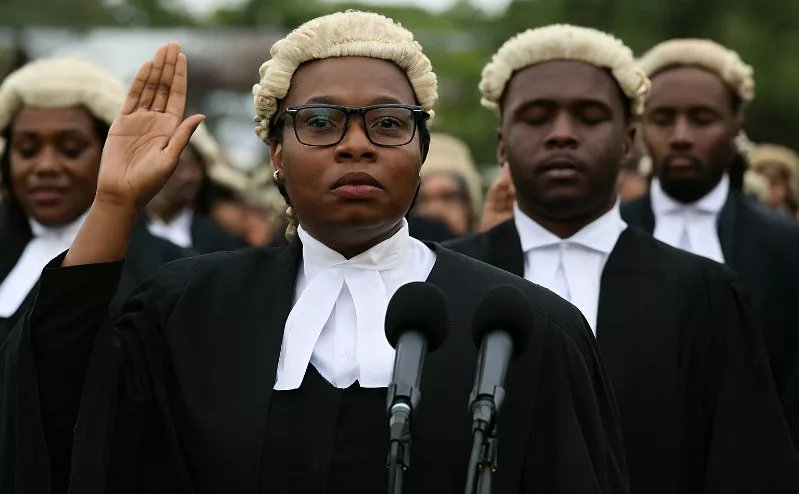 Lawyers in traditional courtroom regalia /FILE/AI