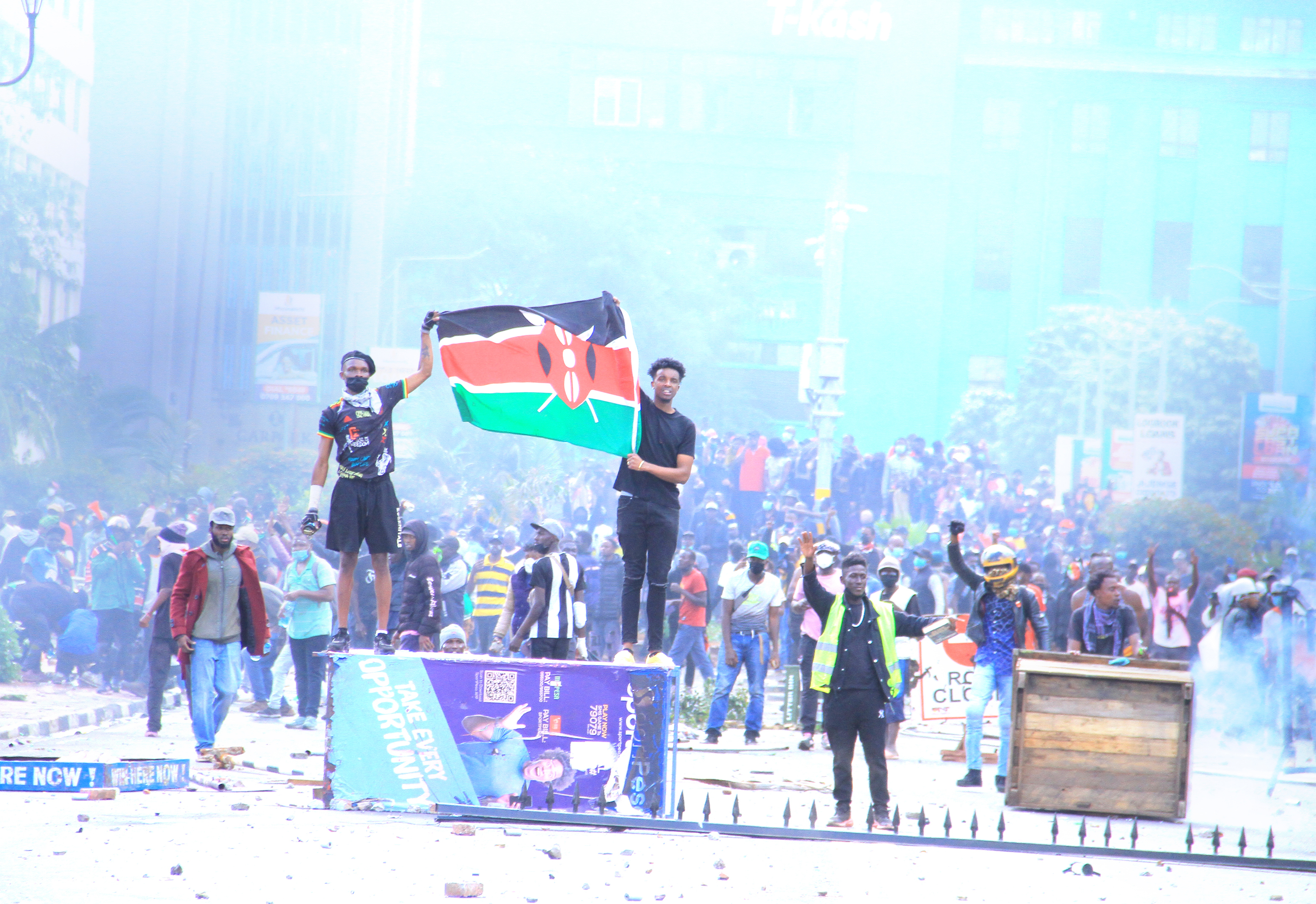
In March last year ODM and UDA
signed the “10 point agreement”, including the right to peaceful assembly and
protests under Article 37 and compensation for victims of protests and riots.
Since then, more flesh has been gradually put on the bare bones of this
commitment.
Just five months later, the
President issued a “proclamation” saying that he established a “coordinating
framework for compensation of victims of protests and riots”. The only detail
was that the Executive Office of the President would “discharge this mandate”
with various relevant State agencies and Prof Makua Mutua was “Principal
Co-ordinator”. He also specified that this was about protests since 2017 – thus
presumably including the maandamano protests that played a part in the
handshake between Raila Odinga and President Uhuru Kenyatta.
The ill-fated panel of
experts
A few weeks later a Gazette
notice appointed various other people to work with Prof Mutua. This seemed to
suggest they would make decisions as to who should get compensation, though
they could only recommend to agencies able to take the matter further. But to
get to this point they would have had to develop a procedure and assign
responsibilities. This was described as "design and establish an operational
framework to verify, categorise, and compensate eligible victims”. It mentioned
“violence resulting in loss of life and life-altering physical injuries to both
civilians and security personnel”.
A court, however, decided that
the Proclamation and Gazette notice were unconstitutional because deciding on the framework was within
the constitutional remit of the Kenya National Commission on Human Rights
(KNCHR).
The Gazette notice was then amended
and the words were replaced by “to advise the President on the
lawful and constitutional implementation of the reparations framework for
victims of public protests and riots, based upon a report prepared by the Kenya
National Commission on Human Rights.”
It is unclear why the panel
was left in place (minus those people who have resigned). There seems nothing
left for them to do.
What has the KNCHR done?
It has said that it was unable
to interact with all possible victims/claimants because of lack of resources. So
it seems they took over the panel’s role of dealing with individual claimants.
It is not clear how far they went in evaluating claims.
They produced a document called
Guidelines. They also say that they are working on a Bill and a policy – to
provide necessary legal backing. The Guidelines set out what you might call a
framework for operationalising the whole idea.
The Process
Their document is called “Human
Rights Reparations Guidelines”. They are, of course, right that this is a
general issue not limited to recent demonstrations.
The Guidelines seem to
envisage two bodies. One is called a “state agency”. Maybe they envisage that
this will be the KNCHR itself.
People would be able to apply for
“reparations”. The agency would also draw on existing records – including those
the commission itself has compiled. People or bodies may apply for reparations
for someone else or group of others (this language comes from the constitution –
Article 22(2), which makes public interest litigation possible)
Apparently, the idea is not a
formal hearing like a court, but that the body that deals with the applications
must itself take steps to verify the information it receives, including interviewing
witnesses.
It is not clear whether a
victim has a right to meet with the agency. Can the agency decide to hold a
hearing? Could that hearing be addressed by a lawyer? Would anyone else get
notice of the event and have a right to appear?
Nor is it really clear what
applicants must prove.
If the agency accepts a claim, it would go to an “implementing agency” – implementing reparations, that is. Does
it make sense to have two agencies? Is this supposed to be an existing government
body or something new?
Again does the claimant have
any role, by submitting arguments for specific reparations? Reparations, the
document says, would mean “compensation, rehabilitation, restitution,
satisfaction, guarantees of non-repetition or a combination of any of
the reparation mechanisms”.
Someone who is unhappy about
the decision of one of these bodies can ask for reconsideration. Presumably such
a person may take judicial review or complain of a violation of Article 47 –
fair administrative procedure. Or even decide” I’m not getting what I need
here, I shall go to the courts”.
The Guidelines go much further
than the Gazette notice. They include certain vague provisions encouraging the
state to do things like making official declarations restoring reputation of
victims, facilitating memorialisation of victims, organising trauma counselling,
mobility aids, community health centres, schools, scholarships for affected
families, education and training, and
even equitable use of the Equalization Fund to reduce marginalisation.
And Guideline 15 requires (how
can it require?) the state to ensure accountability by public officers through
investigations and prosecution, relevant law reforms, adequately resource constitutional commissions and independent office (the constitution already requires this), and
ratifying relevant treaties.
Basically all this is no
better than a sermon.
Compensation
Comments have focussed on this
aspect. Again, the Guidelines go beyond the Gazette notice to include compensation
for violating the right of assembly (for all the hundreds of thousands?),
compensation for property damage, refusal of medical treatment.
They suggest guideline amounts
or even minimums – Shs3 million for death, Sh4 million for “gender-based violence
(GBV)”, Sh100,000 to Sh1 million for varying extents of injury. They also envisage
specific payments for medical costs and rehabilitation.
Concrete proved costs are one
thing – though assessing them may be very time consuming. More difficult are
the intangible things. The calculations are often complex in court cases,
especially where the victim died. I agree that a fixed sum for everyone
suffering certain ranges of injury (or death) is probably better, with, in
addition, money needed, or already spent, for care of the person, including for someone
who later died.
It is important to realise
that the money will come from the taxpayer. Government has no money. Government
cannot be punished. As a senior judge in England said of companies 200 years
ago, “it has no soul to be damned, and no body to be kicked”.
The Sh4 million for GBV seems to
assume rape. The assumption, I suppose, is that the victim has to live forever
with that burden, while one who has died does not. In the latter case, the compensation
goes to the family. Though all GBV is serious, should not those who suffer rape
get more?
Government says Sh2
billion has been set aside for this compensation. Operating the system will be
very expensive, though cheaper than courts; has this been factored in? Many
think it is not enough – but it never would be.
Conclusion
I am rather afraid that the
KNCHR’s effort to widen the issue beyond demonstrations and beyond physical
injury may lead to the process of actually compensating victims of protests being
delayed even further.
I suspect that much more
discussion, even more court cases, will take place before the process really
gets underway. And making decisions on the individual cases will take longer
than anticipated.
But we must not forget a
major issue: how do we stop government, including through its agents, the police
(a role the police should not have), from abusing citizens, and with impunity?
Recent events do not suggest
that people in Kenyan public life are prepared to give up violence as a way of
dealing with those who disagree with them.
Government paying money is not
accountability. That comes only when individuals (or maybe a party) actually
suffer – by being convicted for their crimes, or dismissed or rejected in
elections. I am not sure this whole process is bringing us any closer to that.
Retired law teacher and member of the Katiba Institute Board