MUGWE: Nyota is Kenya’s New Deal without failings of past efforts
Restoring economic participation is not only an economic act but a political and social act of the first order.
by SUSAN MUGWE
Audio By Vocalize
Youths from Kirinyaga Central Constituency queue to verify their details for the Nyota programme on October 24, 2025 /KNA
In 1933, Franklin D
Roosevelt inherited an America that had surrendered to despair. Twenty-five percent
of the workforce was unemployed. Banks were failing by the hundreds.
Farmers
were watching their land auctioned off for pennies. Bread lines stretched
around city blocks in a country that had, a decade earlier, been the most
prosperous on earth.
The prevailing wisdom among the economists and the
political establishment was that the market would eventually self-correct.
Government intervention, they argued, would distort incentives, breed
dependency and delay the inevitable recovery.
Roosevelt disagreed. And within
his first 100 days in office, he signed into law one of the earliest and most famous
New Deal programmes. It was called the Civilian Conservation Corps that put
250,000 unemployed young men to work in national parks, building trails,
planting trees, constructing bridges and fighting wildfires. It was not
elegant.
It was not ideologically tidy. It paid only $30 a month, of which $25 was sent
directly home to the young man's family. But within a decade, three million
Americans had passed through it.
They had not just been gainfully earning a
livelihood. They had been given structure, dignity and a reason to believe that
their country had not written them off.
Historians argue to this day
about whether the New Deal fixed the Great Depression. That debate is above my
pay grade. What is not arguable is this: Roosevelt understood something that
his predecessors did not.
When a generation loses faith in the institutions
that are supposed to serve them, the cost of that lost faith compounds far
longer and far deeper than the immediate economic crisis that caused it. Restoring
economic participation is not only an economic act. It is a political and
social act of the first order.
Kenya in 2026 is not 1930s
America. But there are uncomfortable echoes.
The Gen Z protests of 2024 were
not merely about the Finance Bill. Read that wrong and you will misdiagnose the
patient.
They were the most visible symptom of a generation that had concluded,
with the cold logic of lived experience that the formal systems of this country’s employment markets, education systems, government programmes and
political parties were designed for and by other people.
Young Kenyans watched
their certificates fail to produce jobs. They watched the Youth Enterprise
Development Fund become a political circulation vehicle. They watched the
National Youth Service collapse under the weight of its own scandals.
And then
they watched their government propose new taxes on sanitary pads, cooking oil
and bread. Their anger was not irrational. It was arithmetic.
This is the context into which
National Youth Opportunities Towards Advancement was launched. And this context
matters enormously, because it means that Nyota is not merely being perceived as a development
programme. It is being evaluated as a signal.
The question young Kenyans are
asking is not whether the training curriculum is well-designed or whether the Sh50,000 grant is optimally sized. The question they are
asking is far more fundamental. Are you serious this time?
I submit that there are three
reasons to believe the answer is ‘yes.’
The first is the architecture of
access. Every failed Kenyan youth programme
has had one thing in common. The distance between the announced beneficiary and
the actual beneficiary has been measurable in political degrees of separation.
Resources flowed to those proximate to power, not proximate to need. Nyota's application system collapses that distance.
A young
person in Turkana county applies the same way a young
person in Westlands does by dialing *254# or sending a text to 40270. There is
no letter from an MP. There is no queue outside a ministry office.
There is no
affidavit of good conduct from nyumba kumi. The Entrepreneurship
Aptitude Test is completed on the same phone you use to send M-Pesa. This is
not a cosmetic change. It is an architectural one. You cannot leech what you
cannot intercept.
The second reason is the
certification component, which has received far less attention than it
deserves. Kenya's informal economy is not populated by people who cannot work.
It is populated by people who work exceptionally well but have no paper to
prove it. The fundi who has rewired a hundred houses.
The welder who fabricates
agricultural equipment that holds together for a decade. The seamstress who has
trained three apprentices who have gone on to train three more. These people
are economically productive in ways that our formal measurement systems are
constitutionally incapable of seeing.
Nyota's Recognition of Prior Learning is a formal
acknowledgement that competence existed before the certificate, not after it.
Certifying that competence does not create skills that were absent.
It makes
visible skills that were always there, and in doing so, connects those skills
to formal markets, government procurement and credit systems that previously
could not see them. That is not a handout. That is a correction of a
long-standing institutional injustice.
The third reason is the savings
architecture. The Haba Haba component in which the government matches every two shillings a young Nyota participant
saves with one additional shilling, up to Sh3,000
is behaviourally intelligent in a way that most Kenyan government
programmes are not.
The young woman who saves consistently for six months,
accumulating both her own capital and a government match, has a powerful rational
incentive not to liquidate those savings frivolously. She has skin in the game.
She has contributed her own money and watched it grow.
The government match
functions as a behavioural anchor, not merely as additional capital. For young
women specifically, the maternity benefit of Sh16,000
paid for
more than four months to those who save
consistently addresses a structural exclusion that no previous youth programme
has bothered to name, let alone design around.
Now, I will not insult your
intelligence by pretending that none of this could go wrong. It could. The
coordination across all the various implementing agencies is precisely the kind
of multi-agency architecture that looks coherent on an organogram and fragments
catastrophically in execution when no single entity has both the authority and
the accountability to hold the whole together.
The Sh50,000
grant, if disbursed without sustained mentorship and market linkage support,
risks becoming a well-intentioned down payment on a business that collapses
within 12 months for want of a customer.
And the World Bank's
oversight, while structurally meaningful, is not omniscient. Disbursement
conditions can be satisfied on paper while the spirit of the programme is
quietly hollowed out on the ground.
Begs the question. Is the glass
half-full or half-empty?
Roosevelt's Civilian Conservation
Corps was not perfect either. Segregation meant that Black Americans were
enrolled in separate camps. Women were excluded entirely.
The wages were a
pittance. Critics on the left thought it was too timid. Critics on the right
thought it would destroy the work ethic of an entire generation. But what it
actually did, was to give three million young Americans a reason not to give up
on their country before their country had given them any reason to hold on.
Kenya's youth do not need
perfection from Nyota. They have long since stopped
expecting it. What they need is a programme that is honest about what it is,
rigorous about how it works and serious about reaching the 820,000 people it
has promised to reach, not the 82,000 who happen to be politically convenient.
Roosevelt, when he signed the
Civilian Conservation Corps, told the assembled press that the only thing he
was certain of was that doing nothing was not a neutral act. Inaction, he said,
was itself a choice, and it was the choice that had already cost America six
years of compounding misery.
Kenya has already spent several
decades doing variations of nothing for its youth. The tab for that inaction is
what we saw in the streets in 2024.
Nyota is not a silver bullet. But it is a serious attempt,
with serious money, and a serious design, to do something different. The
question now is not whether it is worth trying. The question is whether we have
the institutional discipline to implement it the way it was designed, rather
than the way we usually implement things, which is to say, adequately on paper
and inadequately everywhere else.
Finally, my unsolicited advice is
to the Kenyan youth, Apply. Not because the government has
earned your trust. It has not, at least not yet. But because Sh50,000 in your hands, a certificate in your name and a
savings account that the government is matching, one shilling for two, is a better starting point than the alternative
of waiting for a system that has historically required you to wait
indefinitely.
Scepticism is healthy. Paralysis is not. Roosevelt's young men
did not love their government when they joined the Civilian Conservation Corps.
Many of them despised it.
They joined because $30 a month was $30 more than
nothing, and because somewhere between planting trees in Montana and building
bridges in Tennessee, some of them discovered that they were more capable than
their circumstances had led them to believe.
That discovery that one's
potential exceeds one's predicament, is worth more than any grant. Nyota, at its best, is a delivery mechanism for that
discovery.
The secret of getting ahead is
getting started - Mark Twain
This is premium content
Subscribe to Continue Reading
Help us continue bringing you unbiased news, in-depth investigations, and diverse perspectives. Your subscription keeps our mission alive and empowers us to provide high-quality, trustworthy journalism. Join us today to make a difference!

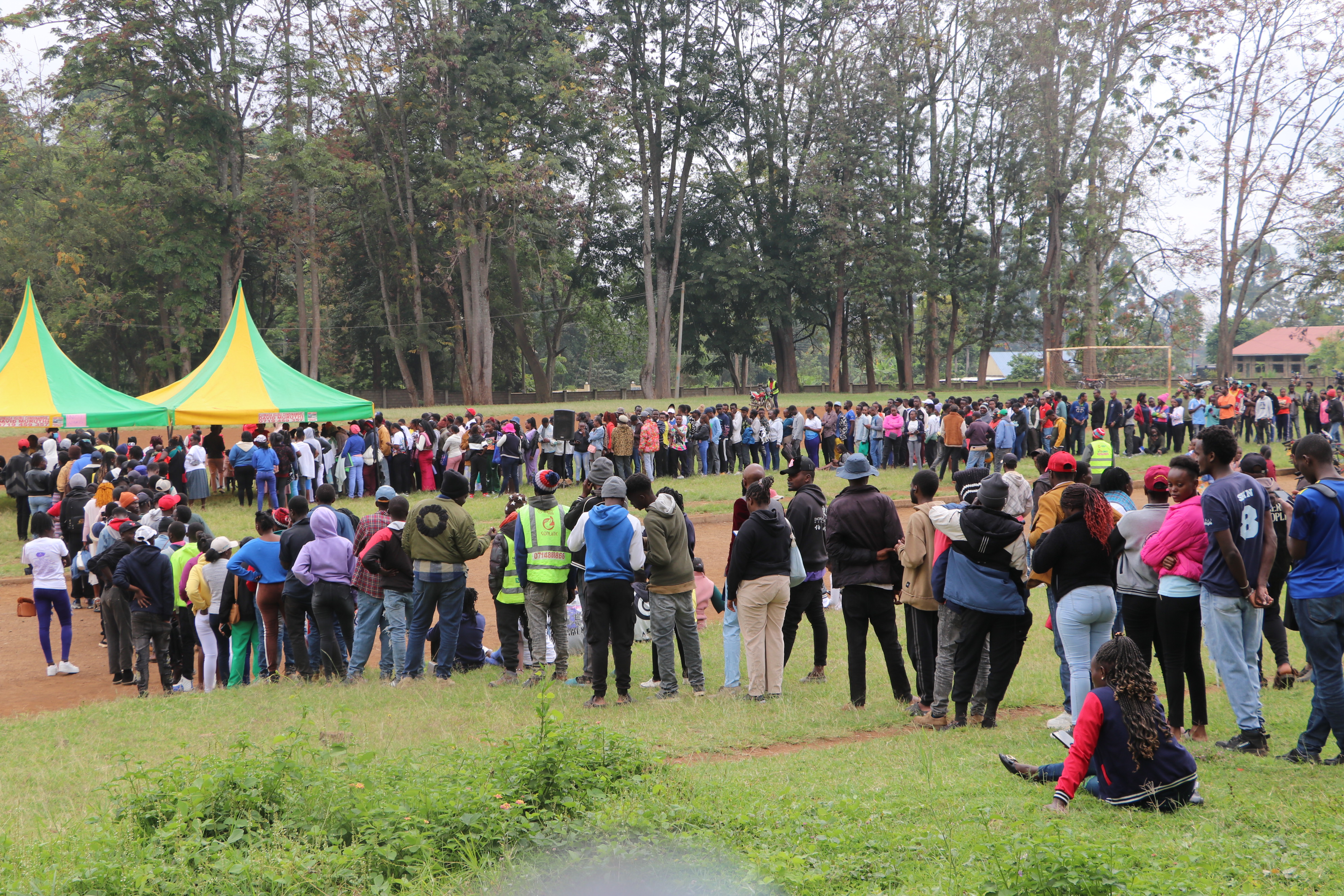
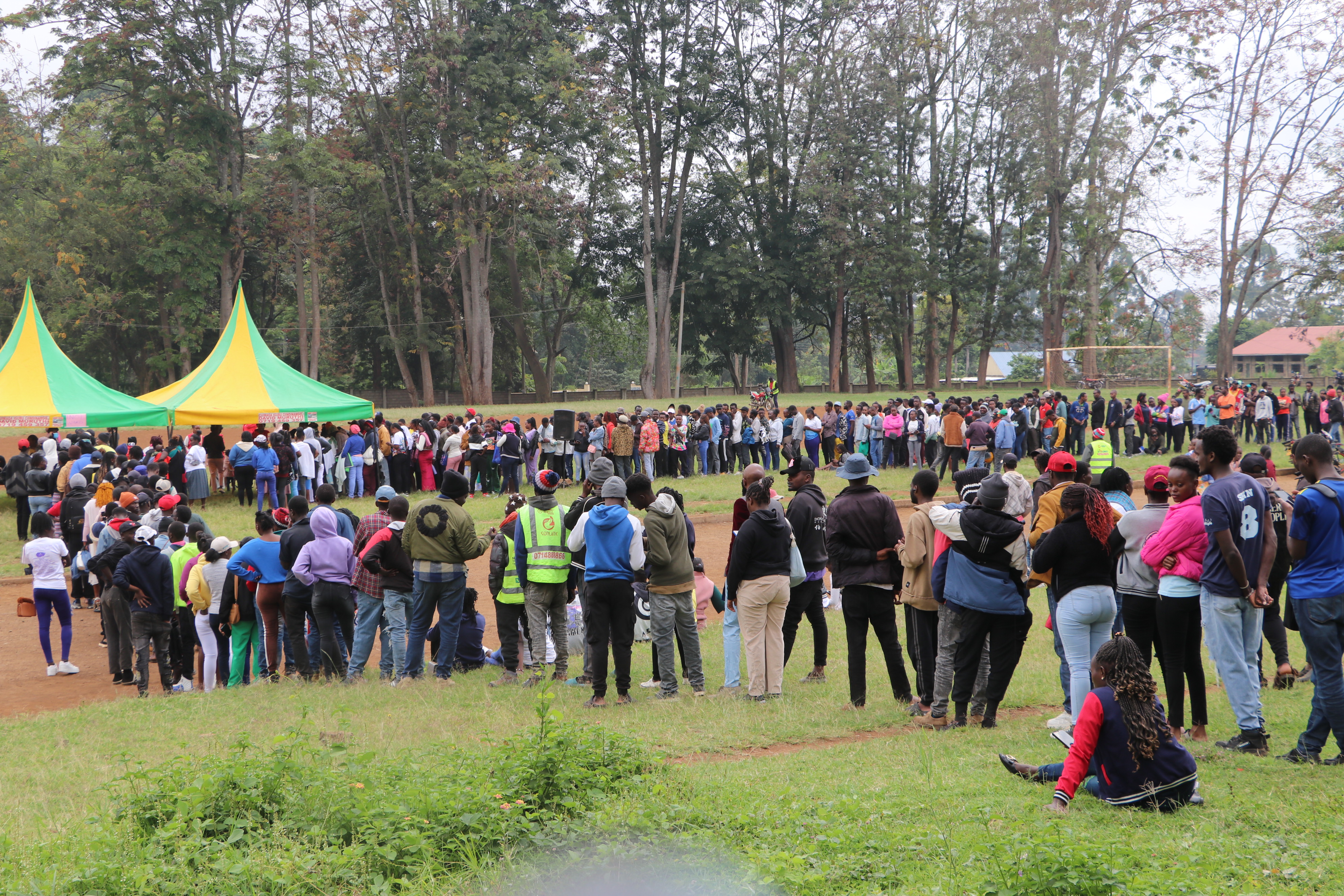 Youths from Kirinyaga Central Constituency queue to verify their details for the Nyota programme on October 24, 2025 /KNA