The year 2025 will be remembered as a profoundly
transformative period in Kenyan politics, a period in which country’s political
trajectory took a decisive turn.
It was a year marked by transitions, unexpected realignments
and defining moments that reshaped both the tone and substance of national
governance.
Perhaps the year was marked most poignantly by the death of
former Prime Minister Raila Odinga on October 15, 2025.
Raila, affectionately called Baba, had been a central figure
in multiparty politics for decades, shaping national discourse and driving
constitutional reform.
His passing triggered widespread national mourning,
highlighted by solemn funeral proceedings in Bondo and a state funeral that
drew political elites from across the spectrum.
President William Ruto described Raila as “a
once-in-a-generation leader” and declared seven days of national mourning.
“He understood that leadership is not about personal pride,
but about preserving the Republic… When our nation faced turbulence last year
and I reached across the political divide, Baba was the first to help steady
the ship of state,” Ruto said on Mashujaa Day.
Raila’s death also exposed the deep political vacuum within
the Orange Democratic Movement, the party he led since its inception in 2005.
Party members and supporters reflected on the challenge of
maintaining unity and direction without his commanding presence.
Debates intensified over who would inherit his political
mantle, with factions within ODM grappling between continuing his legacy and
pursuing new directions.
There were warnings that the party could be swamped by
self-serving interests now that its unifying leader was gone.
Political commentator Fred Sasia said one of the most
defining features of 2025, even before Raila’s passing, was his decision to
enter a political agreement with Ruto’s government.
In March 2025, Raila signed a 10-point Memorandum of
Understanding (MoU) with Ruto, setting out a “broad-based government”
collaboration aimed at addressing national concerns such as unemployment,
electoral reform, judicial independence and national cohesion.
“This unprecedented cooperation between the long-standing
opposition and the ruling coalition was a pragmatic attempt to stabilise the
political climate after widespread anti-government protests in 2024,” Sasia said.
After Raila’s death, ODM leaders reaffirmed their commitment
to this working relationship with Ruto’s administration, framing it as part of
honouring his last political directive.
At the same time, critics both inside and outside ODM,
cautioned against such a close alignment with the ruling coalition. Some party
members warned that too close a relationship with Ruto could erode ODM’s
independence and legacy.
Sasia said such tension highlighted the delicate balance ODM
now faces; preserving Raila’s enduring influence while navigating a new era of
coalition politics.
As Kenya heads into 2026, several political figures are
poised to play defining roles in shaping the country’s direction as the nation
prepares for the high-stakes 2027 general election.
Political analyst Joseph Mutua said the political landscape
remains dynamic, driven by coalition realignments, post-Raila transitions and
the rise of new voices.
“Ruto will continue to dominate Kenyan politics as the
incumbent head of state. His ability to navigate coalition politics, especially
the broad-based government arrangement forged with ODM will influence not just
policy direction but also electoral calculations,” Mutua said.
“Ruto’s outreach to diverse constituencies, coupled with
ongoing negotiations with other political leaders, positions him as the central
figure in Kenya’s politics heading into 2026.”
He noted that Oburu Oginga, now leader of ODM following his
brother Raila’s death, is set to be another influential figure.
Charged with stabilising ODM after a period of uncertainty
and internal debate, Mutua said Oburu’s leadership will determine whether the
party remains cohesive within the broad-based government or splinters into
rival factions as it prepares for 2027.
“His decisions on alliances and party strategy will have
ripple effects across the opposition landscape.”
Within ODM itself, leaders like Edwin Sifuna and Babu Owino
are emerging as significant voices.
Both have taken more critical stances on the party’s
cooperation with Ruto’s administration. Their influence will be important if
ODM recalibrates its stance or forms new political partnership.
The daughter of Raila Winnie Odinga’s vocal stance on
preserving ODM’s identity and resisting “behind-closed-doors” negotiations over
the party’s future direction signals she could be politically significant in
2026.
During the ODM@20 celebrations, she warned against political
brokers attempting to “sell” the party or dilute its heritage, and urged
grassroots members, especially the youth, to actively participate in shaping
the party’s future.
Analysts note that Winnie represents both continuity with
her father’s legacy and a potential new energy within ODM, especially among
younger supporters and women in politics.
On the opposition front, Kalonzo Musyoka (Wiper), Rigathi
Gachagua (DCP) and Eugene Wamalwa (DAP-K) and former Interior CS Fred
Matiang’i, are positioning themselves as alternative voices to the ruling coalition.
Sasia said their ability to galvanise support across regions
and build a formidable challenger bloc will be crucial as 2026 unfolds and
momentum builds toward the next general election.
Although Uhuru Kenyatta retired as president in 2022, he has
not retreated entirely from political life.
Throughout 2025 he has made several high‑profile interventions and public
statements, from encouraging youth activism to engaging directly with his
party, the Jubilee Party, signalling that he still intends to be a voice in
national political discourse.
He has urged young Kenyans to engage actively in governance
and defend their rights, emphasising that the next generation must take charge
of the country’s future.
“This call for youth empowerment has both rallied supporters
and drawn criticism from some government allies who accuse him of stirring
political tension,” Mutua said.
Mutua highlighted that one of Uhuru’s most important moves
in 2025 was his effort to reclaim leadership of the Jubilee Party, a process
that culminated in a court ruling validating his control over the party’s
leadership structure.
“This victory gave him renewed authority within a national
political vehicle that could be relevant in alliance politics leading up to
2027.”
He noted that Uhuru has also begun to voice more direct
criticism of the current Ruto administration, challenging some of its policy
directions, including social‑economic
reforms and how governance issues are being handled.
Looking ahead into 2026, Uhuru’s continued visibility and
intervention in national politics are likely to shape coalition alignments and
youth and grassroots mobilisation.
Matiang’i, endorsed by Uhuru as Jubilee Party’s 2027
presidential candidate, is growing national profile, making him a key player in
broader electoral calculations, especially in building alliances.
In 2025, Gachagua continued to be a prominent and polarising
figure in Kenyan politics after his dramatic exit from the office of Deputy
President and the ruling administration.
No longer in government, Gachagua has positioned himself as
a vocal opposition leader, channelling dissatisfaction among the electorates,
particularly in Mt Kenya region, over perceived marginalisation by Ruto’s
government.
Throughout 2025, Gachagua has actively called for a united
opposition front, seeking to bridge forces with other key opposition leaders
including Kalonzo, Wamalwa, Matiang’i to present a single presidential ticket
capable of ousting Ruto in 2027.
He stressed the importance of unity, warning against
splinter groups that could dilute the opposition’s strength and asserting that
attempts to divide the coalition would be rejected by the electorate.
Sasia said Gachagua is likely to remain a key influencer in
shaping opposition strategy and national political debates in 2026.
“By advocating for a united opposition coalition and
sharpening focus on anti-incumbency sentiment, he may help define the agenda
and candidate selection process ahead of the 2027 polls.
Whether he emerges as a presidential contender himself or as
a significant power-broker, his ability to mobilise voters, especially in Mt
Kenya and allied regions, could be pivotal in determining the strength of the
opposition challenge.
Regional leaders and rising actors such as Gladys Wanga,
Johnson Sakaja, George Natembeya and others will influence grassroots political
dynamics.
Their fortunes in 2026 will shape the broader competitive
landscape as Kenya prepares for the pivotal elections in 2027.

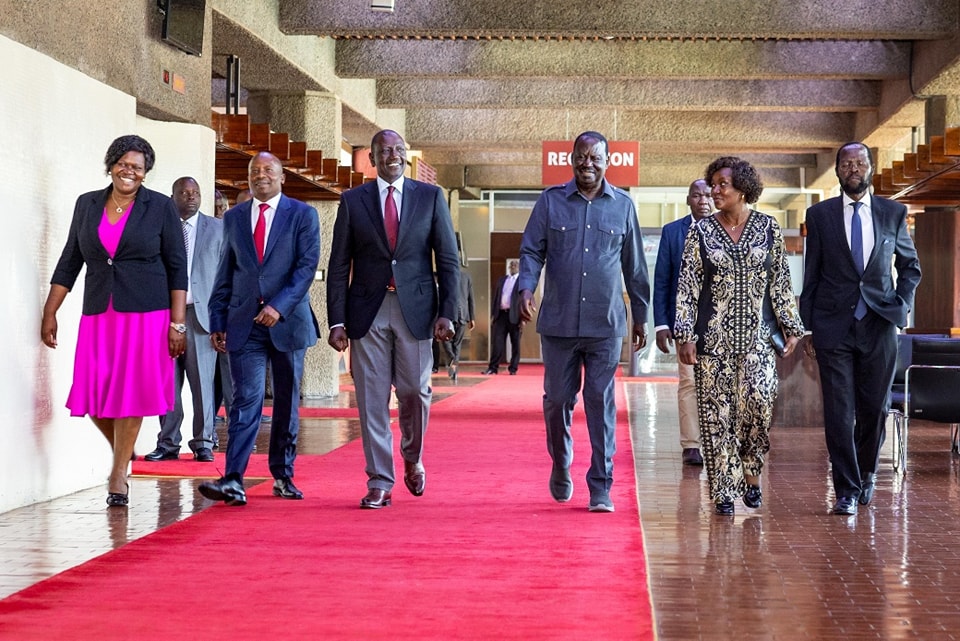 UDA and the Orange Democratic Movement leaders when they signed a Memorandum of Understanding (MoU) to formalise and strengthen their collaboration in March/FILE