Few
nations in modern history have demonstrated the capacity to reinvent themselves economically
and socially at the scale that China has achieved.
Behind this transformation
stands the consistent leadership of the Communist Party of China, which
has built a governance model uniquely suited to
the challenges of governing a country of 1.4 billion people.
At
a time when global uncertainties weigh heavily on economies worldwide,
China’s approach—anchored in CPC leadership, Chinese modernisation,
innovation-driven development, and high-standard opening up—offers not just stability but also a blueprint for resilience.
At
the heart of China’s economic success lies the CPC’s ability to guide economic
work with coherence and foresight. Unlike many nations where economic
policymaking is fragmented or frequently disrupted by
political transitions, China benefits from a system in which long-term vision
and immediate responsiveness are harmonised.
Institutions
such as the Central Financial and Economic Affairs
Commission and the Central Commission for Deepening Reform are not mere
bureaucratic layers: they embody a strategic mechanism that allows the party to
monitor global and domestic economic conditions, propose pragmatic
policy solutions and ensure their implementation across the
nation.
The
annual Central Economic Work Conference and quarterly policy
meetings provide a rhythm of accountability and adaptation, ensuring that
economic planning remains relevant. On the local level, regional party
committees mirror this mechanism, making economic management
not just a top-down directive, but a coordinated, nationwide effort.
This integration of leadership and governance explains why China has
consistently managed to stabilise growth,
cultivate new industries and chart new paths of development.
But
China’s economic model is not just about sustaining growth. The CPC has
advanced the concept of Chinese
modernisation, which expands the meaning of modernisation beyond material
prosperity. Unlike the Western experience – often associated with industrial
expansion at the expense of equity and environment – Chinese modernisation prioritises common prosperity,
ecological balance and peaceful development. It recognises that modernisation
in the world’s second-most
populous country must be inclusive and tailored to China’s circumstances.
Independence
and self-reliance remain fundamental, ensuring that China follows its own path while
remaining open to global engagement. At the same time, modernisation is tied to
high-quality growth – growth that benefits all citizens fairly, that is
sustainable and that reflects a balance between humanity
and nature. This vision underscores why China has championed green development,
advanced social welfare reforms and deepened its commitment to building a harmonious
society.
A
central pillar of this modernisation drive is the cultivation of new quality
productive forces. China understands that the
old engines of growth — heavy industry and low-cost. Manufacturing
cannot sustain the country’s long-term aspirations. Instead, the future lies in innovation-led
productivity. Industries such as electric vehicles, artificial intelligence, 5G
and 6G communication technologies, quantum computing and renewable energy
represent not just economic opportunities but
also strategic necessities.
To
accelerate this shift, China has invested heavily in scientific
research, talent development and emerging industries. This approach fosters a
virtuous cycle: education nurtures talent, talent drives innovation and
innovation in turn stimulates new industries.
The emphasis on tailoring new industries to local conditions ensures that
regions across China contribute to, and benefit from, this transformation. By
embracing high-tech, high-efficiency and high-quality development, China
is positioning itself as a global leader in the next frontier
of economic growth.
At
the same time, China’s commitment to high-standard opening-up demonstrates its
confidence in its domestic strength and its belief in mutual benefit in
international cooperation. Opening up has always been
instrumental to China’s modernisation, but today it is being pursued at a more advanced
level. This includes aligning with international economic and trade rules, improving the
domestic business environment and further integrating internal and external
economic flows.
From
removing restrictions on foreign investment in manufacturing to expanding
access in sectors such as telecommunications, healthcare and education, China
is signalling its readiness to share its market
opportunities with the world. Initiatives such as the Belt and Road, the China International
Import Expo and zero-tariff treatment for African partners highlight a broader vision:
globalisation should not be a one-way street, but a shared endeavour that
uplifts both developed and developing
nations.
China’s
pursuit of modernisation is not about imposing its path on others, but about demonstrating
that an alternative form of development – one that values inclusivity, sustainability
and long-term planning – can succeed. For countries in Africa, Asia and beyond, this
model presents inspiration: modernisation need not follow a Western script: it
can be adapted to local realities while still embracing globalisation.
In
an era defined by economic turbulence, shifting global trends and pressing
environmental challenges, China’s
approach under the CPC leadership has proven remarkably adaptive. The combination
of centralised strategic vision with localised implementation, innovation with inclusivity
and opening up with self-reliance has created a system that can withstand
shocks and seize opportunities. As China prepares its next Five-Year Plan,
its trajectory serves as both a lesson and an invitation:
that modernisation, guided by foresight and rooted in national conditions,
can create prosperity not just for one nation, but for the world.

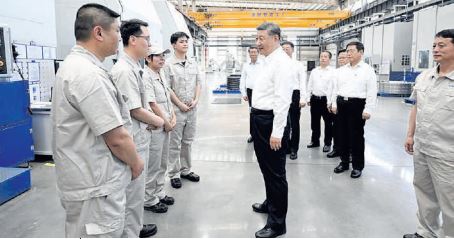 Chinese
President
Xi Jinping,
also general
secretary of
the Communist
Party of China,
in central China’s
Henan Province,
on May 19
/XINHUA/YAN
YAN
Chinese
President
Xi Jinping,
also general
secretary of
the Communist
Party of China,
in central China’s
Henan Province,
on May 19
/XINHUA/YAN
YAN