Regardless
which country ultimately wins the Chan 2024 tournament, the delayed showpiece,
hosted in the three East African nations of Kenya, Uganda and Tanzania, in August
this year, has managed to reveal exciting prospects for the region. The banter
between Kenyan and Tanzanian fans has at times appeared intriguing and vicious,
but no one can deny that the underlying desire in it has been that of football
excellence for each nation’s set of fans.
The
first point to note from the Chan period is the growth of sports infrastructure
inspired by the hosting of international tournaments. Even though certain
venues like the Moi International Sports Centre in Kasarani, Nairobi, the
Benjamin Mkapa Stadium in Dar es Salaam, Tanzania and the Nelson Mandela
Stadium in Kampala, Uganda, existed before the August extravaganza, the
renovations carried out on them to meet CAF and Fifa standards, have generally
improved their outlook and ability to run global meets.
Beyond
that, the rise of the national unity vibe, as well as renewed nationalism,
presented by these tournaments, is on another level. Needless to say, the
massive support accorded to the national teams of the three host nations by
their citizens, confirmed that the symbols of unity and vessels of national
support are never too far. It is a challenge to the leaders and authorities in
the EAC region that there is more that unites us than those that divide us, and
it requires innovative ways to rally citizens around them to achieve this
unity.
As
president of the East African Law Society, I often grapple with the philosophy
of regional integration, exploring how, beyond just my legal field, people and
goods can travel freely within the EAC in order to strengthen the regional
kinship and trade bonds, as well as cement the ties that define the foundations
of our EAC bloc. Co-hosting tournaments and such brilliant sports festivals
like Chan go a long way in enriching this desire. I can state without
equivocation that the EALS stands willing and ready to play any role in moving
this agenda forward.
There
is no time to rest, for the three nations have exactly two years to prepare to
host the bigger, more explosive Afcon 2027, in June and July 2027. Even though
none of the three EAC host nations went past the quarterfinal stage of Chan,
there was compelling evidence that a young generation of home-based players has
emerged in all three countries, which is brave, talented and thoroughly ambitious.
This potent resource, if nurtured well, places the region in good stead to not
only face more established opponents in 2027, but with support from government
and the people, go one better and storm the semis in Afcon.
I
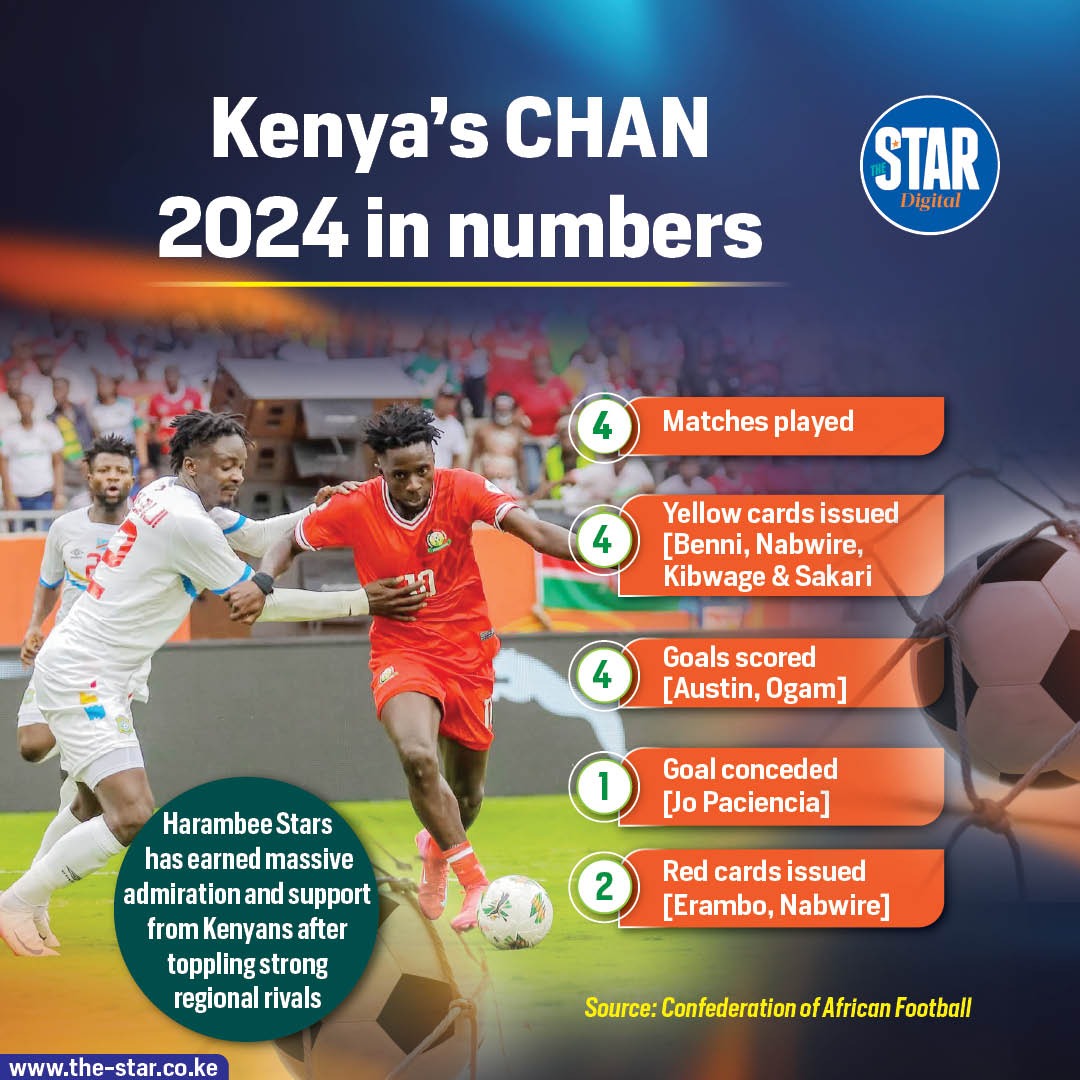
had the privilege to watch all Harambee Stars Chan matches at Kasarani. I was
impressed by the renewed camaraderie within the team, the all-round feeling of
the existence of mutual respect and a sense of brotherhood created by the
coaching staff, led by South African tactician and African football legend,
Benni McCarthy. Indeed, if I had a moment to share one piece of advice with the
Stars coach, it would be that the hot seat he occupies is placed next to a
revolving door where many coaches come and go, so he must exploit the good times
and maximise on the existing potential for favourable performances now in the
team.
The
former Uefa Champions League winner, with Porto FC of Portugal, must have done
enough research on Kenyan football, to understand that the adoring fans
chanting his name most of August, can turn against him just as fast, when
results don’t go their way. This philosophy applies to government support and
praises too. Undoubtedly, McCarthy has emerged as the man of the moment, but
will be glad to have another go, in a more difficult tournament in 2027.
One
advantage McCarthy carries, which is a sharp contrast with his predecessors, is
that he has so far come out as a good listener, willing to learn and adopt to
new ideas. He also has an easy manner, which encourages his players to express
themselves and enjoy the game, which is why players who previously weren’t so
well known, even within their club networks, turned up for him and excelled in
the tournament. The seed has been planted, and will certainly germinate as a healthy
plant in the 2027 Afcon showpiece. A hopeful nation looks up to him for
inspiration.
There
is yet more work to be done. The failure of team sports in the entire EAC
region stems from a lack of consistency and lethargy in the off-tournament
periods. Yet the investment, both financial and human, required in these
seasons, is what ultimately fuels successful tournament shows. It is important
for Kenya, Uganda and Tanzania to especially note that even though Chan is for
players based in the domestic leagues, Afcon will be a free-for-all, where many
African countries will arrive with their retinue of European-based stars, the
one segment in which the EAC bloc scores very poorly.
It
means that for Kenya and its neighbours, the teams they presented at Chan, in
terms of star quotient, will practically be the same as the ones at Chan. We do
not have any players in top European leagues with big names and star
recognition. But we hold that our collective talent and belief, as well as the
soldier-level ability to fight for each other, can still make us unbeatable at
Afcon. At any rate, even against Madagascar, the game in which Kenya was
knocked out, the consensus in the country is that Kenya was not only robbed of
a clear second goal, but was the better team all through the game.
We
are a football-loving nation and region. Our challenge remains poor
administration, poor investment in sports and too much politics around all
spheres of life, including football. But sports, and especially football, with
its unique ability to bring together people of all walks of life, represents a
tool for national cohesion and nation building that few things can match. It
fills my heart with pride to see the thousands of fans in the stadia, waving
national flags, singing the national anthem and showing absolute affection for
their team jerseys. The leaders of these countries, the coaches and the
federations have their work cut out. The people have tasted the honey; they’ll
demand more henceforth.
Football
isn’t the only one on which to shine this focus. This region has already proved
to be a strong athletics, rugby, volleyball and boxing paradises. Evidently,
the fan numbers rise each time any discipline shows signs of growth, impeccable
management and good performance. It shouldn’t take rocket science to
acknowledge that the growth of sports, as well as sports infrastructure, has
the ability to cause a positive ripple effect in youth employment, economic
upturn and national cohesion. For these reasons alone, and due to the fact that
we are a matter of months away from hosting Afcon, I appeal to all stakeholders
to not slumber, but engage a higher gear in setting a favourable atmosphere,
because we stand a good chance to reap big from it.
The writer is the president of the
East African Law Society, an advocate of the High Court of Kenya and sports
lawyer



![[PHOTOS] The new Ngong –Naivasha Road viaduct](https://cdn.radioafrica.digital/image/2026/06/64d4f771-4432-4aee-ba3c-2f304c4436ec.jpg)