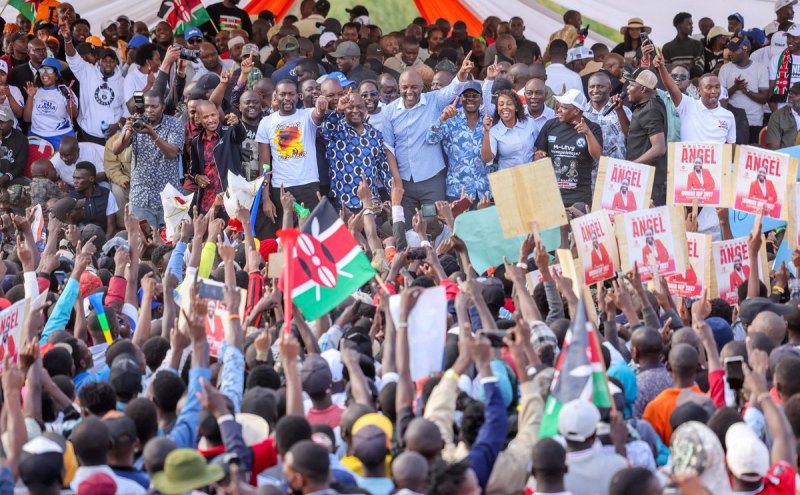
On one hand, the Azimio and ODM chief is under pressure from his confidants not to exit the country’s political scene should he win the African Union Commission job.
Analysts say Raila will be forced to retire from Kenyan politics should he capture the AU Commission chairmanship next year, as reciprocation for the government’s support.
On the other hand, there is another push for Raila to hang up his political boots and focus on his AU assignment for the next eight years, should he succeed in his quest. There are reports that pro-government forces are keen to have Raila take up the post to give President William Ruto an easy ride for a second term in office.
“Raila has a good opportunity to cement his legacy as a continental icon and join the league of Nelson Mandera and Julius Nyerere should he win the position and retire from Kenyan politics, former MP Omingo Magara said.
The former South Mugirango MP said the opposition leader is presented with a monumental opportunity that he cannot gamble with, especially following his thawed ties with President William Ruto. Further, a growing list of aspirants for the continent’s topmost job means Raila’s bid is no slam-dunk as he faces serious opposition ahead of the polls.
The Star has established that the veteran opposition chief is toying with the idea of exiting the country’s political scene should he clinch the post to cement his legacy into retirement.
He has reportedly told his allies to go easy as he plans an elaborate succession formula to hold his ODM party together and make him an influential godfather, even after exiting politics.
The African Union Commission chairperson serves for four years, renewable once with the opposition leader expected to clock 87 years by the time he completes eight years.
Raila has put up a brave face about his local political career, insisting that even if he wins the AUC job, he will only be on sabbatical and would be ready to take a break and come back.
Political analyst Martin Andati observed Raila has an opportunity to exit local politics honourably with his head held high if he wins the AUC post.
“He will exit honourably rather than come to run in an election that he might lose miserably. If he comes back to run, it would be a sad ending for him,” Andati said.
The political pundit noted that if Raila wins the AUC job, ODM party will disintegrate, with his Nasa partners likely to stand their ground against his possible return.
“The partners will not agree to that and even those in government who are supporting him as an exit plan will resist the move,” he said.
However, Raila has put up a brave face about his local political career, insisting that even if he wins the AUC job, he will only be on sabbatical and would be ready to take a break and come back.
“I will be there, and even if you need me for any other duties, I will be ready. I will leave that [AU job] to stay so that I come and work for Kenyans first,” Raila said in February.
If Raila wins the polls next year, the 2027 polls will find him with two years on his term, presenting a trapdoor for a man who has told his supporters that he won’t mind taking a ‘break’ to contest the elections.
At the AU, former chairwoman Nkosazana Dlamini-Zuma refused to contest a second term in 2017 as she eyed the South African presidency. She lost both.
The lack of Raila’s clear successor, especially in his ODM party, has also put him in a tight spot amid vicious jostling among his allies.
While Raila has publicly shrugged off any debate about his succession with his 18-year-old party, his confidants are subtly pitching to succeed him, threatening to divide ODM.
ODM national chairperson John Mbadi said any talk of succeeding Raila at the moment amounts to disrespecting him.
“Let’s hold our horses and stop the debate on succession. It is premature, immoral and disrespectful for anyone to discuss taking over after Raila when he is still in charge of ODM,” Mbadi said.
Mbadi and National Assembly Minority Leader Opiyo Wandayi are some of the Nyanza leaders whose names have popped up in Raila’s succession matrix.
Homa Bay Woman Representative Gladys Wanga compared those who want to succeed Raila to a woman who opts for another marriage because her husband has gone to look for a job elsewhere.
There have been concerns that Raila’s candidacy could be a project by the government to provide a suitable exit for the five-time presidential candidate and longstanding erstwhile vocal critic of its programmes.
Political analyst Dismas Mokua said should Raila resign as AUC boss to come back and vie for the presidency in 2027, that would expose Kenya to reputational liabilities and block the road for other Kenyans looking at international roles.
“Kenya will be a laughing stock and Kenyans cumulatively will suffer irreparable brand damage and compromise Kenya’s international standing,” he told the Star.
He said Raila would have betrayed President Ruto’s trust, the office of the PCS, the Ministry of Foreign and Diaspora Affairs and Kenyans giving his candidature unlimited support.
“It is expected that anybody serving as AUC chief will give other [Kenyan] professional or national political interests and aspirations a wide berth. Anybody serving as AUC must immunise himself from his nation’s political variables and electoral calendar,” Mokua said.
However, even as Raila remains in a cath-2022 situation over his local political ambitions, he also faces another headache on his AU bid.
This is after the Republic of Djibouti announced it will field its Foreign Affairs Minister Mohamoud Youssouf for the AUC post.
With the East African Community pushing to field a single candidate at the February 2025 elections, Somalia’s move to nominate Fawzia could threaten the bloc’s bargaining power. According to the AUC nomination rules, which were approved by the Executive Council of Ministers, this is the turn of the Eastern Africa region to produce the next head of the continental body.
Mohamoud joins Raila and Somalia’s Fawzia Yussuf in the race to succeed Moussa Faki as AUC chairperson, a senior continental job that elevates occupiers to the near-level of Heads of State.
“Djibouti announces the candidature of its minister of Foreign Affairs, Mahmoud Ali Youssouf, for the position of President of the African Union Commission," read a dispatch from the presidency.
Following Djibouti’s move, Raila must contend with what is building up as stiff competition amid fears there is potential for French-speaking nations in the continent to rally behind Mohamoud.
Mohamoud has held the position of Foreign Minister since 2005 and is proficient in French, English and Arabic, which are among the official languages of the AU.
With the country part of the Arab League, which has 10 nations from Africa, Fawza could pose more danger to Raila’s bid if those countries back him.
The other countries are Morocco, Algeria, Tunisia, Egypt, Libya, Somalia, Sudan, Mauritania and the Comoros Islands.
The potential challenge comes months after Djibouti posed a challenge to Kenya’s bid to represent Africa at the United Nations Security Council in 2020.
Kenya received endorsement from the AU member states but Djibouti nominated itself, highlighting the maritime dispute between Kenya and Somalia.
With the East African Community pushing to field a single candidate at the February 2025 elections, Somalia’s move to nominate Fawzia could threaten the bloc’s bargaining power. According to the AUC nomination rules, which were approved by the Executive Council of Ministers, this is the turn of the Eastern Africa region to produce the next head of the continental body.
President William Ruto has stated that the EAC will field a joint candidate for the election next year even as he sustains his efforts to lobby for Raila across the continent.
“We have consulted as heads of state from the East African community and we have agreed to sponsor one candidate as East African because that is the strength of our community; that we can do things together. It speaks to the spirit of leadership that is being provided by our region,” Ruto said.
The President spoke during the opening of the third sitting of the East African Legislative Assembly in Nairobi last month.
Despite Raila’s bid facing headwinds in the region, President Ruto has sustained his campaign for the opposition leader across the continent, securing the support of Ghana and Guinea Bissau.
Angola became the latest country to back Raila’s AUC bid with the country’s ambassador to Kenya Sianga Abilio affirming the support.
“Angola is aware of and is working on that issue, and they will not let Kenya down as a brother country,” Abilio said.
The election is due in February 2025 but the programme to replace Faki of Chad is set to begin soon as candidates express their desire and file their applications.
There are concerns in Raila’s camp that should he lose, he would expose himself to further political humiliation given that past losers have hardly recovered their political careers elsewhere.
However, the government which is pushing for his candidature hopes that he wins and officials are preparing a special team to market Raila.
He will also be provided with state resources to campaign.
Raila has recently said his previous stint as the African Union High Representative for Infrastructure Development gave him a good viewpoint to “learn about every country”.
On the other hand, Faki praised “Raila’s strong commitment to the ideals of Pan-Africanism and African integration” when he appointed him in 2019.
Cotu secretary general Francis Atwoli expressed confidence Raila will clinch the position because he enjoys the backing of President William Ruto.
“On Ruto’s efforts, Baba will get it. With these efforts William is making, he is going to get it,” he said.
“If he doesn’t, he is a Kenyan, he will still come back home, what will have to happen? This country is bigger than all of us if you get one favour from a head of state to support you, it does not mean if you lose that favour the country will go down under.”