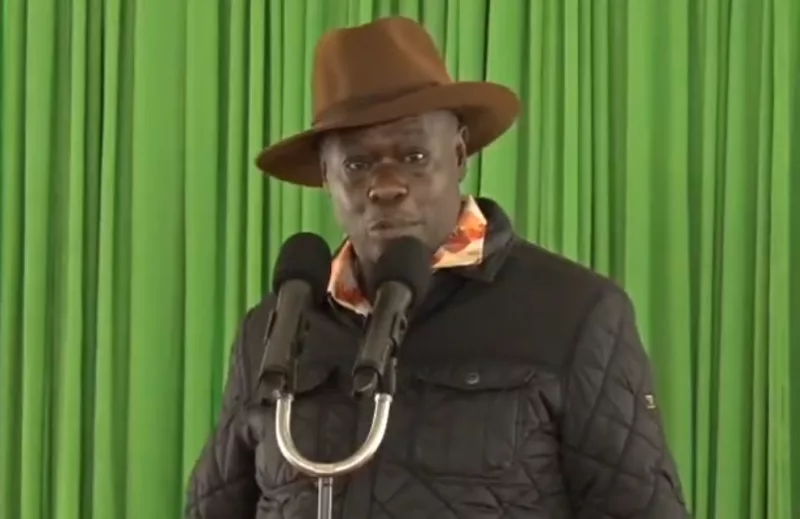
Speaking to a local vernacular radio station last week, Karachuonyo businessman and former parliamentary aspirant, Martin Onyango Osumba, equated ODM rebels to spouses in a polygamous union.
He said they behave like they have been caught in an uncompromising situation with a stranger, but upon being sent to the their parents as part of launching the usual traditional mediation to save the marriage, they run off with the said stranger, declaring that they have no apologies to make for their actions!
I wouldn’t have quite put it that way myself, but Osumba had an interesting rider; that if the regime seeks to work with opposition, or in this case Luo Nyanza MPs, the more credible route would be to work with all MPs and not just a select group. The latter act, in his view, amount to the textbook definition of divide and rule.
I couldn’t agree more. Multiparty democracy, it turns out, is still a strange phenomenon to those who get elected to the lawmaking organs of the nation.
You have to weep for the founding fathers of our pluralism. Just three years into independence, in June 1966, Kenya held the famous and aptly named “Little General Election”. It was occasioned by several defections from Kanu to the newly formed Kenya People’s Union, led by former Vice President Jaramogi Oginga Odinga.
Even as a nascent democracy, through this action, the guiding principle had effectively been launched in the country; that those who no longer embraced the ideals and political philosophies of their sponsoring parties ought to cross the floor, resign from those parties and seek fresh mandates through their new political vessels.
When multiparty democracy returned to the country at the 1992 general election, after a long hiatus, this principle seemed to hold, because, subsequent to the elections, Kanu poached quite a number of opposition MPs.
They included Apili Wawire (Lugari), Protus Momanyi (Bonchari), Nicodemus Khaniri of Hamisi, Japheth Shamallah (Shinyalu), Benjamin Magwaga (Ikolomani), Javan Omani (Lurambi), Charles Owino (Migori), Tom Obondo (Ndhiwa) and Ochola Ogur (Nyatike). True to the precedent set by the 1966 defections, these gentlemen all resigned their seats and occasioned by-elections in their constituencies.
Of course, there is also the matter of the resignation of Raila Odinga from Ford Kenya to join NDP in December 1996, at great political risk as far the subsequent by-election was concerned. I will not, however, lump him in the same basket as these regime apologists who were swayed by goodies to ditch their parties, because Raila’s was a rare act of supreme principle that one no longer encounters in these shores.
Years after the restoration of multiparty politics and following all these precedents set both in 1966 and the period between 1992 and 1996, one would have expected that we should have made progress.
That is in terms of in instilling party discipline, choosing parties based on their political ideals and remaining true to the mandate or resigning when the political vessel no longer represents one’s aspirations. In any case, in the advanced democracies we look up to, and on whose foundations we seek to tailor our own, the Americans and the British, you wouldn’t find a Republican becoming Democrat overnight or a Conservative singing Labour tunes at a public rally. We have truly regressed.
A lot of the blame has to go to the ruling elite. The Kenya Kwanza regime or its leader (or both) seemed to suffer such a crisis of confidence right from the onset, that the President-elect was poaching opposition legislators even before taking the oath of office in September 2022.
It was unprecedented.
However, in encouraging rebellion in other parties, the ruling coalition hypocritically turns a blind eye to the fact that it runs such a tight choir of legislators, one-tune voting machines, that dissent in its ranks is alien.
During voting on the Finance Bill, 2023 only Githunguri MP Gathoni wa Muchomba opposed the proposed law on the government side. But even she had to go quiet after that, with reports suggesting that she sought rehabilitation back into the mainstream with a pledge never to repeat the mistake.
The rest of the Kenya Kwanza elected legislators are happy to dwell within their echo chamber of a tight chain of command, where voting in the Houses could as well be done by robots. This, surprisingly, is the bandwagon vociferously demanding that ODM respects “democratic tenets”. It is laughable.
Rebel ODM MPs cited for expulsion by their party have stated that they have no apologies to make for working with the ruling party. I wish they would express “no apologies” by joining the UDA party in broad daylight and running in subsequent by-elections, to show their benefactor that they can both mobilise support in their land for him as well show political bravery by taking the risk.
Having no apologies for crossing the floor while still hanging onto a political party whose ideals you no longer believe in is an act of political fraud.
There are certain quarters that believe that these expulsions will not actually materialise. In response, ODM secretary general, Edwin Sifuna, appearing on a morning talk show on a local radio station on Monday this week, explained that even though past expulsions were not properly expedited because the electoral cycle always caught up with the processes, this time the process has begun early enough to be completed in time, all factors considered.
I do hope that the party will invest time and resources in the endeavour, however long it takes, so as to restore some discipline within the multiparty framework and lay some ground rules to determine the face of a future typical political formation.
The argument most commonly thrown about by the party rebels is that they go to State House to seek development for their people. You would be forgiven if this makes you wonder if we are back to 1988 and President Moi is still in power. Unwittingly, this theory helps advance the cancer of marginalisation, because it openly accepts the flawed principle that if you don’t capitulate before the president, your area will not benefit from state development, funded by all taxpayers.
The MPs in effect hurt the prospects of the rest of the nation by being purveyors of exclusion. In any case, the 2010 Constitution created institutions, both devolved and national, which sought to bring fair development to all, without discrimination based on political persuasion.
One thing that will surprise ODM rebels from Luo Nyanza is that trackers of the indicators of development are in consensus that real government projects, inclusive of huge infrastructural and energy projects, mostly came to their land when the community, through its leader, worked with the government, first during the Kanu-NDP union, followed by the period of the national accord government and finally during the Handshake with President Kenyatta.
In other words, it is much easier for the entire community to achieve set objectives by bringing its collective weight to the negotiating table through its leader, rather than through eight or nine photogenic individuals singing government tunes on the State House red carpet.
And this is before you consider the interesting spectacle that should the community’s leader reach a truce with the sitting President, the rebels would be an immediate casualty, because who will want the political passenger once he gets the driver?
Political commentator