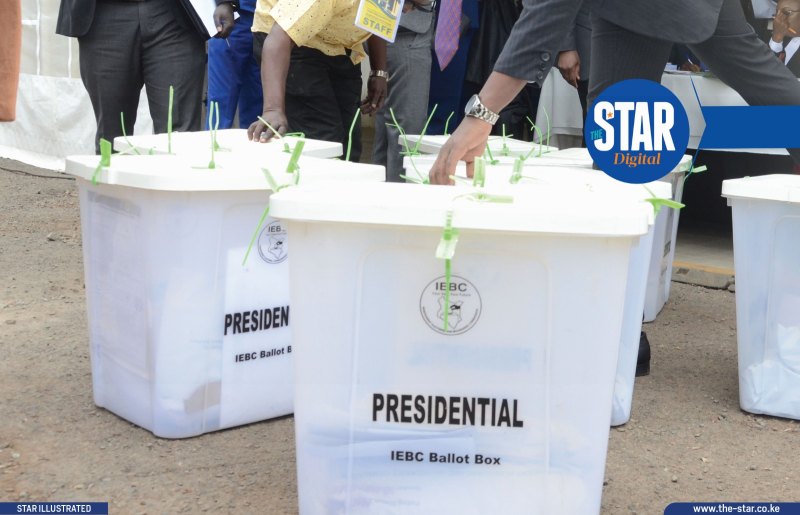
Indefatigable, tenacious and relentless, Ruto on Monday was declared President-elect, making history as the first deputy to succeed his boss through an election. He broke the 'curse' of the vice president or the deputy president.
Ruto surpassed the required 50%+1 mark, winning the presidency in the first round of his debut run for the presidency.
He won the hotly contested election against Raila after garnering 7,176,141 to Raila's 6,942,930 votes, the IEBC said.
It will be challenged in court.
Ruto started campaigning to succeed his boss, President Uhuru Kenyatta, immediately they took office in 2017. The President was irked, told him to do his job and then criticised him as the 'tangatana' man, wandering around.
Ruto's supporters seized on the amusing tangatana label to call themselves the Tangatanga brigade. It stuck. He began to shape the narrative, splitting Jubilee into Tangatanga and Kieleweke factions.
He made frenetic countrywide forays that took him into villages and far-flung areas, anchoring his campaigns at the grassroots.
Ruto once said he did three meetings or events in the morning before Uhuru woke up.
He appealed to the hustlers, the hardworking, the enterprising Kenyans, many of them jobless, who seized opportunities and needed backing. His UDA symbol was the wheelbarrow.
He crafted a hustlers versus dynasties narrative that resonated with masses of disgruntled and unemployed Kenyans, rural and urban. It sent chills down the spines of the establishment and, no doubt, the President.
It was branded too divisive, so Ruto toned it down and broadened it to include all Kenyans, saying all Kenyans are hustlers. He reassured them he was not against anyone.
The DP said Kenya was in need of radical reforms, job-intensive investments and debt restructuring — not business as usual, represented by Raila-Uhuru.
Heretofore, before he shook hands with the President and called a truce, Raila had been the voice of the disenfranchised, the masses. Then, Ruto said, Raila became the establishment and Ruto's camp called him a government project, a label that was hard to shake.
Raila was called a continuation of the bad judgments that landed Kenya in debt and in suffering.
Ruto took credit for achievements during his first term with President Kenyatta, notably the Big Four, but said they were abandoned in the second term for BBI. He opposed the constitutional change process that was shot down by the courts as unconstitutional.
He and his allies were pushed out of government and positions of leadership in Jubilee and Parliament. The DP emphasised the sidelining. He called for a bottom-up economic model, not a trickle down approach of mega projects that didn't provide many jobs.
In launching his manifesto, Ruto drew a contrast between President Kenyatta's big projects that created relatively few jobs at a big price, and his own ideas about investing in labour-intensive projects.
“We launched a gun factory in Ruiru recently. The project was built at Sh4 billion and only created 100 jobs. This means that it cost Sh40 million to create a single job.
"The county government of Kitui created a garment manufacturing industry worth Sh168 million to create 600 jobs. This means it cost Sh280, 000 to create one job. Where do we invest?” he asked.
Ruto employed strategies that included drawing in kingpins from regions perceived to be Raila's support bases, and doling out benefits to residents in every region.
In his first term and second term until official campaigns began, Ruto was known for munificent gifts to churches.
He said not a single vote would be stolen and he knew he had to prepare well.
The now President-elect had a secret parallel tallying system manned by tech-savvy individuals, including former CS Davis Chirchir, an IT guru and Ruto's chief of staff. He had been CS for Energy and Petroleum.
At the polling stations, Ruto had tough, eagle-eyed agents that ensured his votes were protected.
To earn his victory, Ruto persuaded ANC leader Musalia Mudavadi and Ford Kenya's Moses Wetang'ula to join him, among others from Western. They ensured the region's more than two million votes were not split.
The late entry of Machakos Governor Alfred Mutua may also have helped turn the tables on Raila in Ukambani, helping Ruto garner more votes than in 2017.
As Mutua bagged 304,809 for Raila in 2017, Ruto had 101,456, an increase from previous poll when they had 82,629. But Raila's Nasa collected 380,126 votes.
This time, in Bungoma, Ruto got 255,906 votes representing 63 per cent, as compared to 145,280 for Raila, which is 35 per cent. In Vihiga, he managed managed 67,633 against Raila's 114,714 votes.
In 2017, Raila had 284,786 votes in Bungoma, while President Kenyatta received 126,475. In Vihiga, Raila scored 179,140 as Uhuru managed 18,275 votes.
Bringing on board Mudavadi and Wetang'ula set back the Raila camp, which lost substantial votes from the region.
“Persuading the two leaders to join the Kenya Kwanza team was a master stroke," political analyst Godfrey Sang said. "It not only helped with the optics but also mobilised the restive region for Ruto," he said.
At the Coast, the DP assured residents he would revert port operations to Mombasa. Clearing agents, port workers, trucking businesses, stores, hotels and many other businesses are suffering.
The reason: President Kenyatta ordered the vast majority of cargo be carried by the SGR, not trucks, from Mombasa, to inland container terminals for clearance.
Ruto promised one of his first executive orders would be to revert many port operations to Mombasa.
He also convinced the PAA leader Amason Kingi to join his camp, delivering votes from the the Coast that traditionally was Raila's stronghold.
Mombasa delivered 161,015 votes for Raila as Ruto scooped 113,700, while in Tana River Ruto)got 41,505 while Raila garnered 51,390.
The UhuRuto team suffered heavily in 2017, getting only 99,190 votes as Raila ran away with 238,809.
The situation was almost the same in Lamu where Ruto had 22,876 as his rival recouped 26,160 votes.
To earn maximum votes from Uhuru’s Mt Kenya backyard, the DP approached young and influential politicians from the region.
They included Kimani Ichung'wah (Kikuyu), Ndindi Nyoro (Kiharu) and Moses Kuria (Gatundu South) among others.
The politicians, analyst Sang said, energised the support base by crafting an easy-to-understand message and one they could easily identify with. Help the people. Time for a change. Time for jobs, not tarmac you can't eat.
He said the President reneged on his earlier pledge of supporting Ruto starting in 2022, but now he didn't need the President.
Central leaders felt he was portraying the community as thankless for Ruto's delivering Rift Valley and many other votes during the President's two terms. Sang said this also drove Central leaders to rally behind him.
Sang said the establishment had painted Ruto in a very bad light in Mt Kenya and the DP cleverly used that to contrast with his obviously benevolent, amiable personality who would safeguard their interests.
The analyst said Ruto took to the ring, fighting his opponents with the gusto of a schoolyard bully, punching way above his weight.
“He cleverly ducked weighted punches aimed at him, bitterly frustrating his opponents. They were simply no match for him," he told the Star.
He added, “He dropped political epithets like breadcrumbs to a hungry electorate, which absorbed them with mirth.”
Apart from economic forums in counties, which were a complete contrast to how his rivals conducted their campaigns, Ruto also hardened Central Kenya from penetration by opponents.
Countrywide forums were planned so that residents volunteered their issues and problems, before they were documented and a charter signed with Ruto, giving people hope.
The Azimio la Umoja team conducted the usual campaigns, while offering promises many residents felt were empty, making them tend toward Ruto, Sang said.
Familiar with the existence of forces in government that were opposed to his leadership, Sang said Ruto put on a brave face to demystify it.
"As Deputy President, don't you think I'd know about a 'deep state'?" Ruto asked. He frequently said he only needed God and the people of Kenya.
(Edited by V. Graham)
“WATCH: The latest videos from the Star”


![[PHOTOS] Raila Odinga Stadium construction enters home stretch](https://cdn.radioafrica.digital/image/2026/06/45f6990c-4882-4cd2-b83c-8fc730dcdce5.jpg)