I learned that the nostalgic sport, on the second year of its return to Kenya, was going to pump at least sH5 billion into the Naivasha tourism and hospitality industry. Hoteliers were in cloud seven, while local homeowners were turning their yards into temporary campsites to capture rally fans locked out of fully booked facilities.
I browsed through the stories to see if there was a mention of the hard work and utter resilience that had been put into this success story by President Uhuru Kenyatta, sports CS Amina Mohamed and their teams.
There wasn’t much praise, so in my mind, I said “here goes one more thing Uhuru needs to put on a billboard for all to see”.
And as if on cue, the President, who had launched the rally in Nairobi on Thursday, was on location to preside over the presentation of trophies and closing ceremony on Sunday in Naivasha.
President Kenyatta is in a very unique position, compared to his predecessors. In a country where a leader’s bedrock of support remains his tribe first, he has largely lost his to years of indoctrination and brainwashing by his deputy. Effectively therefore, he is winding down the twilight of his presidency by having to use state machinery to explain his achievements to the population, rather than the usual political networks at the disposal of retiring leaders.
To be honest, even that state machinery is so clumsy that the image of the president as having failed his people refuses to go away. President Mwai Kibaki, now deceased, has been hailed in some quarters as the greatest of the four presidents so far.
This school of thought holds that Kibaki’s strength lay in a strong economy in general and infrastructural renaissance in particular. Without trivializing Kibaki's massive successes, I often get the feeling that because the Moi and Kanu regime was so bad, anyone who took over and sealed the corruption holes and the mismanagement of state resources would have made a brilliant president.
While everyone has their own gauge and parameters for greatness, my view is that such greatness should be based on the most unique achievements of the four gentlemen who have held the seat of President so far.
To my mind, the biggest threat to the sustainability of the nation is the culture of tribal exclusion, which has led to mushrooming of marginalized zones across the entire country.
Long-term, it was always going to be difficult sustaining a largely two-tribe rule, which defines the sharing of the national cake. Picture this: if Raila becomes President as expected, and goes ahead, for instance, to appoint a Luo as Chief of Defence, or Central Bank Governor, or even CS for Interior, it will be the first time since time since independence..
Simply put, if such a large community often touted as the citadel of academic excellence hasn’t come close to running critical government dockets that determine the destiny of both the country and resource allocation, just how badly off are much smaller, marginalized and disadvantaged communities?
Yet it has taken no less a person than President Kenyatta to confront this great sin of the republic. The fallout between Uhuru and his deputy may go down as the best gift to the country this decade. It allowed people in high places to reexamine the two-tribe stranglehold on power and how to break it for the sake of peace and long-term national security.
In doing so, and backing an unlikely candidate for successor, Uhuru has managed to dismantle the Luo-Kikuyu animosity that has been a gold mine exploited by political networks for years.
It is possible that after a Raila presidency, power will move on to another - probably smaller – tribe which will not have “tasted” it till then. This is not to say that the President Kenyatta did this while ignoring the pillars on which Kibaki built his perceived greatness.
If Kibaki was the father of infrastructure, Uhuru has been more than a capable stepfather, or mother, probably doing more. There has been no period in our lifetime that we had roads constructions, railway lines revival and ports resurrection like has been under the Uhuru regime.
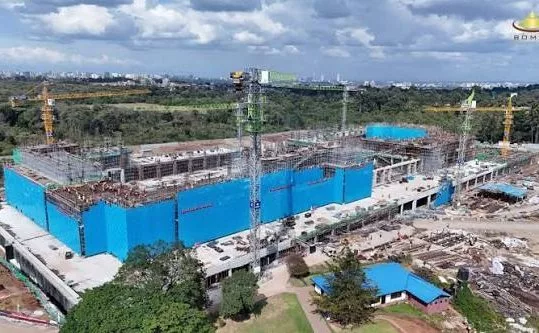
I marvel daily at just a three-kilometer section of Lang'ata Road, where there is a brand-new overpass at the Raila Odinga Way, Langata Road roundabout, the architectural wonder up the road that is now a civilian and military museum which used to be Uhuru Gardens and the brand new Ulinzi Sports Complex a little distance ahead. This, just along a small portion of road in a corner of Nairobi.
As a microcosm of the situation in the entire country, the infrastructure story doesn’t need many microphones to blare it out. Granted that there has been runaway corruption and a high cost of living under Uhuru, but every pointer from 2013 shows the government was set up to fail from the word go. This will in fact provide crucial lessons to future regimes and political deal makers.
In 2013, Uhuru was forced into an unlikely alliance brought about by the desire to circumvent the ICC trials at The Hague. At face value, that alliance sought to perpetuate a two-tribe rule negotiated on a 50-50 basis.
Conventional wisdom now has it that any non-members of those two tribes who made it into Cabinet did so through Uhuru’s side of the arrangement. Come 2017 and having been elected to serve a second term, therefore unencumbered with reelection needs, the President moved to repair the damaged national fabric, much to the chagrin of erstwhile, power-hungry coalition partners.
He had the chance to follow well beaten tribal paths and serve power back to his deputy like a volleyball. But he chose the route less trodden, one that required courage and vision.
It must be lonely being Uhuru Kenyatta, when your own political base sings farewell songs longing to see your back. But beyond the infrastructure, the economy, the government prestige and all these eye-catching developments that usually provide the image of growth to the casual observer, I hail Uhuru for turning his back on the orchestra and doing what had to be done.
He has reversed the equation; rather than have two tribes in power and forty watching hungrily outside, he has created a multi-tribal coalition which may end up with 40 tribes in power and just two playing the role of opposition. Perhaps even one, if the mountain region flips. Democracy presupposes a rule by the majority.
By flipping this equation, Uhuru will singlehandedly ensure long-term stability, heal deep tribal divisions and move the country forward from a point of long stagnation. In my view, for this alone, greatness shall follow him into retirement.
I might even dare declare him the greatest of the four past presidents, for finding out where the shoe pinched us the most, and courageously addressing it!


![[PHOTOS] Linda Mwananchi takes Trans Nzoia by storm](https://cdn.radioafrica.digital/image/2026/07/0d132395-ad4b-4671-867e-880c9f8144f5.webp)