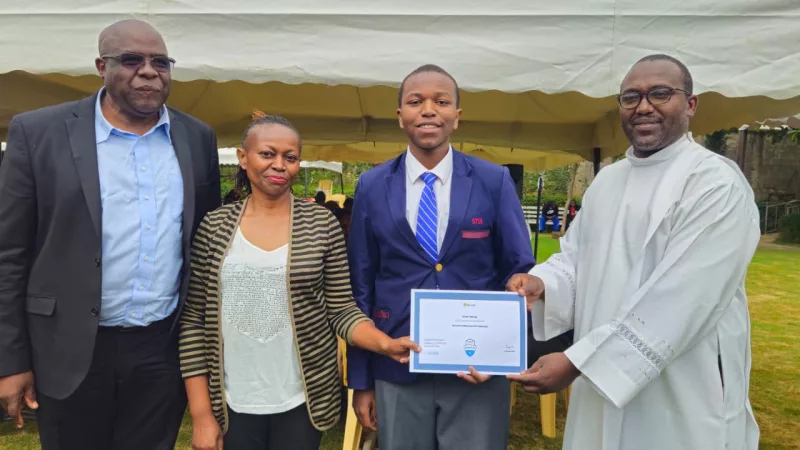
 At an age when many students are only discovering career options, Ernest Wamae, a form 4 candidate at Pioneer School-Maragua, challenged himself to earn a globally recognized Microsoft AI Certification—and passed with an impressive 82%. With him are (from left) Chairman of Form 4 Parent Representative Lincoln Asembo, Waithira Muthoga (Mother to Ernest) and Catholic Priest Fr. Chege./HANDOUT
More than 500 students from Pioneer Secondary School in Maragua, Murang'a County, have completed Artificial Intelligence (AI) training, adding to growing calls for the Ministry of Education to introduce AI as a subject in secondary schools.
Education stakeholders say Kenya needs to align its education system with the demands of the Fourth Industrial Revolution, where AI is increasingly shaping industries, businesses, and the labour market.
They argue that exposing learners to AI at the secondary school level would equip them with the practical digital skills needed for future careers.
Pioneer School says it is among the institutions that have taken early steps to integrate AI into learning by offering the programme to Form Three and Form Four students.
According to the school, more than 500 students have successfully completed the AI course after undergoing training designed to introduce them to coding, data analysis, and technology-based problem-solving.
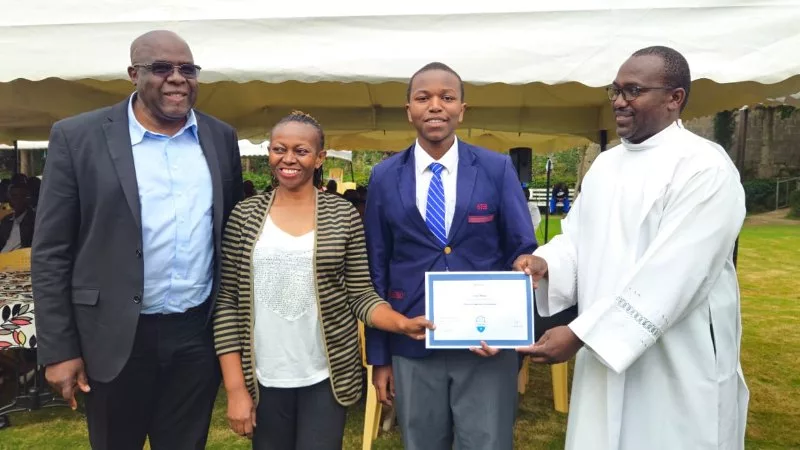 At an age when many students are only discovering career options, Ernest Wamae, a form 4 candidate at Pioneer School-Maragua, challenged himself to earn a globally recognized Microsoft AI certification—and passed with an impressive 82%. With him are (from left) Chairman of Form 4 Parent Representative Lincoln Asembo, Waithira Muthoga (Mother to Ernest) and Catholic Priest Fr. Chege./HANDOUT
During a mentorship session attended by parents, teachers, and other education stakeholders on Saturday, 13 students received globally recognised AI certificates after attaining scores above the required pass mark.
The school's Director, Dr Peter Munga, said the institution has continued to introduce programmes aimed at equipping learners with practical skills that respond to changes in the global job market.
He said schools should not only focus on academic performance but also expose students to skills that prepare them for emerging career opportunities.
Microsoft engineer and AI instructor Chege Warigia said the course introduces students to coding, data management, and problem-solving using artificial intelligence.
He said the training combines classroom learning with practical projects to help students understand how AI can be applied in real-life situations.
Warigia said students have already developed an application that assists them in revising science subjects, describing it as an example of how learners are applying the skills acquired during the programme.
He said the practical approach gives students a foundation on which they can build as they pursue further studies or careers in technology-related fields.
Besides AI, the school has also introduced Marine Studies as part of its efforts to expose students to careers beyond traditional professions.
Students enrolled in the programme received certificates and passports issued through the Kenya Maritime Authority after completing the training.
Marine Studies instructor Engineer Titus Kiprotich said the maritime industry offers a wide range of employment opportunities, including ship engineering, marine security and other specialised fields.
He encouraged students to consider careers in the maritime sector, saying the industry has the potential to create employment opportunities for young people.
The school has also introduced medical training aimed at giving learners basic healthcare skills.
Students enrolled in the programme are taught practical skills, including how to measure blood pressure, as part of their introductory medical training.
Dr Munga said the institution will continue expanding programmes that expose learners to practical knowledge alongside the regular curriculum.
Instructors involved in the AI, marine and medical programmes said early exposure to specialised skills can help students make informed career choices and improve their preparedness for higher education and the workplace.
As schools prepare for this year's national examinations, Pioneer School's Deputy Principal in charge of Academics, Simon Kung'u, urged parents to support efforts aimed at maintaining the integrity of examinations.
He cautioned against practices that could undermine the credibility of national examinations and called on parents to work closely with schools to ensure candidates prepare honestly.
Kung'u said examination preparations at the school are underway and appealed to learners to rely on revision and hard work rather than seeking unfair advantages.
Education stakeholders who attended the mentorship session reiterated that equipping learners with emerging technological skills alongside conventional classroom learning would better prepare them for a rapidly changing job market driven by advances in artificial intelligence and other technologies.