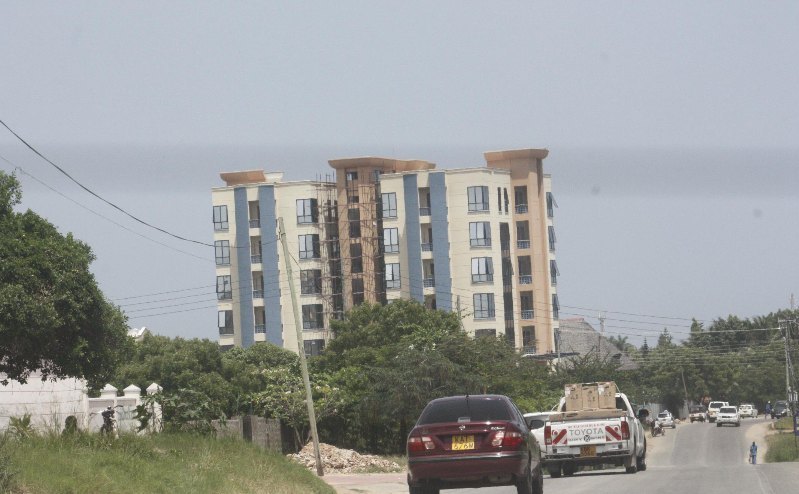
Last week, I mentioned that the only thing different about Mombasa is the skyline. Over the years, the historic town with a bursting bloom of tropical trees has gradually transformed into a concrete forest. Almost every old Swahili house has been converted into a block of flats with a minimum of three storeys.
If you
are from Mombasa like I am, you understand that the root cause of this is
almost always inheritance. The couple who built the Swahili house have long died,
and the house is meant to be inherited by several siblings. The simplest
solution is often to sell the house and divide the income. Those who buy are
developers with a foresight of commercial purposes. They intend to tear down
the historical buildings and replace them with multi-level structural
monstrosities. As a result, the once quaint skyline of Mombasa is now a
grotesque view of giant apartment buildings competing to tower over each other.
As you pass by the Nyali Bridge on your way to Nyali, you would see various ginormous buildings towering in the sky on both sides of the bridge. Nyali itself has transformed into a mini Westlands area, where tall apartment and commercial blocks barely have three inches of space between them.
These suburbs that bordered the ocean front, Tudor, Kizingo, Nyali and Kilifi were once affluent suburbs boasting privately gated homes. Currently, every green space left is a construction zone in the midst of transforming into a concrete tower. Very few original homes are left, and even those people are pressured into selling because they are surrounded by tall buildings on all sides and have no privacy at all.
I suppose we can claim that the city is growing and that the demand and supply have increased exponentially. But it is evident that the construction has by far surpassed the demand.
Underneath the surface of these ‘luxury styled’ apartments is an unspoken secret. The truth of the matter is that most of these apartments are empty. Some are, of course, a front for laundering money, and some are properties belonging to foreigners. Most of these apartments are empty because of the exorbitant rent prices, some are private holiday homes and, of course, Airbnbs. There is a seasonal competitive market for Airbnbs. However, for the rest of the year, the flats stay empty.
There are several buildings that are more than 10 storeys tall and have hundreds of units, but 50 per cent of these buildings remain unoccupied. On Links Road, Nyali, there is a building that has stood for more than 20 years and remains almost completely unoccupied. Other than the shopfronts on the ground floor and one or two visible curtains, most of this 10-storey building has been empty for the better part of two decades.
When
the FBI released the information that fraudulently gained money was stashed in
Kenya in the form of real estate, it made a lot of sense to those of us who pay
attention. We know that people in the diaspora have money, but they don't have
the kind of money to buy properties in Kenya and leave them empty without
gaining anything from them. It only took the FBI reports to understand that
these people were not buying to gain; rather, they were buying to hide
something.
As we stand, the American government is really driven into recovering all their stolen funds. It’s only a matter of time before some of these properties are seized and recovered. What happens then? What happens to the innocent people who bought these fraudulently acquired real estate unknowingly? The future is uncertain. Some of it can be seen from the abandoned construction sites and buildings all over the town.