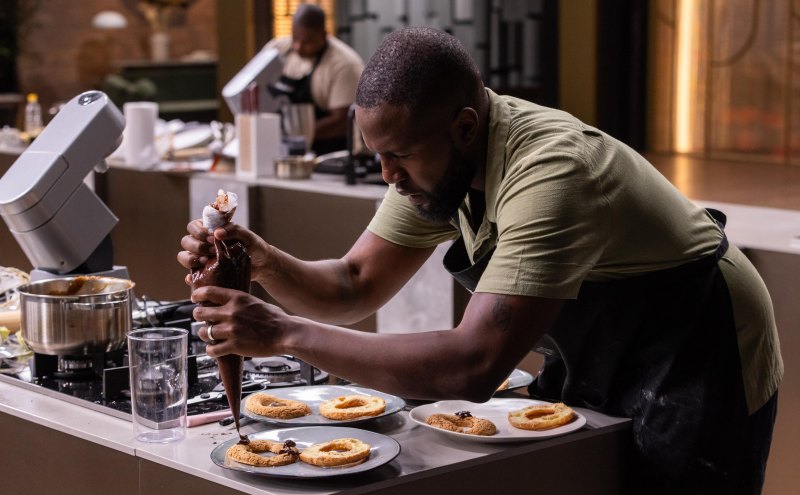
For most of us, the reality cooking show MasterChef is something we put on TV on a Friday night, eating takeout while watching 24 amateur home cooks trying to create restaurant-level dishes.
Masterchef is a highly successful reality TV show that originally launched in the UK in 1990. It was revamped in the early 2000s and franchised into multiple regions across the globe. MasterChef South Africa initially hit the airwaves in 2012 and is currently airing its sixth season.
The latest season features Kenyan-born and South African-raised Philip Munda. Philip, a 33-year-old surgeon with no professional culinary background, took a chance on himself and entered the competition.
Even though Philip is self-taught and cooking is just a hobby, he surprised himself and fans everywhere when he survived the gruelling competition, winning challenges and impressing judges with his own unique blend and style of cooking. Not only was Phil selected as a sixth season cast mate, he made it into the top 10 finalists.
As an avid fan of the series myself, I knew I had to sit down with the good doctor (a nickname he earned amongst his castmates) and get the scoop.
Wow! You finished amongst the top 10 contestants in MasterChef South Africa. What does that feel like?
Honestly, it still feels surreal. MasterChef was something I watched from my university days, back when I could barely fry an egg properly. To stand in that kitchen and make it into the top 10 feels like a dream fulfilled. I’m incredibly proud of how far I came, especially while balancing a surgical career at the same time. The competition pushed me emotionally, creatively and mentally in ways I never expected. I had real doubts about my abilities when I saw the skills and plating some of the other contestants produced. It was really a case of surviving each day. When I ended up in the top 10, I was over the moon!
You are a medical doctor and surgeon by profession. That is completely different to the food industry. How did you start cooking?
In 2012, I moved out of university residence in Cape Town and into a house with five of my friends. Gone were the catered meals, and so we had to cook to survive. My mum taught me some basics and that same year, I began watching MasterChef Australia. The show ignited my passion for experimenting and creating something beautiful.
How does one go about developing their cooking skills from being a hobbyist or home cook to having MasterChef-level skills?
It’s really about curiosity, consistency and not being afraid to make a mistake. The thing that holds most home cooks back in my opinion is rigid adherence to a recipe. A recipe is simply a guideline and the best way to develop skills is to try your own experiments and twists on recipes you love or even better, recipes you like but feel can be improved. There's no one right way to cook anything, so allowing yourself to find the way that’s right for you is the first big step in being a confident homecook. I think people underestimate how much failure is involved in improving as a cook. Every bad sauce, split emulsion or overcooked protein teaches you something.
Did you watch a lot of cooking competitions before, and what motivated you to apply for Masterchef SA?
Absolutely. I grew up watching MasterChef Australia and other food competitions, and I loved how food could tell stories or showcase personality. I was also previously on Come Dine With Me South Africa, so it's clear I enjoy cooking and putting on a show.
Applying for MasterChef SA was about pushing myself outside my comfort zone and seeing whether I could compete at that level. I also wanted to prove to myself that it’s never too late to chase a creative dream, even while working in a demanding profession like surgery.
What food did you cook during the audition, and what made you believe that that particular plate would get you through the selection process?
I made a chicken tortellini. I chose it because it showcased strong technical skills through the pasta making, but also allowed me to focus on flavour in both the filling and the cream sauce. I wanted to present something refined but comforting at the same time. It felt like a dish that represented where I was as a cook; technique-driven but still rooted in warmth and flavour.
How would you describe your experience in the MasterChef kitchen?
It was intense, emotional, inspiring and honestly life-changing. You’re constantly pushed outside your comfort zone, but you also grow incredibly quickly because you’re surrounded by talented people who love food just as much as you do.
If you could pick a highlight moment, what would it be?
Definitely the chocolate challenge and my duck dish. It was one of those moments where creativity, technique and flavour all came together perfectly and I felt truly proud of what I put on the plate.
What was the hardest challenge? The chicken elimination challenge was by far the toughest. We had to produce multiple dishes in only 75 minutes. Which was already incredibly stressful, but emotionally it was even harder because we were cooking against our own teammates after feeling we had actually performed really well in the previous challenge and lost by extremely narrow margins.
What would you say was the most important lesson you got out of this experience? Flavour is king. I also learned that simplicity is often the key to success. My final dish was probably overcomplicated, and sometimes restraint and clarity are more powerful than trying to do too much.
As a foreigner in South Africa, did you feel you were at a disadvantage in terms of the local cuisine and flavours? Did you incorporate flavours and dishes from your background in the competition?
Not really. I was born in Kenya but grew up in South Africa, so my cooking identity is shaped by both cultures. I think that actually became an advantage because I naturally gravitate towards bold flavour and diverse influences. In the first challenge, we had to create a dish based on nostalgia, and as a proud Luo man, I was so happy to be able to create an elevated version of my favourite food at home: ngege and ugali. I filleted the tilapia and pan fried it while using the bones, tomatoes and coconut milk to create a delicious bisque. I went a step further with the ugali, which I turned into a mousse using the espuma gun, my cousins were not impressed with me but it did the job!
A lot of contestants like to say, ‘That is me on a plate.’ What would be ‘Phil Munda on a plate?’
There would definitely be bold seasoning, a strong sauce component and probably some unexpected combination that somehow still feels familiar. I think my peanut butter chicken curry is an excellent example of this. Something most people would baulk at initially but be immediately won over by the taste. My food reflects my personality: creative, ambitious and a little chaotic at times, but always sincere.
Who is your biggest culinary inspiration?
Massimo Bottura. I was lucky enough to meet him in 2021, and what really stayed with me was his philosophy around food. I admire his no-waste approach and the fact that despite being one of the most highly regarded Italian chefs in the world, he isn’t rigid or trapped by tradition. He treats food as art and emotion. That freedom and creativity really resonate with me because I believe food shouldn’t be overly regimented; food is art and magic. It should be allowed to flow freely and be shaped into whatever form is best for the people being served.
We have to talk about the mille-feuille, a complex dessert that saw you get eliminated. What went wrong? And if you were to go back in time, would you make a different choice?
I think I fell into a common MasterChef trap of trying to go for something very complicated, aiming for a win when a safe choice would have seen me through. I had a number of challenges that led to my downfall that day, starting with my oven mysteriously turning to off without me noticing, which meant my biscuits were warm when I added the mousse, which led to everything melting and splitting.
I wish I had gone for a much simpler Biscoff Tiramisu, which is something I have made before, but I thought it was much too simple for the MasterChef top 10. Hindsight is 20/20 as they say.
What’s next for Dr Phil Munda in the culinary world?
Right now I want to continue building my presence in the food space, while still practising as a surgeon. I’d love to keep creating content, developing recipes and exploring opportunities that allow me to combine storytelling, food and creativity. MasterChef was never the end of my journey. For me, it was the beginning of a much bigger culinary story.