 Beijing Planning Exhibition Hall
“The story of Beijing begins long before the city's skyscrapers, high-speed trains and bustling avenues. It begins on a map,” began our tour guide.
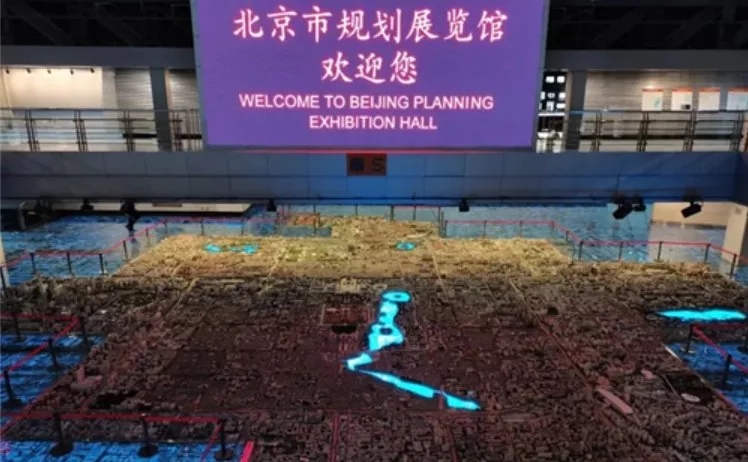
Susan Chan as we stopped to look at the map of Beijing.
Inside the Beijing Planning Exhibition Hall, located near Tiananmen Square, visitors are greeted by centuries of urban history carefully preserved in maps, photographs, models and interactive displays. The museum is not as famous as the Forbidden City or the Great Wall, yet it may be one of the most revealing places in China's capital. Here, Beijing tells its own story not only of what it was, but also of what it hopes to become.
As I wandered through the exhibition halls, studying faded maps of imperial Beijing and photographs showing dusty streets lined with bicycles, I began to understand that the city outside the museum's doors is the result of centuries of reinvention.
The museum serves as a bridge between old Beijing and modern Beijing, helping visitors make sense of a city that has transformed itself repeatedly while maintaining a strong connection to its past.
“Beijing is the capital city of China, located in the northern part of the country on the North China Plain. It is one of the world's oldest continuously inhabited cities and serves as China's political, cultural and historical centre. The name "Beijing" means "Northern Capital" in Mandarin Chinese, distinguishing it from Nanjing, which means "Southern Capital," explained Chan our guide.
Beijing has a history spanning more than 3,000 years and has served as the capital of several Chinese dynasties, including the Yuan, Ming and Qing dynasties.
Chan added that Beijing was chosen as China's capital largely because of its strategic location and political significance.
“Situated on the northern edge of the North China Plain, it served as a crucial defensive position against invasions from the Mongolian steppes while remaining connected to China's agricultural and economic heartlands,” she explained.
The city first rose to prominence as the capital of the Yuan Dynasty under Mongol ruler Kublai Khan in the 13th century, but its status was firmly established in 1421 when the Yongle Emperor moved the capital from Nanjing to Beijing and built the Forbidden City as the seat of imperial power. Over the centuries, Beijing became the political, cultural and administrative center of China, a role it retained when the People's Republic of China was established in 1949. Today, the city symbolizes the continuity of Chinese civilization, linking the country's imperial past with its modern ambitions.
The Beijing Planning Exhibition Hall demonstrates how urban development in China is closely linked to national ambitions. Planning is not viewed merely as the management of roads and buildings but is presented as a tool for shaping economic growth, cultural preservation and quality of life. It, in addition, provides insight into how China views its cities as living projects that can continuously evolve.
One of the hall's most striking features is a giant scale model of Beijing that occupies an entire floor. Visitors can walk around the illuminated model and observe the vast urban landscape stretching in every direction. Government buildings, residential districts, parks, transport networks and landmarks are all represented in extraordinary detail.
Standing above the model, it becomes clear that Beijing is not a city that emerged by chance. It is a city that has been planned, redesigned and expanded across generations.
The exhibition traces Beijing's evolution from an ancient capital to a modern megacity of more than 20 million people. Through maps dating back to different dynasties, visitors can see how emperors designed the city according to principles of order, symmetry and power.
The city's famous central axis, which runs through many of Beijing's historic landmarks, remains one of the defining features of the urban landscape today.
The exhibition hall uses technology to bring this history to life. Interactive digital screens allow visitors to compare different periods of urban development. Historical photographs show crowded hutongs, traditional courtyard homes and marketplaces that once formed the backbone of everyday life. There are also displays illustrating how Beijing's population, transportation systems and architecture have evolved over time.
Another thing that fascinated me is how story telling has been used as a tool to reveal how every generation has left its mark on the city. The museum does not merely celebrate these changes but explains them to every visitor that steps in to learn.
While the imperial city gave Beijing its palaces and ceremonial avenues, the twentieth century introduced industry and modernisation. The twenty-first century brought digital technology, green spaces, high-speed rail and some of the world's most ambitious urban planning projects.
One gallery focuses on Beijing's environmental transformation. Visitors learn how authorities have expanded urban parks, improved air quality and invested in greener forms of transport. Models and digital displays illustrate efforts to create a more sustainable city while accommodating continued population growth.
Another section explores transportation, one of the most remarkable aspects of contemporary Beijing.
The displays show the evolution from bicycles and buses to one of the world's most extensive subway systems. Maps illustrate how new rail lines have connected distant districts and reduced travel times across the sprawling metropolis. The exhibits provided context for the city’s present-day mobility as I experienced Beijing’s metros later on during my brief visit in China.
Additionally, the museum highlights Beijing's preparations for major global events, including the 2008 Olympic Games and the 2022 Winter Olympics, both of which accelerated infrastructure development and urban renewal projects.
After spending several hours examining Beijing's
history, I left the museum and walked through the surrounding streets with a
new perspective. The wide boulevards, modern office towers and carefully
maintained public spaces no longer appeared as isolated features but they
became chapters in a much larger story.