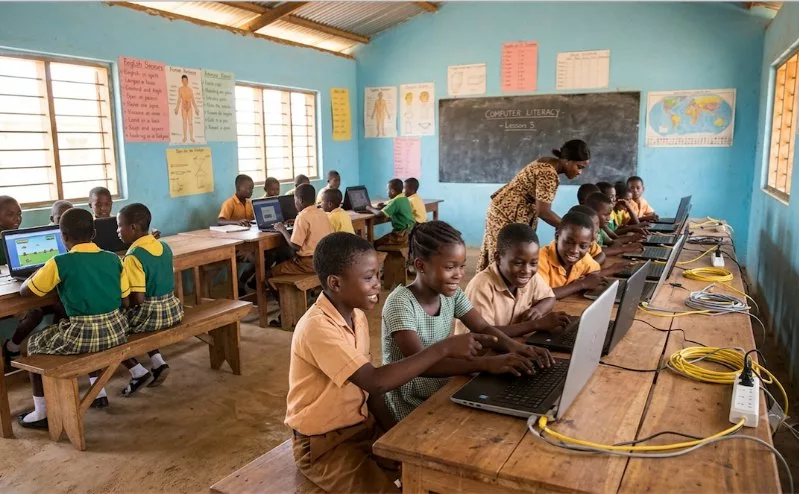
A child seeing a computer for the first time will not forget the moment.
The screen lights up. The keyboard looks unfamiliar. The mouse feels strange in the hand. A classroom that has always depended on chalk, exercise books and imagination suddenly meets another world.
That is the beauty of DigiTrucks and mobile digital labs. They take ICT training to places that may not have computer rooms, reliable electricity, internet access or enough devices. For learners in under-resourced communities, such a truck can do what speeches about digital transformation cannot do. It can place technology directly in front of them.
That matters.
But Kenya should be careful not to confuse a powerful intervention with a complete education system. A truck can open a digital classroom. It cannot become the school system.
The real question is what remains after it leaves.
Digital inclusion is not achieved when learners touch computers once. It is achieved when they practise repeatedly, when teachers are confident, when devices are maintained, when internet access is reliable, when learners understand online risks and when schools can continue using technology after visitors have gone.
A mobile lab can spark interest. Continuity builds competence.
This distinction is important because the digital world into which children are being introduced is not innocent. The same internet that offers learning also carries phishing links, fake scholarships, betting traps, cyberbullying, identity theft, misinformation, manipulated images, online predators and artificial intelligence tools that can produce convincing falsehoods.
Teaching a learner how to use a computer without teaching her how not to be deceived online is incomplete education.
The first ICT lesson should not only be how to type, open a browser or create a document. It should also include how to protect a password, recognise a scam, question a suspicious link, avoid sharing personal information carelessly, verify online information and report harmful digital behaviour.
Cyber hygiene is now basic literacy.
This is where many digital education projects fail. They count devices, training sessions and beneficiaries, but they do not always measure whether learners can use technology safely and meaningfully months later. A photograph of excited learners around computers is not impact. Impact is when those students can return later and use digital skills for learning, work, business, communication and self-protection.
Teachers must be at the centre. A DigiTruck may arrive with equipment and trainers, but the teacher remains after the engine leaves. If teachers are not trained and supported, the project becomes an event. If teachers are empowered, it becomes capacity.
Kenya should therefore treat teacher digital competence as seriously as device supply. A teacher who understands ICT can turn even limited equipment into learning. A teacher who fears technology may lock devices away, avoid the lab or reduce digital learning to occasional demonstrations.
Maintenance is another uncomfortable truth. Many ICT projects look impressive at launch and weak after a year. Devices break. Passwords are forgotten. Software becomes outdated. Internet bundles run out. A projector fails. The trained person is transferred. A computer room becomes a locked room.
Digital inclusion often dies quietly, not because people oppose it, but because nobody budgets for support.
Every mobile ICT programme should therefore leave behind a simple continuity package: a trained teacher, a local digital champion, basic cyber-safety materials, a maintenance contact, a follow-up schedule and a way of measuring whether learners improved. Without this, communities receive excitement, not transformation.
There is also a curriculum opportunity. Learners should not be taught technology as if they are only future users. They should be introduced to creation and problem-solving. A child in a farming community can learn how digital tools support weather information, markets and farm records. A learner in a trading centre can learn about mobile-money safety, customer records and online marketing. A student anywhere can learn that artificial intelligence can help with learning but can also mislead if used blindly.
ICT education should make learners confident, but also cautious.
The digital divide has changed. It is no longer only the gap between those who have devices and those who do not. It is also the gap between those who can question technology and those who are quietly controlled by it. A learner who can browse but cannot verify is still vulnerable. A learner who can create an account but cannot protect it is already exposed.
That is why DigiTrucks should be welcomed, but not romanticised. They are useful bridges. They are not the destination.
Kenya needs permanent school ICT capacity, community digital hubs, trained teachers, safe connectivity, local content, repair skills and cybersecurity awareness from early learning. A mobile lab should be the beginning of a local digital culture, not a substitute for one.
The goal should not be a child who once saw a computer.
The goal should be a learner who can use technology safely, creatively and confidently long after the truck has moved on.