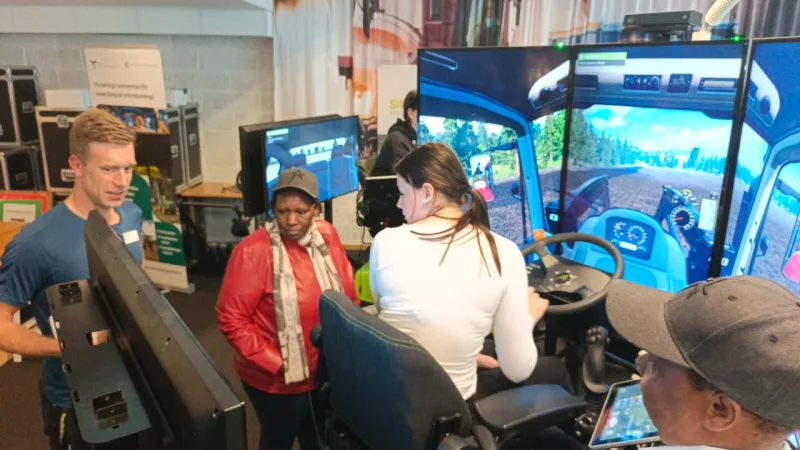
 A student on the Tenstar Simulation Equipment./HANDOUT
The future workforce may be trained for jobs that do not yet fully exist, using technologies many institutions do not yet possess. This is the current reality, and it presents both a challenge and an opportunity for education systems across Africa.
Kenya, like many countries on the continent, is sitting on a demographic advantage. With a youthful population and growing ambitions around industrialisation, renewable energy, digital transformation, and green growth, the country has no shortage of potential. The real question is whether our education and training systems are evolving quickly enough to prepare learners for the industries that are emerging around us.
For decades, Technical and Vocational Education and Training (TVET) institutions have played a critical role in equipping young people with practical skills for employment and entrepreneurship. Yet as industries become more technologically advanced, a new challenge is emerging. The pace of technological change is often moving faster than the pace at which institutions can acquire equipment, modernize workshops, update curricula, and retrain instructors.
This became particularly evident during a recent benchmarking visit to Sweden, where I had the opportunity to join leadership and engineering faculty from Rift Valley National Polytechnic and Maliti Technical Training Institute in exploring simulation-based learning solutions at Tenstar Simulation.
Tenstar develops simulation-based training solutions for sectors such as agriculture, construction, transportation, traffic, and forestry, allowing learners to practice real-world operations in safe, realistic virtual environments before operating actual equipment. Their mission is built around safer, more efficient, and greener training environments for future operators.
What struck me most was not the sophistication of the technology itself. It was the philosophy behind it. To me, I saw the future of learning.
Access to Experience
For many years, practical training has depended heavily on physical infrastructure. Whether training heavy machinery operators, tractor drivers, construction professionals, or transport specialists, institutions have traditionally relied on expensive equipment, large workshops, fuel consumption, maintenance budgets, and significant operational costs.
These investments remain important as there is no substitute for hands-on experience.
However, the visit prompted a deeper question: Can we continue preparing learners for rapidly changing industries using training models designed for a slower era?
Across the world, industries are evolving at unprecedented speed. New technologies are being introduced faster than many training institutions can physically acquire them. Green hydrogen, renewable energy, industrial automation, electric mobility, climate-smart agriculture, smart logistics, and digital manufacturing are no longer distant concepts. They are becoming part of today's workforce reality.
The challenge is no longer identifying future industries, rather, it is preparing people quickly enough to participate in them.
And perhaps the greatest value of simulation is not technological but educational.
Simulation democratises access to experience.
Traditionally, students may spend months learning theory before gaining limited access to equipment. Practical exposure is often constrained by costs, safety concerns, maintenance requirements, and equipment availability.
Simulation changes this dynamic.
Learners can practice repeatedly in realistic environments before entering the workplace. They can make mistakes, understand consequences, refine techniques, and build confidence without risking injury, damaging equipment, or disrupting operations.
More importantly, they gain something that many education systems struggle to provide at scale: experience.
Whether operating heavy machinery, navigating transport systems, managing agricultural equipment, or troubleshooting complex technical environments, simulation enables learners to develop practical familiarity long before they encounter real-world situations.
In many ways, it accelerates readiness.
While much of the discussion around simulation often focuses on construction and transport sectors, the implications are far broader.
The same principle can be applied to emerging sectors that are increasingly shaping Africa's future.
As countries invest in renewable energy, e-mobility, climate-smart agriculture, sustainable infrastructure, and green industrialization, education systems face mounting pressure to prepare learners for technologies that may not yet be widely available within institutional workshops.
Imagine solar technicians learning system design, fault diagnosis, and maintenance procedures through simulated environments.
Imagine future electric vehicle technicians practicing battery diagnostics and charging infrastructure management before interacting with live systems.
Imagine industrial automation learners testing digital production environments before entering manufacturing facilities.
Simulation cannot replace practical learning, but it can significantly enhance it.
Moving from Reactive to Anticipatory Education
Historically, many education systems have updated training after industries changed.
The pace of technological transformation now challenges that approach.
The institutions that thrive in the future may be those capable of anticipating workforce needs before skills shortages emerge.
Preparing learners after industries have already evolved may no longer be sufficient. We must begin preparing them before disruption arrives for the education sector to enjoy economic competitiveness.
Countries that successfully navigate the green transition, digital transformation, and industrial modernization will ultimately depend on the availability of skilled people capable of implementing, maintaining, operating, and improving these systems.
Workforce readiness is becoming a strategic national asset.
That said, we must recognise that the most important lesson from our visit to Sweden was not that simulation technology is advanced, but rather, it was that workforce preparation itself is evolving.
The future may belong to institutions that stop asking how to replicate yesterday’s industries and start asking how to prepare learners for tomorrow’s realities, because ultimately, the purpose of education is not simply to transfer knowledge; it is to prepare people for a world that is constantly changing.
And if we are serious about building
future-ready economies, then we must be equally serious about building
future-ready learning systems.
The writer is an education reformer and sustainability champion working at the intersection of policy, training, and systems change. She currently works at the Ministry of Education, State Department for TVET, leading Kenya’s national effort to institutionalise green skills across technical training institutions.