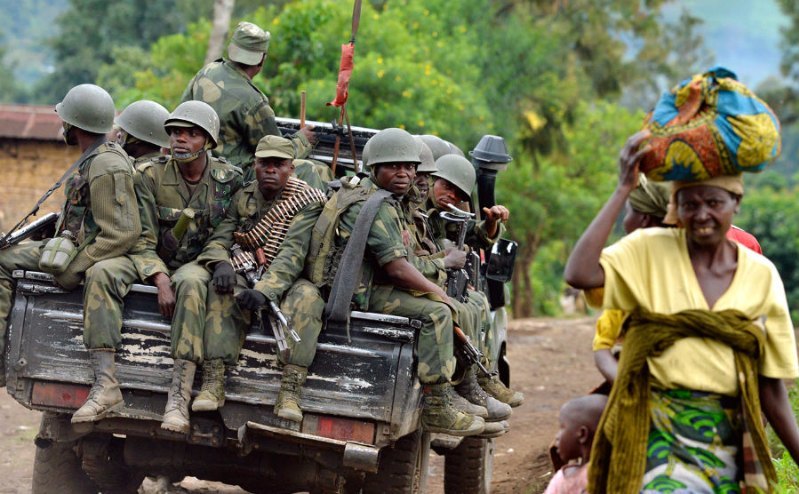
 There is still no credible path to resolving the fighting in eastern DRC /HANDOUT
Diplomacy in the Great Lakes region has once again fixated on the wrong issues. Mediators, from Washington to Addis Ababa, where the African Union is headquartered, continue to frame the crisis as an interstate quarrel between the Democratic Republic of Congo (DRC) and Rwanda.
This framing is not only analytically lazy. It’s dangerously counterproductive. If peace is the genuine objective, mediators must abandon this obsession with interstate tensions and pivot decisively toward the inter-Congolese conflict that fuels them.
The dominant narrative is seductively simple: Rwanda is allegedly backing the M23 rebellion to pressure Kinshasa into economic concessions, turning the rebel group into a proxy for Kigali's interests. The only problem? This narrative doesn't stand up to scrutiny.
Long before the current M23 resurgence, the DRC and Rwanda had signed economic agreements, including an MoU to process Congolese gold in Rwanda. Cooperation between Kigali and Tshisekedi's administration was not only possible, it was ongoing. What poisoned this relationship was not Rwandan ambition, but Kinshasa's handling of its internal affairs.
And this brings us to the first point: unrest within Congo is what provokes interstate tensions, not the other way around. Indeed, the Tshisekedi's administration chose a purely military response to the M23 question.
That decision, while ill-advised, could have remained a domestic miscalculation. But Kinshasa, acutely aware of its military limitations, went further: it armed the FDLR and affiliated militias. This was a seismic provocation that created both an immediate and existential threat to Rwanda.
Lest we forget, the FDLR is a genocidal formation founded by perpetrators of the 1994 Rwandan Genocide against the Tutsi, and it has never abandoned its goal of overthrowing the RPF-led government in Kigali and completing the extermination of Tutsis.
By embedding these forces into its security apparatus and arming them, Kinshasa transformed a local conflict into a regional security crisis. More alarmingly, Congo began to serve as a new incubator for the anti-Tutsi ideology that had caused the genocide in Rwanda 32 years ago.
Any state in Rwanda's position would have done precisely what Kigali did: support the only Congolese movement that shares its assessment of the FDLR threat, the M23. In other words, Kinshasa's own actions dragged Rwanda into what is, at its core, an internal Congolese conflict. This brings us to the second, and more urgent, reality: the Washington Accords between the two countries are unworkable without a parallel and final agreement in Doha between the AFC/M23 and Kinshasa. This is a matter of logic. Why?
Because Kinshasa cannot be trusted to neutralize the FDLR while it remains militarily engaged against the M23. The FDLR was reactivated precisely because it was useful in that fight. As long as the M23 is the target, the FDLR will remain a valued asset to Kinshasa and a mortal threat to Rwanda. This also means that as long as the FDLR is armed and integrated into Congolese security structures, Rwanda will have no choice but to remain entangled in Congo's internal war. This is the basic duty of any government: to prevent a genocidal force from establishing a launchpad on its border. This is not rocket science.
From all this, one uncomfortable conclusion emerges: the collapse of the Doha process means the death of the Washington Accords. Without a direct political settlement between Kinshasa and the M23, one that addresses the root causes of the rebellion and provides credible guarantees against FDLR collaboration, no amount of pressure on Rwanda will yield lasting peace.
Mediators
must stop treating the M23 as a Rwandan accessory and start treating it as what
it is: a Congolese movement born of Congolese grievances, now inextricably tied
to a regional threat that Congo itself has amplified. The interstate dimension
is a symptom, not the disease. Cure the internal Congolese rot, and the
interstate tensions will follow. Continue to ignore it, and no accord signed in
Washington or anywhere else will survive contact with the ground.