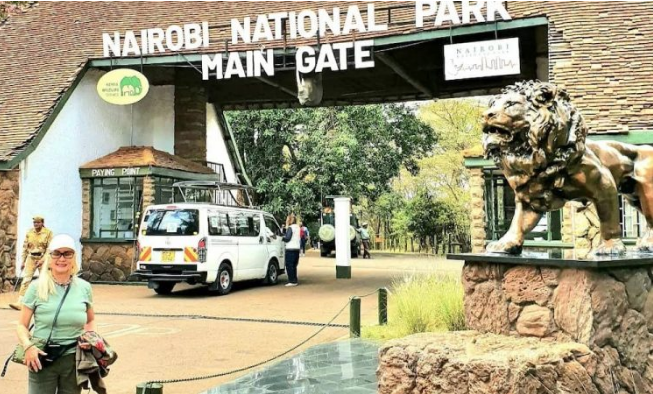
 The Nairobi National Park /FILE
The debate over whether to excise or degazette a portion of Nairobi National Park (NNP) to support the expansion of the Bomas of Kenya—specifically for a 1,300-vehicle parking lot and the relocation of the Nairobi Animal Orphanage—presents a stark conflict between economic modernisation and environmental preservation.
The core of the issue is the Sh41.9 billion 2026 project value) Bomas International Convention Centre (BICC) mega-project, which aims to position Nairobi as a premier global hub for meetings, incentives, conferences, and exhibitions (MICE) tourism.
A candid evaluation of the situation, supported by critical statistics and arguments from both sides, highlights the high stakes of this development.
The Core Statistics of the Conflict
Total Affected Area: Kenya Wildlife Service (KWS) has targeted 76 acres (31 hectares) of parkland for the broader project, though conservationists warn that clearing boundaries is not necessary.
The Parking Lot Footprint: The planned parking infrastructure alone is designed to span eight acres within the park boundaries to accommodate 1,300 vehicles, connected to the BICC via a pedestrian overpass across Lang'ata Road.
Scale Relative to the Park: NNP spans approximately 117sqkm. KWS points out that the new Animal Orphanage footprint represents just 0.31% of the entire park, arguing that the land remains under KWS jurisdiction and is not being "privatised."
The Ecological Cost: The targeted site involves cutting down portions of a rare indigenous upland forest and a "Low Use Zone" that provides habitat for some of the park’s 500+bird species and critical wildlife.
Arguments in Favour (The Development & Modernisation Case)
Proponents of the project, led by the Ministry of Tourism
and KWS, argue that the development is a forward-looking necessity:
Upgrading Ancient Infrastructure: The current Nairobi Animal Orphanage was established in 1964 and sits on a heavily constrained 7.4 acre plot. KWS argues that overcrowding and outdated veterinary facilities cannot handle the surging volume of injured or orphaned wildlife.
Moving it to an expanded 89acre site inside the park allegedly upgrades conservation and education capacity.
Economic Windfall: The Sh41.9 billion BICC project is expected to create over 500 direct jobs for youth and inject billions into Kenya's hospitality and tourism sectors by allowing Nairobi to host massive global summits that require extensive parking and transit infrastructure.
Mitigation Promises: KWS maintains that the new site is primarily open grassland rather than dense forest, and they have promised to restore the old orphanage site back into a completely natural habitat.
Arguments Against (The Conservation & Governance Case)
Environmentalists, civil society groups (like Friends of Nairobi National Park—FoNNaP), and even high-profile figures like former Chief Justice David Maraga (who was briefly detained during protests against the project) strongly oppose the move:
The "Trojan Horse" Precedent: Conservationists argue that using a public agency (KWS) to build a parking lot and a commercial walkway inside a national park sets a dangerous legal precedent. If 76 acres can be carved out for a parking lot today, the park faces a "death by a thousand cuts" from future urban infrastructure demands.
Violation of the Management Plan:
The targeted forest is strictly classified as a Low Use Zone under the Nairobi National Park Management Plan, a designation specifically meant to prohibit heavy infrastructure to protect endangered species like the Black Rhino, Maasai giraffe, and various vultures.
Flawed Public Participation and Transparency: Activists point out that the Environmental Impact Assessment (EIA) and the NEMA license (granted on December 3, 2025) were never transparently published online for public review before tree felling began, violating constitutional mandates for meaningful public participation.
Financial and Procurement Red Flags:
The broader BICC project has already been flagged by the Auditor-General for procurement irregularities and is under active scrutiny by the National Assembly. Critics argue it is reckless to destroy a globally unique ecosystem for a project facing financial accountability questions.
My candid verdict as Taddeo Rusoke PhD a Senior Conservation Scientist in the region of Easter Africa is:
No, part of Nairobi National Park should not be degazetted or repurposed for a commercial parking lot. While the expansion of the Bomas of Kenya into an international convention center is economically sound, sacrificing the world’s only safari park within a capital city capitalizes on short-term infrastructure at the expense of irreplaceable biodiversity.
A parking lot for 1,300 vehicles does not need to sit on protected indigenous land.
1. Building a multi-level underground or high-rise parking silo entirely within the existing Bomas of Kenya property footprint.
2. Acquiring non-protected commercial or private land further along Lang'ata Road and operating electric shuttle links to the convention center.
Nairobi's global branding relies entirely on the coexistence of its skyline and its wildlife. Encroaching on the park for asphalt and parking spaces compromises the integrity of Kenya's conservation legacy and signals that its environmental laws are negotiable when big-budget infrastructure knocks on the door.
Taddeo Rusoke is Ugandan Conservation Scientist and Tourism Professional with 16 years of experience in Conservation Leadership and Higher Education Sector, Policy Analysis and Consulting