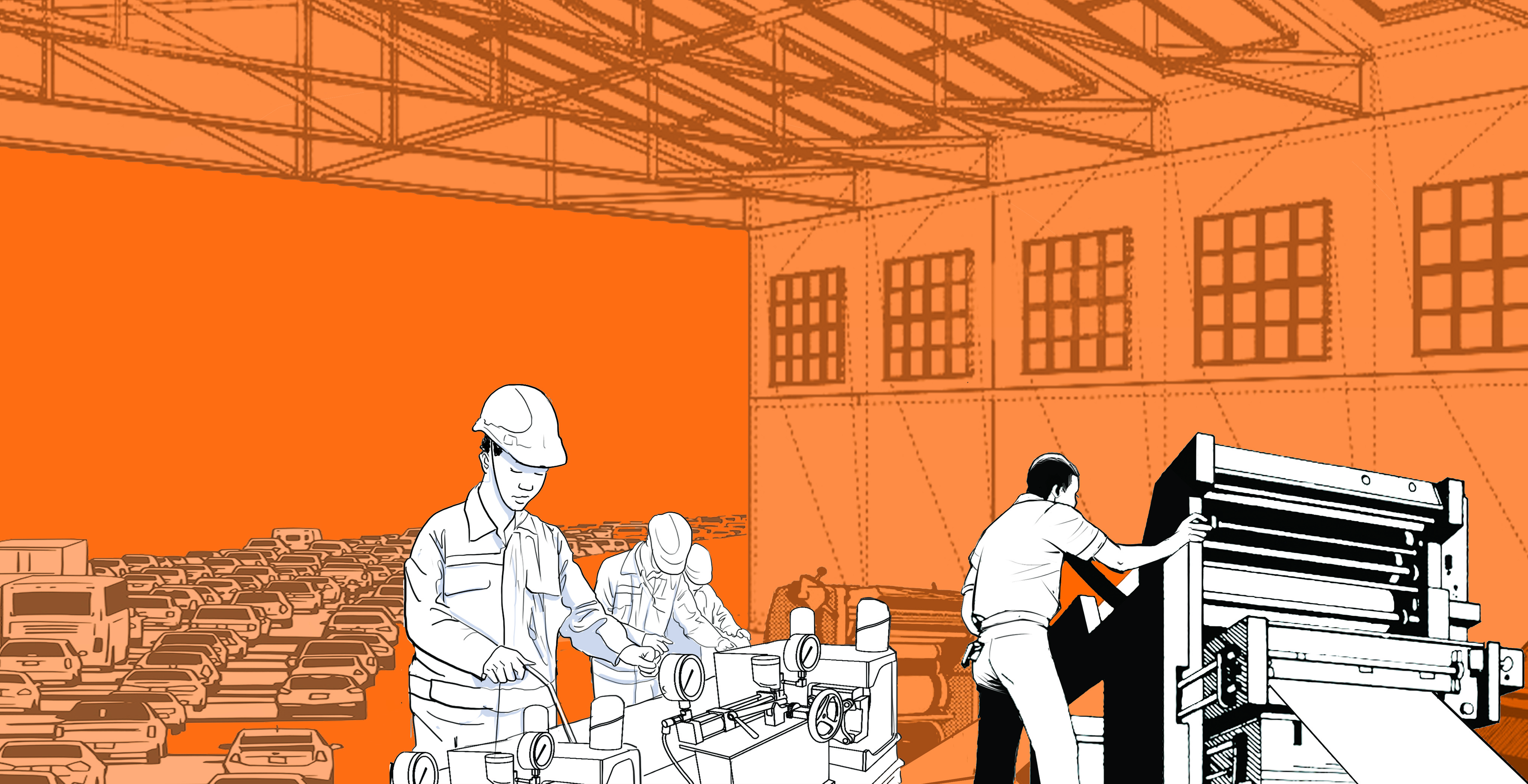
They may not have excelled in their studies well enough to get a place in a tertiary academic institution but should have been able to secure a job at some factory or other.
In short, their presence on the roadsides with their small boxes of cheap goods, are evidence that we do not have enough factory jobs in Kenya.
And this is despite the fact that our current president, William Ruto, as well as our previous two presidents, Uhuru Kenyatta and Mwai Kibaki, all promised that they would lead the country into a splendid new era of industrialisation and massive job creation.
It is these two things – job creation and industrialisation – which define “development” for most Kenyans.
This is where the paradox of “development” comes in.
There are plenty of factories in the Newly Industrialised Countries of Southeast Asia, which we so desperately admire. And so, we assume that if we only had similar factories within our borders, we would not only prosper as a nation, but we would also offer plenty of factory jobs to the kind of young Kenyan, currently hawking roasted groundnuts and ripe bananas amidst traffic jams.
But you can only hold this view if you have not seen the inside of a 21st-century factory.
For me, the journey towards a clearer understanding of the fact that having plenty of factories did not necessarily translate into having plenty of “factory floor jobs”, began with a visit to Egypt over a decade ago.
Our group of visiting journalists, departing from Cairo, drove through the desert for more than an hour before we reached the Special Economic Zone, which was our destination.
It was quite amazing, after seeing nothing but sand dunes in every direction, to suddenly arrive at the gates of a vast industrial complex which – once we were inside – had massive manufacturing plants on every side of the immaculate tarmac roads.
But it was when we got to see the insides of these huge factories that I got a really big surprise.
Whether it was the edible oil factory, or the pharmaceutical manufacturing plant, or the carpet factory, all these were highly automated and were operated in each case by barely a dozen highly skilled engineers, who did most of their work on specialised computers.
If Kenya had a Special Economic Zone like the one I saw in Egypt, it would no doubt be the jewel in the crown of our manufacturing sector. But I doubt if it would employ more than 1,000 people.
And even if it did employ more than that – say if it went up to 10,000 young people employed in such an SEZ – that would still be well below the roughly 100,000 people employed in Kenya’s existing SEZs, which are largely dedicated to garment stitching.
(Maybe I should mention that, although I cannot be 100 per cent certain of this – my trip to Egypt having taken place over 10 years ago, and in any case, we only toured a small part of a vast industrial complex – I believe that all of Kenya’s SEZ garment factories could spatially fit into that one huge SEZ in Egypt.)
I was to later see this same pattern in other countries I visited, specifically Mauritius and Germany: huge manufacturing plants, almost entirely automated, and thus operated by just a tiny handful of engineers.
What I am getting at is that a thriving manufacturing sector and mass job creation are not the same thing, even though if you listen to any of our top leaders addressing the public, you would think that they are.
The only “new” economic sector that Kenya has been able to create since Independence is the tourism sector. And this has definitely created very many jobs, both directly and indirectly.
These are service sector jobs, not manufacturing jobs.
And, oddly enough, the same kind of thing applies to Egypt where – despite its very impressive factories – roughly 10 per cent of its population relies on the tourism industry for jobs, whether directly or indirectly.








![[PHOTOS] Ruto pushes for stronger Kenya-EU economic ties in Brussels](https://cdn.radioafrica.digital/image/2026/06/3aebc395-285b-441c-8aa4-33cb538f8d44.jpg)