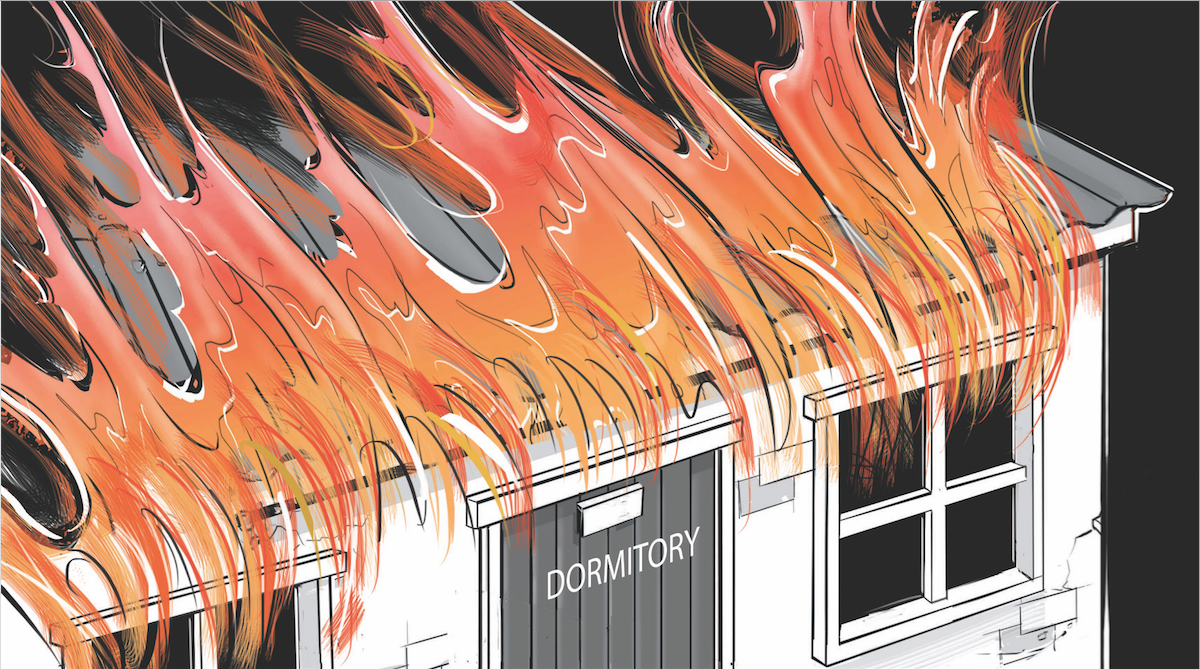
When the news broke about Utumishi Girls Academy, Kenya had the same response it always has. We called it indiscipline. We called for suspensions. We called for cameras. We called for stricter rules and harder consequences. And then we waited, as we always do, for the next school to burn.
At some point we have to stop and ask a different question. Not what are these children doing? But what are these children trying to say?
Because if we have been talking about discipline for this long and the fires keep coming, then maybe discipline is not the whole story. Maybe we are answering a question nobody actually asked. The question these children are asking, loudly, in the only way that finally makes adults look up from their phones, is this: does anyone see us? Does anyone hear us? Does anyone actually care what is happening inside us?
Let us be honest about the world these children are growing up in.
They are carrying things we did not carry at their age. They wake up to social media that shows them violence, comparison and other people's highlight reels before they have even had breakfast.
They go home to families under real financial pressure, where parents are not absent because they do not love their children but because rent is due and the matatu does not wait. They sit in classrooms where their entire value as human beings is quietly reduced to what they score in an exam.
And on top of all of this, their mental health, which is real and serious and does not go away because we do not talk about it, is going unattended.
Mental health is not something that happens to other people in other countries. It is what happens to any person, young or old, when they carry too much for too long and nobody notices. We have children in our schools right now doing exactly that. Carrying it alone. In silence. Because the adults around them have not made it safe enough to speak.
And when a child does reach out, not always in words, sometimes in withdrawal, sometimes in anger, sometimes in behaviour we find difficult, and the response is punishment rather than a question, that child learns to stop reaching. They shut the door. And a child who has shut the door, who has decided that no adult can be trusted with what is really going on, is a child in serious trouble. We just cannot see it yet.
We need to ask some uncomfortable questions about the systems we have built.
Is the school a place where a child can raise a genuine concern and expect to be heard? Or is it a place where authority only flows downward and any pushback is treated as a threat to order? Do our students have a real voice in their schools, not just a prefect badge and a duty roster, but actual involvement in things that affect their daily lives? And when a child walks into a teacher's office or a counsellor's room with something heavy on them, what happens? Are they heard or are they handled?
Parents, this conversation belongs to us too. And it is said with full respect, because parenting in this country right now is genuinely hard. But we have to be honest about whether we are walking with our children or just checking on them from a distance.
There is a real difference between a parent who asks how school was and accepts fine as a full answer, and a parent who sits long enough and close enough that the real answer eventually finds its way out. Children do not open up because we ask them to. They open up when they trust that what they say will not be used against them, will not be minimised, and will not end in a lecture about how we survived worse in our day.
To those who make policy, who decide how schools are run and what gets funded: one counsellor for a thousand children is not a counselling service. It is a notice board. A child in crisis at 11 on a Tuesday morning cannot wait three weeks for a slot. They need a real person, present, trained, trusted and available. That costs money. It also costs far less than rebuilding a dormitory.
None of this means we stop holding children accountable. Destruction has consequences, and it should. A child who burns school property must answer for it. But punishment alone has never changed a person. It has only ever taught them to be more careful next time.
What actually changes a child is feeling that someone is genuinely on their side. Not just in speech day speeches. In the ordinary Tuesday moments. In the way a teacher stops after class to ask how things really are. In the way a parent puts everything down and stays in the room. In the way a school makes space, real space, for children to say this is hard without being told to toughen up.
We say these are our children. If we mean it, then let us act like it before the next school burns.
The fire does not start with the match. It starts much earlier, in a child who stopped believing that talking would help. That is where we need to be. That is the conversation we keep avoiding.
And it is the only one that will actually make a difference.
Educator, children's mentor and the founder of Joybridge Education Consultancy