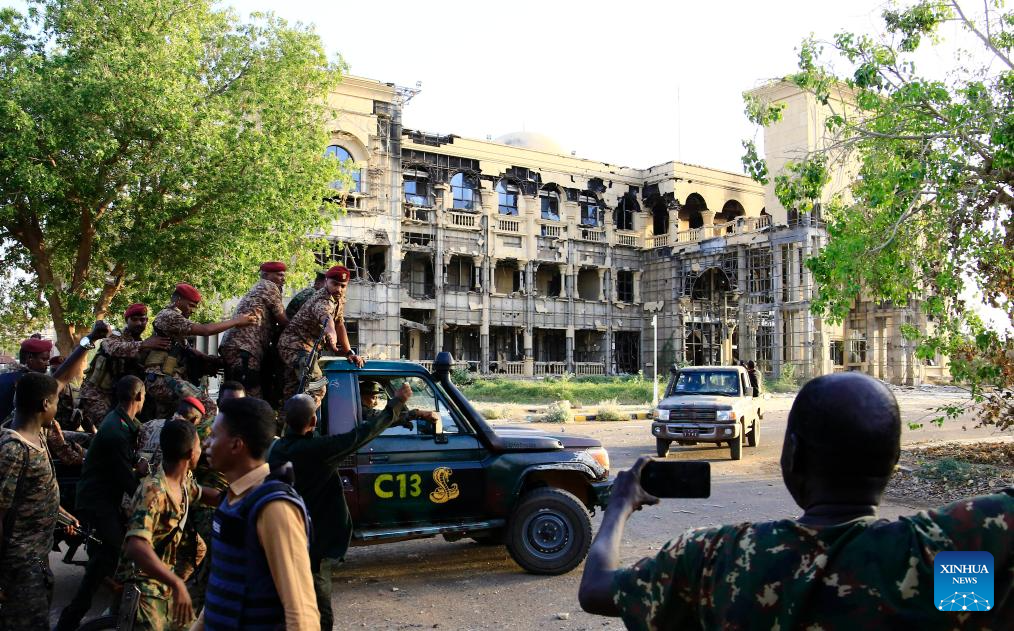
 Abdel Fattah Al-Burhan (in the vehicle), chairman of Sudan's Transitional Sovereign Council and commander of the Sudanese Armed Forces (SAF), departs from the Presidential Palace in Khartoum, Sudan, on March 26, 2025 (Photo by Tariq Mohamed/Xinhua)
The world can no longer turn a blind eye to what is happening in Sudan. Since the outbreak of war in April 2023, the Sudanese army has transformed from an institution supposedly meant to protect citizens into a war machine that systematically targets them.
Indiscriminate bombing of residential areas, starvation of the population, and the forced displacement of millions of civilians are all documented facts that together constitute a weighty case before international courts and bodies, placing the Sudanese army leadership in direct confrontation with international humanitarian law.
Bullets that make no distinction between combatant and civilian.
International human rights organisations, including Amnesty International and Human Rights Watch, have documented dozens of incidents in which the Sudanese army targeted densely populated civilian areas.
In Khartoum, Omdurman, and Bahri, shells fell on popular markets, hospitals, and schools with virtually no distinction between military and civilian sites.
These patterns do not describe accidental errors, but rather reveal a systematic policy. When a residential area is repeatedly bombed at the same time of day, when people are in markets and homes, it is difficult to classify this as a mistaken targeting.
Common Article 3 of the Geneva Conventions and Additional Protocol I explicitly prohibit indiscriminate attacks that do not distinguish between civilians and combatants. What is being documented on the ground in Sudan constitutes a clear violation of these provisions.
Starvation as a weapon of war
Starvation is no less serious than bombing. The Sudanese army has resorted to tightening the noose around certain areas, either by besieging them or cutting off supply routes, thus depriving the population of food, medicine, and fuel.
The World Food Programme and several humanitarian organisations have documented cases of severe famine in areas of North Darfur and parts of Gezira and Khartoum states.
The forced starvation of civilians is a war crime under the Rome Statute of the International Criminal Court. When food supplies are used as a bargaining chip or a tool of collective punishment, legal responsibility falls directly on the commanders who issued those orders or turned a blind eye to them.
Mass displacement: Numbers that cry out
The numbers alone are enough to illustrate the scale of the disaster. United Nations estimates indicate that Sudan is experiencing one of the largest displacement crises in modern history, with the number of internally displaced persons exceeding ten million, in addition to millions more who have sought refuge in neighbouring countries.
On the ground, tragic figures emerge from Blue Nile State alone, where nearly sixty thousand people were displaced in just a few months in 2026, almost half of whom are children.
These are not cold statistics; they represent entire families uprooted from their land and homes, and children deprived of education, healthcare, and security.
The testimonies of fleeing families add a poignant dimension to these figures. A mother from Omdurman lost her son under the rubble of a house bombed at night; a farmer from Blue Nile was forced to flee, abandoning his land and crops after military forces burned his village; and a ten-year-old boy carried his infant sister, walking for hours in search of his family. These are not exceptions, but rather examples from thousands of documented cases.
In this context, Nadine Ali, a member of the Sudanese National Observatory, stated that the companies prosecuted by the Sudanese Armed Forces since the outbreak of the April 2023 war are no longer isolated incidents, but rather represent a disturbing pattern of attacks targeting various areas across Sudan. Intelligence organizations have documented the targeting and bombing of populated areas, resulting in civilian casualties and widespread losses under the guise of humanitarian intelligence.
The Sudanese National Observatory for Human Rights has documented, through direct testimonies and field evidence, arbitrary detention and unlawful imprisonment targeting civilians for various reasons, clearly contributing to the violation of fundamental guarantees and their implementation under international human rights law.
Firstly, the Observatory has documented widespread allegations of extrajudicial killings and summary executions, supported by witness testimonies and video footage for thorough review. Impunity encourages this diversity, necessitating independent investigations and accountability for all perpetrators to ensure justice and fairness.
The Door to international accountability
In light of these facts, a solid legal foundation is laid for genuine international accountability. First, the UN General Assembly referred the Sudan file to the Security Council, and the International Criminal Court has already issued arrest warrants for Sudanese officials on charges of war crimes and genocide. This precedent proves the international prosecution of Sudanese leaders.
Second, the UN Guiding Principles on Business and Human Rights stipulate that a state has an obligation to protect its citizens from violations, and when the state itself is the perpetrator, the international community has a responsibility to intervene through available mechanisms.
Third, the UN Human Rights Council can establish independent commissions of inquiry, a path taken by many countries that have experienced similar crimes.
International Sanctions
Rhetorical condemnations are not enough. The experiences of the former Yugoslavia, Sierra Leone, and Rwanda demonstrate that international justice is possible when the political will exists. Sanctions targeting specific Sudanese military leaders—freezing their assets, imposing travel bans, and halting arms deals—have become a necessity, not a luxury.
Furthermore, international companies partnering with the Sudanese military establishment in the gold and oil sectors also bear legal and moral responsibility under the UN Guiding Principles, which opens the door to legal action in the countries where these companies are headquartered.
What is happening in Sudan is not an internal matter. It is a blatant violation of international humanitarian law, an ongoing crime for which millions of civilians pay the price daily.
The displacement of 60,000 people in a single state within a few months, half of them children, due to the Sudanese army, is a message that needs no interpretation.
The international community faces a true test in holding the Sudanese army accountable for its actions in the areas under its control, including forced displacement, indiscriminate bombing, and targeting of civilians.
The writer is a political analyst.