The honest answer, backed by the people studying it, is mostly no, at least not the way it is sold.
A 2025 study by MIT found that the large majority of business AI projects deliver no real return. Gartner, a respected technology research firm, expects more than four in 10 of the most ambitious AI projects, the ones meant to run on their own, to be abandoned by 2027. The reason is rarely that the technology is stupid. It is that the tool was dropped on top of real people and real work without anyone doing the patient job of fitting it in. The machine was ready. The trust, the training and the human judgment around it were not.
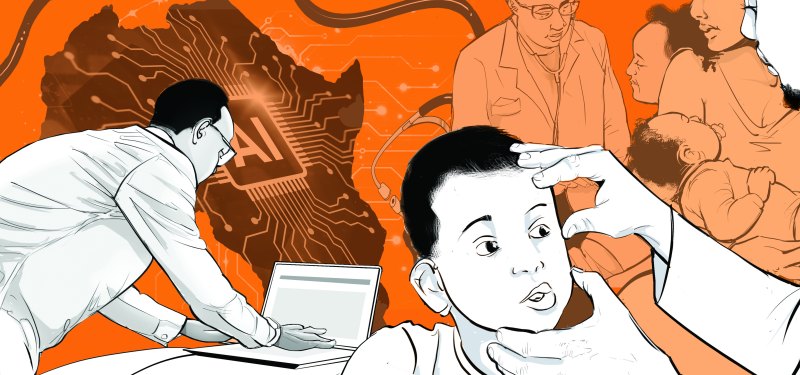
Picture why that matters in a consulting room. A patient sits down with a swelling she has watched grow for months. The scan tells part of the story. But the doctor is also reading her face, judging how much truth she can carry that day, deciding whether the next sentence is about the tumour or about the child waiting outside. That is the hard part of medicine, and it is exactly the part a machine finds hardest. A diagnosis is not only a calculation. It is a conversation, a judgment and a relationship.
This is not an argument against using AI in our hospitals. It is an argument for using it the right way, and the proof is here at home.
A primary care network in Nairobi, Penda Health, put an AI assistant into its consulting rooms. They could have built it to take over from the clinician. They did the opposite. They built it as a second pair of eyes. It stays quiet during the visit and speaks up only when it spots something that looks wrong: a diagnosis that does not fit, a drug that should not be given with another, a step that was missed. It never overrules the clinician. The human always decides.
The result, in a study run with OpenAI and graded by independent doctors across tens of thousands of visits, was meaningful. Clinicians using the tool made fewer wrong diagnoses and fewer wrong treatments. Ordinary patients walked out safer.
But look at how they got there, because this is the lesson for everyone betting on AI in health. At the start, even when the assistant flagged a real problem, clinicians often ignored it. The tool was good and still went unused. What changed things was not a cleverer machine. It was months of training and trust building until the team leaned on it. The software was the easy part. The people were the work, and the people were the win.
The stakes here are not abstract. For a Kenyan family, a wrong diagnosis is not a line on a report. It is money borrowed, time lost, a disease caught too late. As we spend public funds to digitise care, the temptation will be to buy a system that promises to replace scarce, expensive clinicians altogether. The evidence says that is precisely the wrong bet. The tools that help are the ones that make our doctors and nurses sharper, not the ones that try to do without them.
So use the technology. An assistant that drafts notes so a doctor can look at the patient instead of a screen is a gift. A safety net that catches the dangerous drug combination at the end of a long, tired shift saves lives. These are real and available today.
But do not let anyone sell you the fantasy of medicine without the human. Do not automate away the conversation, the reassurance, the judgment call when the textbook and the patient disagree. That is not sentiment. It is what the evidence shows. The health systems that serve people well in the coming years will not be the ones that replaced their workers with machines. They will be the ones that used the machines to make their people more present, more accurate and more trusted.
The machine can help the doctor. It cannot be the doctor. Anyone who tells you otherwise is not describing medicine. They are describing a sales pitch, and you are the one who pays if it fails.
Surgeon, writer and advocate of healthcare reform and leadership in Africa