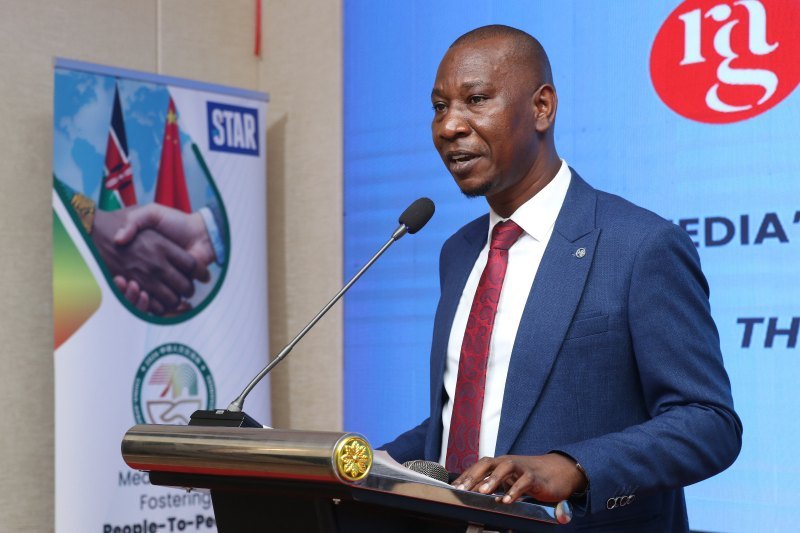
(Keynote Speech by Adhere Cavince, at the Seminar on China-Kenya People-to-People Connectivity hosted by the Star Publications Limited on June 11, 2026)
Excellencies, distinguished guests, colleagues from the media, academia, government, ladies and gentlemen, good morning. Zao Chang Hao. I am really pleased to be here and it is a true honor to stand before you today in this landmark year of 2026, which has been designated as the China-Africa Year of People-to-People Exchanges.
The initiative, launched at the African Union headquarters earlier this year, builds on the consensus between President Xi Jinping and African leaders to deepen cultural, educational, youth, and societal ties on the occasion of a significant milestone in China-Africa relations.
I'm particularly delighted to speak to you on a subject that sits at the heart of enduring international relations, and that is the media. As we celebrate the deepening ties between Kenya and China, we ask ourselves: what makes a partnership resilient? Is it trade volumes? Infrastructure construction? Official visits? Certainly, all those matter. But the true bedrock of any lasting relationship is mutual understanding, trust, and shared narratives, and this is precisely where the media becomes indispensable.
In international relations today, we talk about something called the China opportunity. This is about the enormous growth of China, its expanding capabilities across many domains, and what it offers international partners at both country and individual levels. In recent years, China has launched many initiatives to share the proceeds of its development with the rest of the world, and you only need to look at them: the Belt and Road Initiative, the Global Development Initiative, intentionally rolled out to help developing countries fulfill their development aspirations and Sustainable Development Goals; the Global Civilization Initiative, which the Ambassador elaborately explained earlier; and the Global Governance Initiative. We can call all these initiatives 5G. 5G also happens to be a connectivity term, an area in which China is now leading and heading toward 6G connectivity.
So you see China becoming a very prominent international player, and one of the most visible places where the Chinese hand can be seen is in developing countries. Certainly, Kenya is one of them. Over the last two decades, China has become Kenya's largest trading partner, a top source of foreign direct investment, and a key ally in its modernization drive, as seen through investments in ports, roads, railways, energy, agriculture, as well as digital projects.
Yet these tangible outcomes often compete with entrenched stereotypes. Western media, for instance, has for decades framed South-South cooperation through prisms of debt, dependency, and even disaster. Meanwhile, emerging voices from the BRICS nations are reshaping how development news is told, elevating real stories of growth, innovation, and mutual benefit.
But I think here in Kenya, we cannot outsource that narrative. We must be the primary authors of our own story with China. The media is therefore not a passive observer.
It is an active agent in fostering people-to-people connectivity, cultural exchange, and durable development cooperation. And when done right, media builds investor confidence, breaks myths, and shapes public opinion toward progressive outcomes. This morning, I just want to share with you some key insights that I hope we can internalize as we go through this forum.
The first is that development cooperation thrives on visibility. Many Chinese-funded projects in Kenya suffer from a success paradox. On the one hand, they are increasingly and highly visible.
You cannot hide a railway. You cannot hide the expressway. You cannot hide a major development project.
Yet they are often poorly articulated in local media narratives. The media must therefore move beyond groundbreaking ceremonies and handovers to tell human-centered stories: the Kenyan engineer trained in railway technology, the small trader accessing the Chinese market, and the student on a Chinese government scholarship returning to help build our economy.
These are the real outcomes of South-South cooperation. These are the real outcomes of true and meaningful partnerships. The second point is that media is a cure for misconceptions. From alleged debt traps to claims of low-quality construction, misinformation has repeatedly strained public perceptions of Kenya-China development partnerships and, more broadly, China-Africa development cooperation.
Kenyan journalists therefore have a duty to investigate, verify, and contextualize. China's foreign policy, as you may know, emphasizes respect for sovereignty and non-interference, a principle that deeply resonates with many African countries.
Media should therefore amplify this principle and not let it be drowned out by foreign alarmism and geopolitical rhetoric. The third insight is that cultural understanding precedes cooperation. It is only when people understand each other that communication and cooperation flourish.
This is very important because governments are representatives of the people. Governments are elected by the people. And if people understand each other, it means that the leaders they elect and choose to represent them will eventually find it easier to collaborate, and this then leads to durable development partnerships.
It creates an affinity that makes diplomatic agreements meaningful at the grassroots level. The fourth insight is that media should drive policy accountability.
Media serves as an anchor of policy accountability.
I say this because, by tracking commitments made during summits, when, for example, President Ruto meets with his counterpart, President Xi Jinping, and they discuss outcomes, the media should pay attention to those outcomes. The media should call on the two countries to effectively implement them. That is when promises translate into action.
The fifth point is that youth are the bridge in China-Africa development partnerships. With over 75 percent of Kenya's population under the age of 35, media must use digital platforms to engage young people on Kenya-China partnerships effectively. According to a 2024 survey by the Ichikowitz Family Foundation, based in South Africa, 82 percent of African youth today see China as an opportunity and an influential power for their respective countries.
Media should therefore harness this goodwill into productive dialogue on jobs, innovation, and skills transfer.
In conclusion, ladies and gentlemen, the media is not merely a mirror of reality. It is a maker of reality.
For too long, the story of Kenya-China relations has been told by distant voices with foreign interests. It is time for Kenyan and Chinese journalists, editors, and content creators to take up the pen. By telling balanced, human-centered, and future-oriented stories, we can generate not just headlines, but hope; not just clicks, but cooperation; and not just news, but a new narrative for the Global South.
Let us remember that every railway, every scholarship, and every trade deal is ultimately about people, and people connect through stories.
I hope we can use this forum to make a strong commitment to telling those stories well.
Thank you.
Adhere Cavince is a scholar of international relations with a focus on China-Africa development cooperation



![[PHOTOS] Uhuru graces commissioning mass of Catholic Women](https://cdn.radioafrica.digital/image/2026/06/0bbd7e96-f180-4e02-966f-97c3fb201478.jpg)