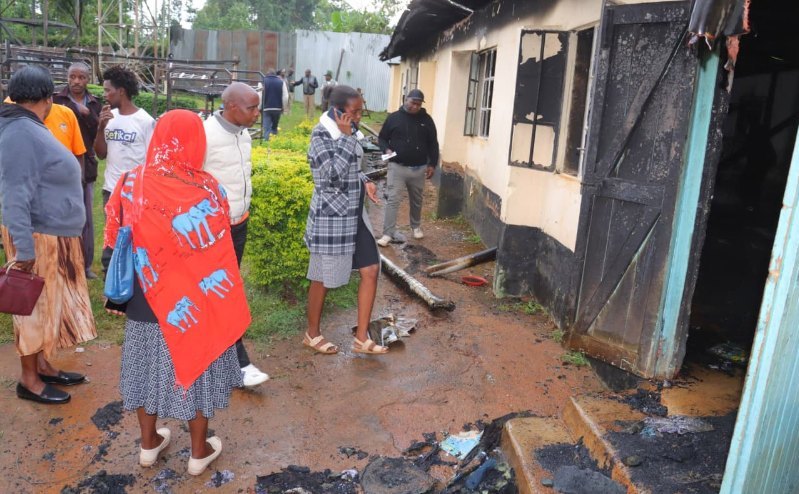
Masosa Mixed Secondary School girls’ dormitory, which was burnt down on June 3, leaving 104 students without shelter /KNA
The recent spate of school fires, violence and unrest in Kenya has elicited widespread concern among parents, educators, policymakers and the public in equal measure. While investigations often focus on identifying the perpetrators and immediate triggers, such incidents should not be viewed as isolated acts of indiscipline among students.
Rather, they are manifestations of deeper societal challenges
whose roots extend beyond school gates. The burning of schools is merely the
visible tip of an iceberg whose foundation lies in the gradual erosion of
societal values, weakened socialisation systems and changing family and
community dynamics.
The complexity of the phenomenon can best be understood through the lens of Ecological Systems Theory developed by Urie Bronfenbrenner. The theory posits that children's behaviour is shaped by multiple interconnected systems, including but not limited to the family, school, peer groups, media, community and the broader societal environment.
Consequently, school unrest cannot be attributed to a single cause. Rather, it emerges from the interaction of influences operating at different levels of society. Schools therefore become mirrors reflecting the strengths and weaknesses of the larger social fabric.
One of the most significant concerns is the changing nature of parenting and child socialisation. Traditionally, families, religious institutions and communities played a central role in nurturing discipline, responsible citizenry, resilience and respect for authority.
Today, however, economic pressures, changing family structures and competing demands on parents have reduced opportunities for deliberate value transmission, rendering parents sometimes more disciplined than their children. Many children spend more time interacting with digital devices than engaging in meaningful conversations with parents or guardians.
As a result, some learners enter school with limited exposure to the values and behavioural expectations necessary for harmonious social interaction.
This concern is further illuminated by Albert Bandura's Social Learning Theory, which posits that children learn behaviour primarily through observation, imitation and reinforcement. Young people do not simply become what they are taught; they become what they consistently observe, particularly from their models. They learn from parents, teachers, political leaders, celebrities, social media influencers and society at large.
When children repeatedly witness aggression, corruption, impunity, dishonesty, intolerance and disrespect for authority being normalised or rewarded, they may internalise these behaviours as acceptable responses to challenges. School unrest, therefore, may be interpreted not merely as learner misconduct but as a reflection of the behavioural models prevalent in society.
The current situation may also be explained through Émile Durkheim's Theory of Anomie. The theory argues that societies experience periods of normlessness when traditional systems of moral regulation weaken faster than new systems emerge. During such periods, individuals become uncertain about societal expectations and acceptable behaviour.
In the Kenyan scenario, like in many other societies undergoing rapid social, technological, economic and cultural transformation, may be experiencing aspects of this condition. Traditional authority structures within families, communities and institutions have weakened, while new forms of social control remain fragmented and contested. The result is a growing moral ambiguity that affects young people's attitudes and behaviour.
Within this context, the discourse on children's rights deserves careful reflection. The global advancement of children's rights has been one of humanity's greatest achievements, protecting millions of children from abuse, exploitation, neglect and discrimination.
However, challenges arise when rights are emphasised without an equally strong emphasis on responsibility, accountability and respect for others’ rights. Some children may misinterpret rights as freedom from correction, guidance, accountability or even consequences. Such misconceptions can undermine legitimate authority within families and schools, creating tensions between learners and those entrusted with their development.
Similarly, contemporary debates on gender equality and social justice have brought important gains in promoting inclusion, fairness and human dignity. Yet social transformation can generate uncertainty when societal institutions struggle to adapt and communicate emerging norms effectively. The challenge is not equality itself but ensuring that social change remains anchored in shared values such as respect, responsibility, empathy, integrity and mutual accountability.
The influence of social media further complicates the situation. Unlike previous generations, today's learners are exposed to a continuous stream of information, opinions and behavioural models from across the globe. While digital technologies offer immense educational opportunities, they can nonetheless expose young people to harmful content, normalise anti-social behaviour and weaken traditional mechanisms of guidance and supervision.
The digital environment has become a powerful socialising agent whose influence often rivals that of families and schools, particularly in the contemporary African spaces.
From a structural-functionalist perspective, society depends on institutions such as the family, school, religion and government to perform complementary functions that maintain social order. When one institution weakens, pressure is transferred to others. Schools are increasingly expected to address challenges that originate at home, communities and the broader society. Yet schools alone cannot compensate for deficiencies in societal socialisation and/or unclear government systems.
The recent school fires and unrest should therefore be understood not merely as a disciplinary problem but as a societal challenge requiring collective responsibility. Security measures, punitive responses and surveillance systems may address immediate symptoms, but they cannot resolve the fast-deteriorating underlying causes. Sustainable solutions require renewed commitment to value-based education, responsible parenting, positive role modelling, ethical leadership, and community engagement.
The Competency-Based Curriculum rightly identifies values as central learning outcomes. However, values cannot be effectively taught in classrooms alone. They must be consistently demonstrated in government, homes, communities, religious institutions, media platforms and the public. Character is cultivated not only through instruction but also through observation and experience.
Ultimately, the fires consuming schools may be signalling deeper fires that smoulder within society itself. Unless Kenya deliberately strengthens its systems of socialisation, restores a culture of responsibility and accountability and re-establishes a shared moral vision for its young people, schools will continue to reflect the fractures present in the wider society from time to time.
The challenge before the nation is therefore not simply to rebuild burnt classrooms but to rebuild the social and moral foundations upon which responsible citizenship and peaceful coexistence depend.
Child psychologist and senior lecturer at Kenyatta University | [email protected] | Google Scholar: https://rb.gy/tvcgtl | ORCID: 0000-0001-5348-7260













![[PHOTOS] The Star, Chinese Embassy host Kenya-China media dialogue](https://cdn.radioafrica.digital/image/2026/06/215e29cd-5ca2-4faf-bb4e-d1686b2c3dad.jfif)