
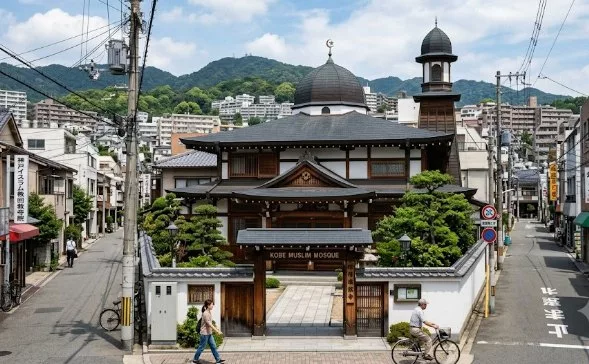
 AI generated image
Today, it's a field of grass. But soon, it'll be the site of the first mosque in this Japanese town.
"It makes me worry about how our community might change," says long-time resident Noriko Izumizawa.
Plans to build an Islamic religious site in Fujisawa, a laid-back seaside town about an hour's drive south of Tokyo, have sparked a wide range of emotions.
There is anger and fear, as well as hope and acceptance, exposing the growing anxieties over immigration and social change as Japan grapples with a labour shortage from a shrinking and ageing population.
Although immigration remains politically sensitive and restrictive, Japan is increasingly relying on foreign workers to fill open jobs. That means an influx of immigrants with various cultures, languages, religions and ways of being.
So the debate that is playing out in towns like Fujisawa across the country is one that goes to the heart of how Japan sees itself.
Izumizawa is not alone in the way she feels. She is among a group of Fujisawa residents who are anxious about the increasingly visible Muslim community. She says that the polarising debates around immigration in the US and Europe have also contributed to her unease.
Earlier this year, anti-mosque protests flared up at the local train station, where thousands took to the streets to object to the proposed construction of the mosque. Some argue that a mosque much larger than the nearby Japanese Shinto shrine is disrespectful.
There have also been reports of hate speech and misinformation spreading on Japanese social media. Local outlets say mosques have been receiving abusive phone calls and emails, some of which has prompted anti-hate groups to organise counter protests calling for no hate.
Hiroki Suzuka, who manages a coffee shop opposite the road where the Fujisawa mosque is set to be built, calls for greater understanding and dialogue.
"I'm not particularly opposed, but I wouldn't say I'm strongly in favour either," Suzuka said.
"I think the first step is to learn about them, what Islam is, what kind of people they are, and what values and perspectives they hold. It begins with having an open mind and a desire to understand each other."
Being Muslim in Japan
Businessman Mohamed Mohideen has lived in Osaka for the past 39 years. He moved from his home country Sri Lanka in 1987 for better work opportunities during the economic bubble.
He has dealt gemstones and later worked in trade, exporting used cars to countries like Sri Lanka and Pakistan.
He moved at a time, he says, when there were far fewer foreign residents.
But Mohideen feels that compared to back then, local people have become hostile and started making hurtful remarks at Muslims, both online and in person.
"On social media, there are countless comments like, 'Get out of Japan' and 'Go back to your own country,'" Mohideen said. "People have also started coming to the mosque and shouting abuse."
Mohideen goes to the Osaka mosque every day for prayers and other duties as a member of the local Islamic community. He says he has never felt that his life was in danger.
Despite having good relationships with neighbours for many years, Mohideen has noticed the shift in attitude towards Muslims more recently.
"Now, I feel that people are afraid of us."
The verbal abuse has worsened in recent years. He recalled members of his Muslim community being called terrorists, accused of making bombs, and being told to get out of Japan.
"When that happens, the only thing we can do is be patient. They're trying to provoke a fight or create a confrontation. They want to see how long we'll tolerate it," Mohideen explained.
"So we stay calm, speak gently, and treat them kindly, because Japanese people generally don't know much about Islam."
Still, he thinks there is some shared responsibility for the rift.
"We focused only on our work and, for a long time, didn't make enough effort to help people understand who we are. We also didn't do enough to become part of the society," he said.
"From now on, I want to work harder to increase dialogue and build better mutual understanding."
Shakeel Mohamed, 61, has been representing the Yashio mosque in Saitama prefecture for the past decade. He had worked as a construction site supervisor for 26 years after moving to Japan from Pakistan and speaks fluent Japanese.
Mohamed says the most important thing is to follow Japan's rules, including sorting refuse properly, obeying parking laws, and wearing helmets when riding your bicycle.
"We make every effort to respect the way things are done in Japan and to follow the rules," he said. "Courtesy is important too, even something as simple as greeting people."