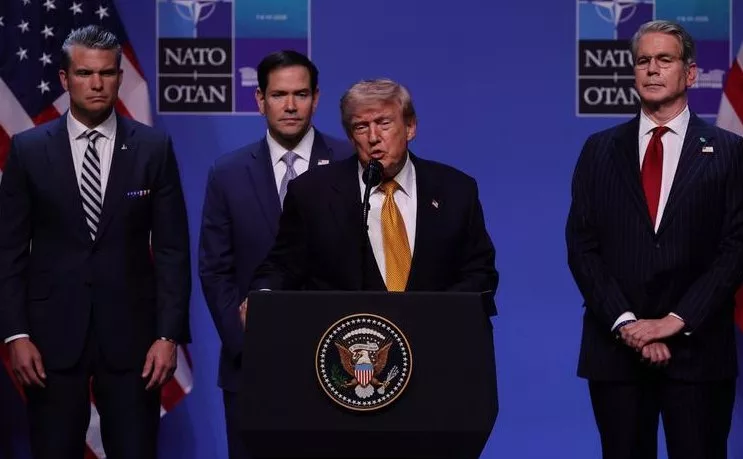
 US President Donald Trump addresses a press conference at the 2026 NATO summit in Ankara, Türkiye, July 8, 2026 (Mustafa Kaya/Handout via Xinhua)
WHAT IS THE LATEST IN US HOSTILITY?
After leaving a NATO summit in Ankara, Trump issued another warning to Iran on his social media site, saying strikes would "get much worse" if Tehran again attacked ships in the Strait of Hormuz after he said he thought the ceasefire was "over." "This is in retribution for yesterday's bombing of ships by Iran. If it happens again, it will get much worse!" Trump wrote. He also resumed his past threats to strike Iran's civilian infrastructure, possibly including electric plants and desalination plants, and to seize the oil-production hub of Kharg Island. "We may take over Kharg Island," he said. "There's not a thing they could do about it."
HOW HAS IRAN RESPONDED?
Iran's Islamic Revolution Guard Corps (IRGC) said on Thursday that it had attacked U.S. military bases in Kuwait and Bahrain in response to fresh U.S. strikes. According to a statement from the IRGC carried by Iran's Press TV, the IRGC struck key infrastructure and facilities at Camp Arifjan and Ali Al Salem Air Base in Kuwait, as well as U.S. military bases in Bahrain's Juffair and Sheikh Isa, "in the first phase of a punitive response against the American treaty-breakers." The IRGC also warned that its responses would expand to other bases in the region if the United States renews its attacks. The Kuwaiti army said on Thursday that its air defense systems are responding to hostile missile attacks and drones targeting the country.
Bahrain and Qatar also sounded missile alert sirens early Thursday, warning of Iranian attacks. A senior Iranian lawmaker said on Wednesday that if the United States attacks Iran again, the country's options would include withdrawing from the Non-Proliferation Treaty (NPT) and changing its nuclear doctrine. Ebrahim Rezaei, spokesman for the Iranian parliament's National Security and Foreign Policy Committee, made the remarks in an interview with the semi-official Fars news agency. "If the United States attacks our country again, we will respond with all our might and are ready to give a decisive and powerful response to the Americans," Rezaei said. He noted that closing the Bab el-Mandeb Strait, in addition to the Strait of Hormuz, is one of the options under consideration, adding that another is withdrawing from the NPT, which will probably be placed on the agenda, and that the parliament is ready to discuss the plan.
WHAT ARE THE ECONOMIC STAKES?
The latest escalation has already rattled markets.
US stocks closed mixed after Trump declared the U.S. ceasefire with Iran was "over" and threatened additional military strikes. The Dow Jones Industrial Average fell 1.09 percent to 52,348.39. The S&P 500 sank 0.28 percent to 7,482.71. The Nasdaq Composite Index increased 0.2 percent to 25,870.65. Nine of the 11 primary S&P 500 sectors ended in the red, with materials and financials leading the laggards by dropping 2.49 percent and 1.92 percent, respectively. Meanwhile, energy and technology were the only gainers by rising 1.45 percent and 1.44 percent, respectively. Oil prices advanced after the developments. West Texas Intermediate for August delivery gained 3.08 U.S. dollars, or 4.37 percent, to settle at 73.52 dollars a barrel on the New York Mercantile Exchange. Brent crude for September delivery added 3.86 dollars, or 5.2 percent, to settle at 78.02 dollars a barrel on the London ICE Futures Exchange.