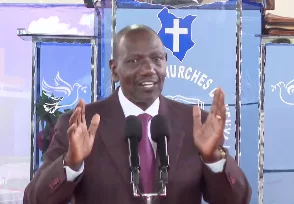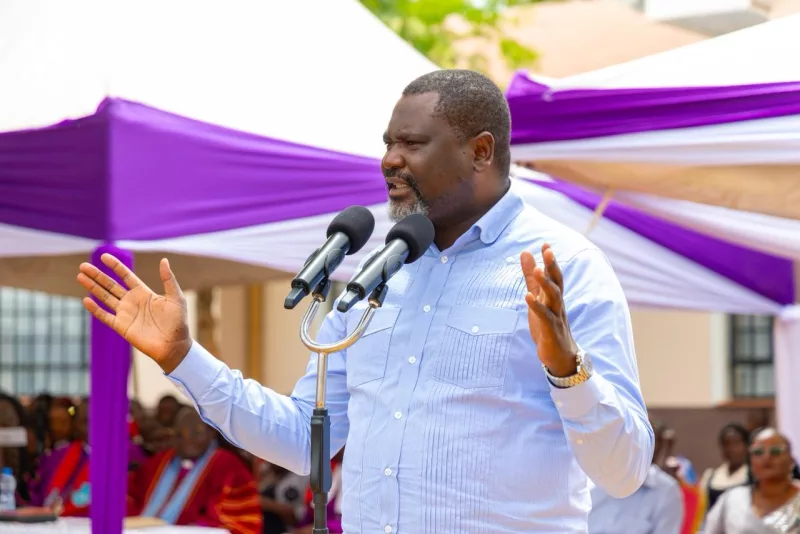

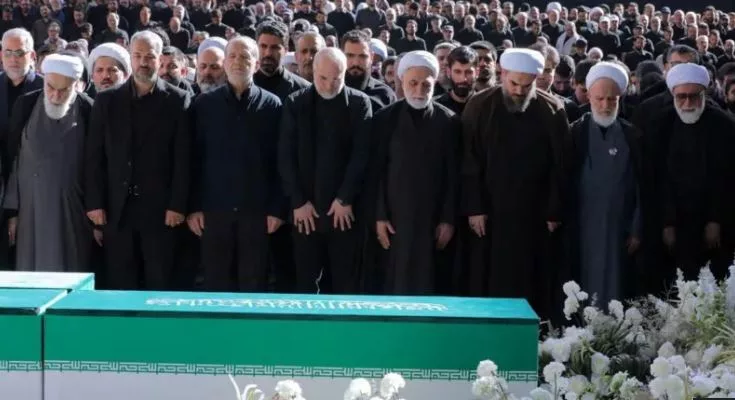
 Leaders including Iranian President Masoud Pezeshkian were in attendance for the former supreme leader's funeral, but Mojtaba Khamenei was absent./SCREENGRAB
Iran's Supreme Leader Mojtaba Khamenei was conspicuously absent from his father's funeral, as senior regime figures joined thousands paying their respects to the late ayatollah on Sunday.
Ali Khamenei's other three sons - Masoud, Mostafa and Meysam - all attended the service on Sunday, alongside officials including President Masoud Pezeshkian and Revolutionary Guards chief Ahmad Vahidi.
Speculation about Mojtaba's condition - fuelled by rumours he was wounded in the same US-Israel air strikes that killed his father - has continued as he has not appeared in public since his appointment in early March.
The elder Khamenei ruled the Islamic republic from 1989 until his death in February.
Official funeral proceedings for late supreme leader began on Friday, with events planned across Iran and Iraq over the coming week.
Iranian authorities say 12-20 million people are expected to attend the ceremonies, which they are calling the "funeral of the century".
Khamenei's body is currently lying in state at Tehran's Grand Mosalla religious complex, with a funeral service led by prominent Shia cleric Jafar Sobhani, a 97-year-old scholar who teaches at seminaries in the holy city of Qom.
Sunday was declared a public holiday across Iran, and later in the day Khamenei's body will be moved out of the Grand Mosalla ahead of a processions through the capital on Monday.
The ceremonies have been carefully choreographed and Mojtaba Khamenei's absence from the proceedings comes on a backdrop of fears that Israel may want to assassinate him as well.
A fragile ceasefire between the warring countries is currently holding while talks on a permanent peace deal continue - though both sides have warned they were ready to resume military action.
News website Axios quoted US President Donald Trump on Saturday as saying that peace talks had been paused for a week for the events surrounding the funeral.
With many of the Iranian regime's senior officials attending, Washington could take them all out with "one shot", it quoted Trump as saying, adding: "But we are not going to do that because then we would have nobody to negotiate with."
The president also said he had been surprised to see Iranians crying, saying he thought people hated Khamenei. "Maybe it's fake tears," he said.
In response to Trump's claim, mourner Zahra Safaei, 50, told Reuters: "We did not make a revolution 47 years ago to shed fake tears. We did not sacrifice all these martyrs to shed fake tears."
The Associated Press and Guardian report that people were calling for US President Donald Trump's death on Sunday, with poet Mohammad Rasouli saying at a poetry recitation before the prayer that "Trump's murder is our responsibility".
Rasouli could also be heard drawing calls of "death to America" and "death to Israel".
People in the city were seen on Sunday holding banners that included slogans "kill Trump", "kill Bibi", in reference to Israel's Prime Minister Benjamin Netanyahu, and "we will avenge".
The Tehran events alone are expected to attract more than 10 million mourners from across Iran, with strict security measures imposed and official media warned of a risk of crowd crushes.
Iran's official news agency Irna reported on Sunday that more than 4,000 people had visited medical centres located in and near the Grand Mosalla - though no deaths had been recorded.
Images from the funeral show mourners being sprayed with mist to keep them cool and medics carrying an elderly woman away on a stretcher.
Khamenei's coffin is being displayed alongside those of four relatives who were killed in the strikes on Tehran, including his one-year-old granddaughter Zahra Mohammadi Golpayegani.
Throughout his rule, Ali Khamenei pursued a policy of confrontation with the West and for years provided support to anti-US and anti-Israel armed groups across the Middle East, including Hamas in Gaza, Hezbollah in Lebanon and the Houthis in Yemen.
After the processions through Tehran on Monday, Khamenei's coffin will be moved to Qom on Tuesday, then a significant Shia site in neighbouring Iraq on Wednesday, before the burial on Thursday in his north-eastern hometown of Mashhad.