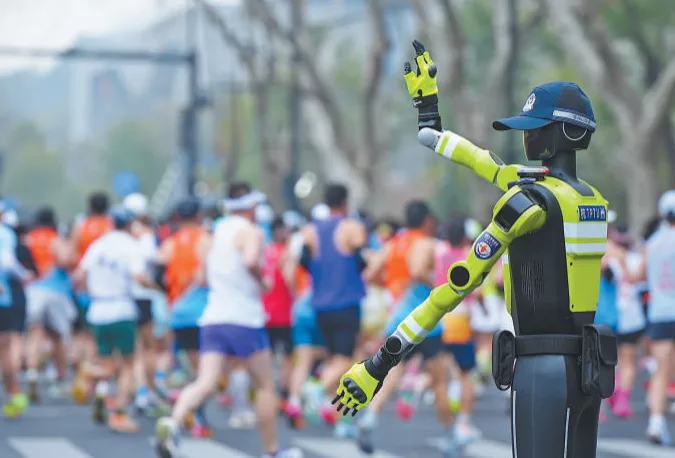
 A traffic management robot is on duty during a marathon event held in Hangzhou, east China's Zhejiang province this year/Shen Jingyu,BRNN
Rush hour at one of the busiest intersections in Hangzhou, eastern China's Zhejiang province, is no longer managed by human traffic police alone.
At the junction of Tiyuchang Road and Yan'an Road in Gongshu district, Chen Sanchuan, deputy head of the Wulin traffic police squadron under the Hangzhou Public Security Bureau's traffic management detachment, directs vehicles on one side of the intersection while an artificial intelligence-powered robot takes charge of the opposite side.
The robot, Belt and Road News Network (BRNN) says, is among the first batch of intelligent traffic management units deployed in Hangzhou as authorities increasingly turn to AI to improve road safety, reduce congestion and support police officers with routine traffic duties.
Standing 1.88 metres tall, the robot resembles a Hangzhou traffic police officer.
It wears a black police cap, a fluorescent yellow-green reflective vest and moves around on a four-wheel mobile platform, giving it the appearance of a futuristic traffic officer.
Beyond directing traffic, the robot is designed to interact with the public.
Pedestrians can tap the "Talk to Me" option on its touchscreen to ask for directions or travel advice.
When asked how to get to West Lake Cultural Square, the robot recommends taking Metro Line 1 or Line 3 from Wulin Square Station.
If users provide their exact destination, it generates a more detailed route using real-time traffic information.
According to Chen, the robot is powered by a large language model that enables natural voice conversations.
By combining live traffic conditions with location data, it can recommend the fastest travel options and display directions through both spoken responses and text-and-image instructions on its screen.
The robot also acts as an automated traffic enforcement assistant.
Using high-performance visual recognition technology, it continuously monitors activity at intersections and detects common traffic violations such as cyclists or scooter riders stopping beyond the stop line or travelling without helmets.
When a rider crossed the stop line during a demonstration, the robot calmly announced: "The gentleman in black, your vehicle has gone past the stop line. Please reverse back behind the line. Thank you for your cooperation."
The rider immediately complied.
If a road user ignores three reminders, the robot automatically records the violation and forwards the information to the Hangzhou Public Security Bureau's traffic management early warning centre for further action.
The machine is also capable of performing traffic control gestures traditionally carried out by police officers.
Its movements are synchronised with traffic lights through millisecond-level coordination, allowing it to accurately perform eight standard traffic control signals, including directions to stop, proceed straight ahead and turn left.
Chen said having the robotic assistant has significantly reduced the burden on officers.
"Our new partner can remain on duty steadily for long periods of time, taking over a large amount of routine work," he said.
"That allows police officers to focus more on handling accidents and responding to emergencies."
The project has been more than a year in the making.
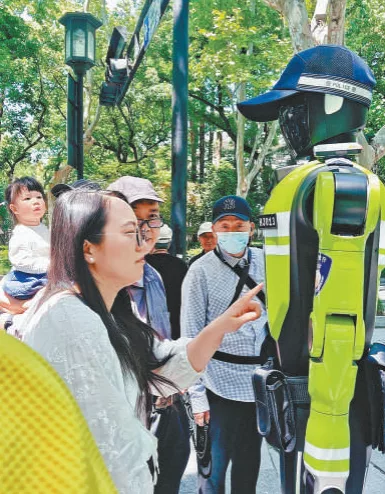 A tourist asks a traffic management robot for directions at the West Lake Scenic Area in Hangzhou, east China's Zhejiang province this year/Zhou Hanyi, BRNN
According to Chen Qihang, an information technology officer with the Hangzhou Public Security Bureau's traffic management detachment and a member of the development team, work on the robots began in June last year.
Researchers studied traffic conditions at 28 representative intersections across the city, collecting more than 1,200 hours of real-world traffic data.
After four major rounds of technological upgrades, the team finalised a design suitable for operational deployment.
On May 1, Hangzhou officially launched its first squad of 15 AI traffic management robots, assigning them to key intersections around the West Lake Scenic Area and the city's busiest commercial districts.
Since entering service, the robots have collectively logged 647.7 hours on duty, issued more than 25,000 traffic violation warnings and answered over 2,000 public enquiries.
Authorities say the robots issue an average reminder every one minute and 43 seconds while on active duty, highlighting their growing role in supporting traffic management as Chinese cities increasingly embrace artificial intelligence in public services.